




Some in govt nervous about press freedom: Nazri
There are leaders within the ruling administration who are "nervous" about the current extent of press freedom, Minister in the Prime Minister's Department Mohd Nazri Abdul Aziz warned journalists today.
There are leaders within the ruling administration who are "nervous" about the current extent of press freedom, Minister in the Prime Minister's Department Mohd Nazri Abdul Aziz warned journalists today.
Even the 'liberal' leaders are finding it difficult to maintain their fort in face of pressure from those urging for more restrictions, he told a journalism forum in Kuala Lumpur organised by the National Union of Journalists (NUJ).
"I think this government under Prime Minister Abdullah Ahmad Badawi is a very, very liberal government," the minister told the 70-odd people in the audience when officially launching the event.
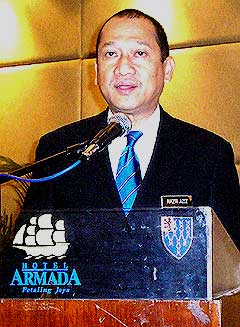 "(But) I must tell you that it is not easy, because there are many leaders who are not comfortable with the present liberalism given by the prime minister to the press. This is something we have to manage properly," said Nazri.
He, however, did not named the leaders who were worried about there being too much freedom.
"I'm telling you there are many people who are nervous about the present situation," Nazri warned.
Many observers have noted the increase in news reports and articles on 'sensitive' issues during Abdullah's government, when compared to that of former premier Dr Mahathir Mohamad.
'Correct, fair and quality' reporting
Just when it seemed that Nazri - who is also de facto law minister - was to speak of an impending crackdown on media organisations, he turned to place the onus on journalists to avert such an outcome.
"So what can journalists do to defend and promote press freedom?" he asked.
The answer, he said, lies in reviving the move to set up the proposed media council.
 The council has been opposed by the NUJ - a position reiterated earlier in the forum by journalists union's president Norila Daud.
Norila said that the council will be another layer of control on journalists. If there was to be a council, a number of restrictive laws on the press should be repealed first, she added.
However, Nazri argued that the council should not be seen as a way of imposing restrictions on journalists but to promote the "welfare" of journalists and improve journalism standards as well as to act as a mechanism to address complaints against journalists.
Comparing it to professional bodies such as the Bar Council and the Malaysian Medical Council which have the powers to discipline lawyers and doctors, Nazri said the media council would act to promote "correct, fair and quality" reporting.
He said while this would provide an alternative to thrashing out matters in court, the public - including MPs or ministers - should be able to go to the council to voice their grievances and seek corrective measures.
He also spoke of journalists who used their profession to either lash out at individuals for personal reasons or to curry favour with certain parties to further their personal interests and obtain contracts.
The media council proposal was opposed by most journalists as it was seen as a unilateral move to impose further restrictions on the media in the country that is already heavily controlled.
The proposal has been placed in the hands of the Malaysian Press Institute to implement. Nazri, however, suggested that NUJ picks up the ball and brings the plan to fruition.
"If you can write of the behaviour of MPs, NUJ also has to be able to ensure (the behaviour) of their own members. You also have to look at your own members," said Nazri.
He ended his speech by saying, "I support press freedom so long as you don't break the law."
'That is Zam's opinion'
At a press conference later, Nazri reiterated his support for greater press freedom in the country. This includes the right for news organisations to carry reports on the views of opposition figures.
Commenting on the statement of Information Minister Zainuddin Maidin, who has attacked The Sun newspaper as being sympathetic to DAP and PKR, Nazri said he does not personally share the view.
"That is his opinion. I have my own opinion (on the matter)," he said.
On the possibilities of a Freedom of Information Act, however, Nazri stressed on the importance of safeguarding national security by maintaining a strict control of classified secrets through the Official Secrets Act.
The government will also maintain and enforce other laws that serve to prevent - or punish - journalists for reports that threaten public order or touch upon racial or religious sensitivities, vowed Nazri.
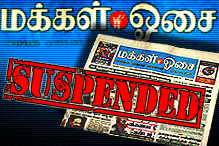 He cited the recent suspension of
Makkal Osai
following its publication of an image of Jesus Christ holding a cigarette and a beer can.
He cited the recent suspension of
Makkal Osai
following its publication of an image of Jesus Christ holding a cigarette and a beer can.
He denied that the suspension was due to political considerations following the paper's unflattering reports on the Indian-based MIC.
On the Prophet Muhammad caricature controversy, which led to the suspension of three dailies, Nazri said he was unaware if unequal treatment had occured.
While Sarawak Tribune, Berita Petang , and Guangming Daily were suspended over the offensive caricature, New Straits Times and private television networks TV3 and ntv7 were left off the hook.
"If there was an anomaly, we should not condone such unequal treatment in the enforcement of the laws," said Nazri.


