


/file/publisher-c1a3f893382d2b2f8a9aa22a654d9c97/2024/10/72085e5867a0aaae71ab95cf4cae01f5.jpg)

US official: Russia, China block Asean leaders' statement on South China Sea
Russia and China were alleged to have blocked a proposed consensus statement for the East Asia Summit (EAS) drafted by Southeast Asian countries, mainly over objections to language on the contested South China Sea, a US official was reported as saying yesterday.
According to Reuters, a draft statement arrived at by consensus by the Association of Southeast Asian Nations (Asean) was put to the 18-nation EAS meeting in Laos on Thursday evening, the official said.
"Asean presented this final draft and said...
Russia and China were alleged to have blocked a proposed consensus statement for the East Asia Summit (EAS) drafted by Southeast Asian countries, mainly over objections to language on the contested South China Sea, a US official was reported as saying yesterday.
According to Reuters, a draft statement arrived at by consensus by the Association of Southeast Asian Nations (Asean) was put to the 18-nation EAS meeting in Laos on Thursday evening, the official said.
"Asean presented this final draft and said that, essentially, this was a take-it-or-leave-it draft," the official said on condition of anonymity.
The US, Japan, Australia, South Korea and India said they could support it.
However, the official said: "The Russians and the Chinese said that they could not and would not proceed with a statement."
At a press conference in Vientiane on Friday, Russian Foreign Minister Sergei Lavrov said the final declaration had not been adopted because of "persistent attempts by the US, Japan, South Korea, Australia and New Zealand to turn it into a purely political statement."
The US embassy in China has yet to respond to the matter.
Issues of contention
The US official claimed that there were a couple of issues of contention, but the key one was how it referred to the UN Convention on the Law of the Sea (Unclos) going further than in the previous 2023 EAS summit statement.
However, the official said: "There was certainly no language that was getting into the nitty gritty of any particular standoff, no language that was favouring any claimant over any other."
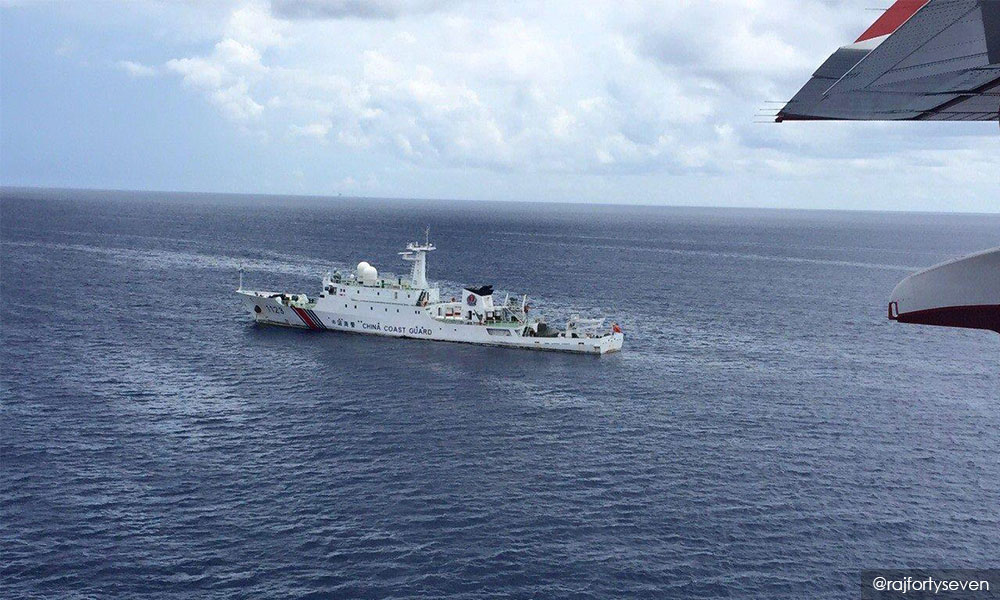
It should be noted that China claims nearly all of the South China Sea and has stepped up pressure on rival claimants, including several Asean countries, notably the Philippines.
Asean has spent years negotiating a code of conduct with Beijing for the strategic waterway, with some member states insisting it should be based on Unclos.
While China says it backs the code, the nation insisted that it does not recognise a 2016 arbitral ruling that said its claim to most of the South China Sea had no basis under Unclos, to which Beijing is a signatory.
Extra sub-clause
According to a draft seen by Reuters, the proposed EAS statement contained an extra sub-clause over the 2023 approved statement, which was not agreed to.
It noted a 2023 United Nations resolution, opening a new tab saying that Unclos "sets out the legal framework within which all activities in the oceans and seas must be carried out."
Another sub-clause not agreed said the international environment, including "in the South China Sea, the Korean Peninsula, Myanmar, Ukraine and the Middle East ... present challenges for the region".
Chinese Premier Li Qiang told the summit that Beijing was committed to Unclos and striving for an early conclusion of a code of conduct while stressing its claims have solid historical and legal grounds.
"Relevant countries outside the region should respect and support the joint efforts of China and regional countries to maintain peace and stability in the South China Sea, and truly play a constructive role for peace and stability in the region," he was reported as saying.
Yesterday, Bernama reported that Asean managed to persuade China to use diplomatic channels to resolve disputes in the South China Sea, avoiding any military confrontation.
/file/publisher-c1a3f893382d2b2f8a9aa22a654d9c97/2024/10/312e4857bc08a095eb2603fdf8bea6e5.jpg)
/file/publisher-c1a3f893382d2b2f8a9aa22a654d9c97/2024/10/d460c851e7fe7bfc6f98d3f819f9f32f.jpg)
/file/publisher-c1a3f893382d2b2f8a9aa22a654d9c97/2024/10/cfd7071049ab0fb905dce87d95514f7e.jpg)
/file/publisher-c1a3f893382d2b2f8a9aa22a654d9c97/2020/07/d47b7223dbfd8a1394c52b3d055e3581.jpg)


China says something & does something else! When China's maritime aggression is at its peak in South China Sea, China's premier said at ASEAN Summit, "Beijing is committed to peace in Asia" There is no way, China can be trusted. Beijing has backstabbed every nation that thought it has "good relations" with China. The way Manila is dealing with Beijing is exemplary & should be replicated by the rest of the ASEAN nations. Malaysia only know how to kow-tow to Beijing! Russia & China are both big bullies that is lead by evil autocrats that rule with iron fist rule are guaranteed to bully Asean into submission! But according to gullible, retarded & fools of bigot nation, its the fault of America!!!