


/file/1214/18bccfedb1a2373216dfdb3ddeb1e0eb.jpeg)

Total fertility rates rise across ethnicities, but Chinese still low
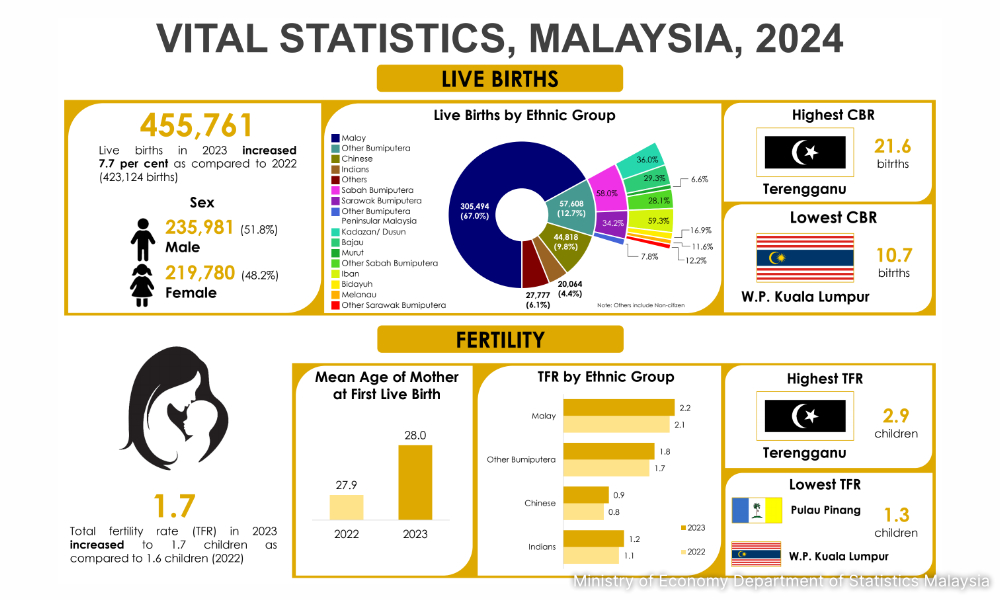
Total fertility rates (TFR) for Malaysia rose for the first time in a decade to 1.7 children per woman in 2023, compared to 1.6 the year before, the Statistics Department said.
The TFR measures the number of children birthed by each woman aged 15 to 49 in the population.
The rate grew by 0.1 across ethnicities last year, with Malay TFR being the highest at 2.2 children per woman in 2023, up from 2.1 the year before...
Total fertility rates (TFR) for Malaysia rose for the first time in a decade to 1.7 children per woman in 2023, compared to 1.6 the year before, the Statistics Department said.
The TFR measures the number of children birthed by each woman aged 15 to 49 in the population.
The rate grew by 0.1 across ethnicities last year, with Malay TFR being the highest at 2.2 children per woman in 2023, up from 2.1 the year before, according to data released yesterday.
This is followed by other bumiputera at 1.8, Indian at 1.2 and Chinese at a low 0.9 children per woman.
This indicates that many ethnic Chinese women aged 15 to 49 do not have children.
TFR in Malaysia has been closely watched after it started declining below the replacement rate of 2.1 in 2023.
Replacement rate refers to the average number of children born per woman to sufficiently replace herself and her partner.The TFR for the Malay community is still above the replacement rate.
READ MORE: Is there a way to make people have more babies?
At the state level, Terengganu maintained its position as the state with the highest TFR, at 2.9 in 2023, followed by Kelantan (2.7) and Pahang (2).
The states with the lowest TFR are still Penang and Kuala Lumpur, at 1.3 children respectively.
The district with the highest TFR is Song in Sarawak, recording 4.6 children per woman in 2023, followed by Bukit Mabung in Sarawak (4.1) and Pasir Putih in Kelantan (3.5).

The district with the lowest TFR last year was Kinabatangan, Sabah at 0.4, followed by Kalabakan, Sabah (0.6) and Timur Laut, Penang (1).
Live birth rates have also returned to pre-Covid-19 levels, with 455,761 births in 2023, an increase of 7.7 percent (32,637 births) compared to the year before.
The number of births rose across ethnicities.
A total 51.8 percent of babies were males and the Malay community welcomed the most births.
More Chinese deaths than births
Although Terengganu has the highest TFR, it also has the lowest life expectancy at 72.2 years in 2024, a few years shorter than the national life expectancy of 75.2 years.
Selangor has the highest life expectancy at 76.2 years this year.
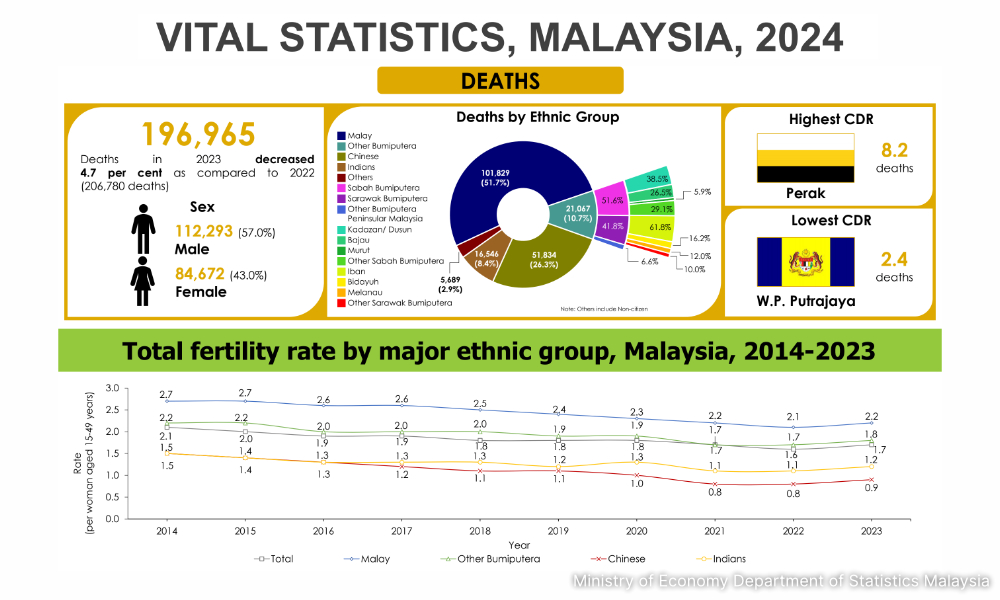
More Indian, Malay, and other bumiputera babies were born than those who died in the same ethnic group last year but in the ethnic Chinese community, the number of deaths in 2023 exceeded the number of births.
For example, 305,494 Malay babies were born in 2023 while 101,289 deaths were recorded in this ethnic group.
Among the ethnic Indian community and non-Malay bumiputera community, 27,777 and 57,602 babies were born respectively in 2023, while 16,546 and 21,067 people of all ages died from these communities respectively.
Conversely, 44,818 ethnic Chinese babies were born in 2023 while 51,834 people of all ages from the ethnic group died the same year.
/file/publisher-c1a3f893382d2b2f8a9aa22a654d9c97/2024/10/0ab0e2cbac6dc8cdc2a8ad02338af5e4.jpg)
/file/publisher-c1a3f893382d2b2f8a9aa22a654d9c97/2024/09/99e6d93d5d385e79056e71a43f3309fd.jpg)
/file/publisher-c1a3f893382d2b2f8a9aa22a654d9c97/2024/09/9cd2a40919526c6c2bf360eb30ca6db0.jpg)
/file/publisher-c1a3f893382d2b2f8a9aa22a654d9c97/2023/11/844a8ec1efa02e9f757deef69f7c238d.jpg)
/file/publisher-c1a3f893382d2b2f8a9aa22a654d9c97/2024/07/be3414f8b63af4be0d7f466bcc45173e.jpg)
/file/publisher-c1a3f893382d2b2f8a9aa22a654d9c97/2024/01/6670858564c0eaa971fea2a5477abbb0.jpg)


Report this comment
Are you sure you want to delete this comment?
This action cannot be undone.