


/file/publisher-c1a3f893382d2b2f8a9aa22a654d9c97/2024/09/1b256cd5b8000da6295b994de14f8708.jpg)

Survey: M'sians strongly desire both respect for Islam, multiculturalism
While Malaysia’s ethnic relations are said to have deteriorated in recent years, a recent survey revealed that the majority support both respect for Islam and multicultural coexistence.
According to a survey by Project Stability and Accountability for Malaysia (Projek Sama), a significant cross-ethnic consensus emerged: 75 percent of Malay and Chinese respondents and 81 percent of Indian respondents agreed that “respect for Islam and respect for multiculturalism must go hand-in-hand.”
While Malaysia’s ethnic relations are said to have deteriorated in recent years, a recent survey revealed that the majority support both respect for Islam and multicultural coexistence.
According to a survey by Project Stability and Accountability for Malaysia (Projek Sama), a significant cross-ethnic consensus emerged: 75 percent of Malay and Chinese respondents and 81 percent of Indian respondents agreed that “respect for Islam and respect for multiculturalism must go hand-in-hand.”
Only 22 percent of Malay respondents felt that “respect for Islam must take precedence over respect for multiculturalism”, while 21 percent of Chinese and 16 percent of Indian respondents favoured the opposite.
A weighted sample based on West Malaysia’s ethnic composition showed that 76 percent wanted both respect for Islam and multiculturalism to coexist, 16 percent preferred Islam to take precedence, and eight percent prioritised respect for multiculturalism.
Concerned with deteriorating ethnic relations and ongoing cultural conflicts that could undermine political stability and accountability, and derail institutional reforms, Projek Sama commissioned pollster Invoke to conduct its first quarterly survey on ethnic relations in West Malaysia.
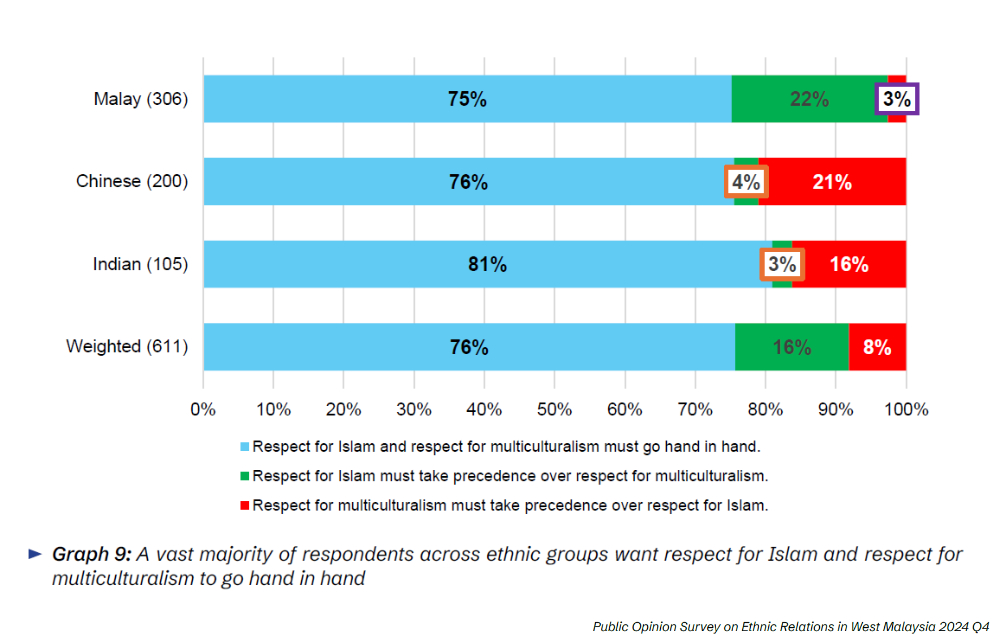
The survey was conducted from Oct 1-28, 2024, using random digit dialling and interactive voice response robocalls, gathering complete responses from 611 adults aged 18 and above: 306 Malays, 200 Chinese, and 105 Indians.
Of the 10 questions asked, valid data was successfully collected for eight.
Class matters more than race
The survey also showed that most respondents did not feel the government treats everyone fairly. However, Malays and Chinese viewed this more as a class issue, while Indians saw it as more of an ethnic issue.
Less than half of the respondents (42 percent of Malays, 45 percent of Chinese, and 31 percent of Indians) believed that “the government and its agencies treat everyone fairly”.
Among those who felt unfairly treated, twice as many Malays viewed this through a class perspective, ie, “the government and its agencies normally side with the rich and the powerful over ordinary people like me” (41 percent), compared to those who saw it as communal, “the government and its agencies normally side with other races over our race” (17 percent).
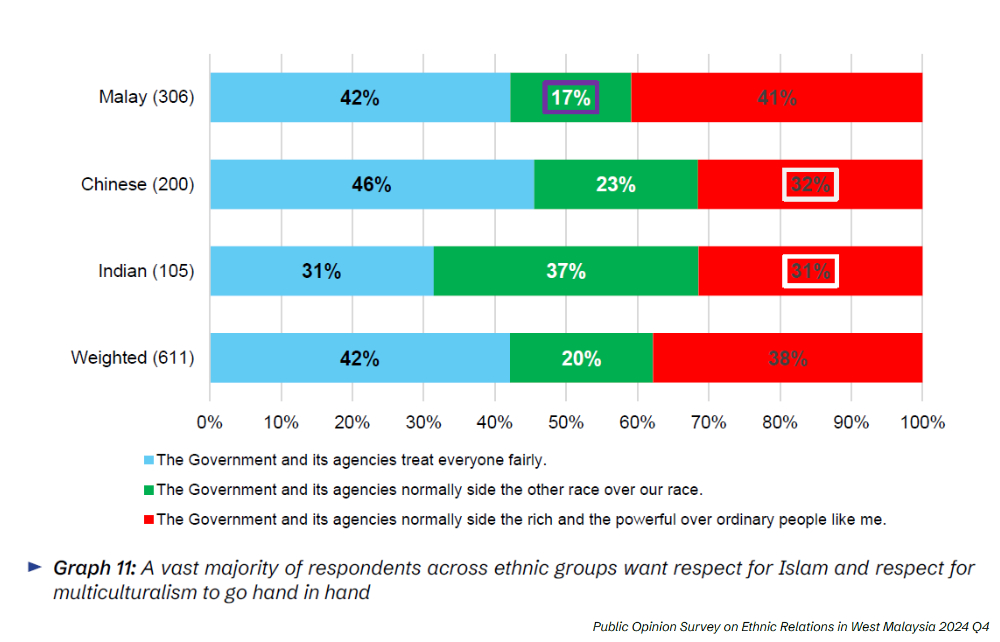
Similarly, although with a smaller margin, more Chinese respondents perceived the government’s unfairness through a class lens (32 percent) rather than a communal lens (23 percent).
For Indian respondents, however, the majority felt that “the government and its agencies normally side with other races over our race" (37 percent), as compared to those who felt class-based discrimination or that the government had been fair (both 31 percent).
Another finding was that the majority wanted the government to act against violence without a blanket ban on 3R (race, religion, royalty) discussions.
From the survey, 78 percent of Malay respondents wanted the government to “take stern actions against the use, threat, or instigation of violence, whether or not the issue is related to 3R”.
In contrast, 67 percent of Malay respondents wanted the government to “prohibit hurtful or harmful comments in 3R discussions”, while only 41 percent supported a complete ban on “any discussion related to 3R, even if the discussion is civil and rational.”
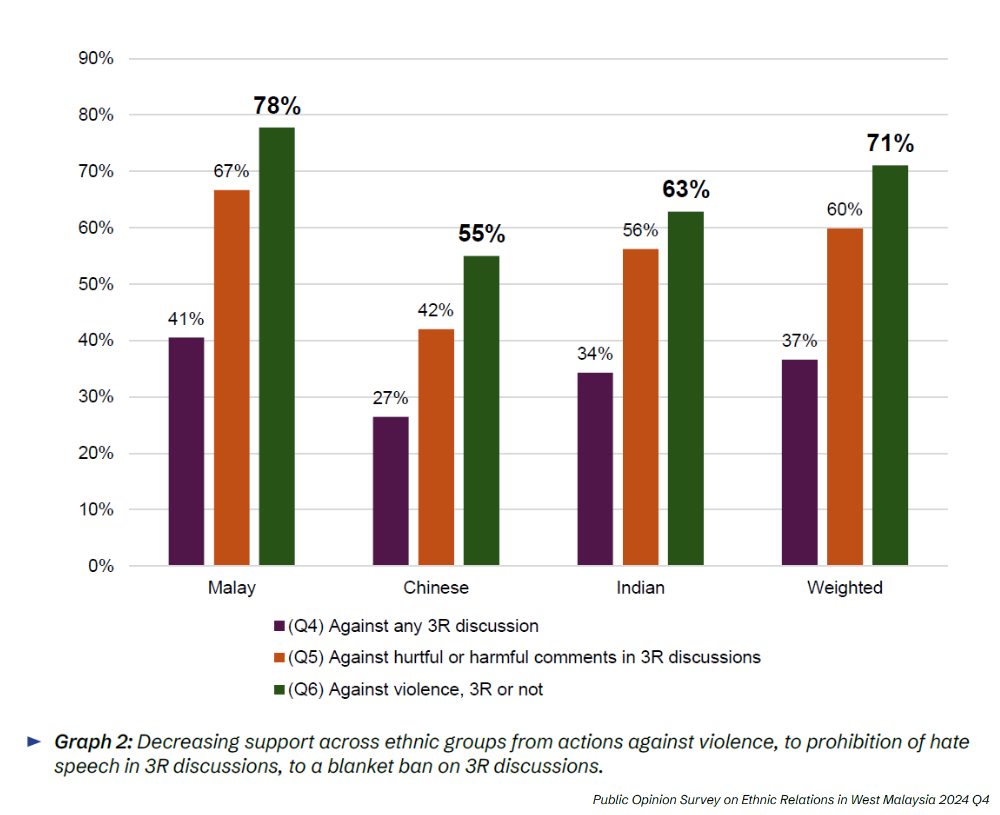
A similar but lower level of support was observed among Indian respondents (actions against violence - 63 percent; prohibition of hate speech in 3R discussions - 56 percent; and prohibition of all 3R discussions - 34 percent), and Chinese respondents (55 percent, 42 percent, and 26 percent).
Common destiny
Meanwhile, the survey showed that a majority still believed in a common human destiny, though some felt the global order is hostile to Muslims or non-Whites.
The report indicated that a clear majority across ethnic groups (67 percent of Chinese, 65 percent of Indians, and 54 percent of Malays) felt closest to the universalist position that “humans have a common destiny. We must help each other and cooperate to preserve the planet.”
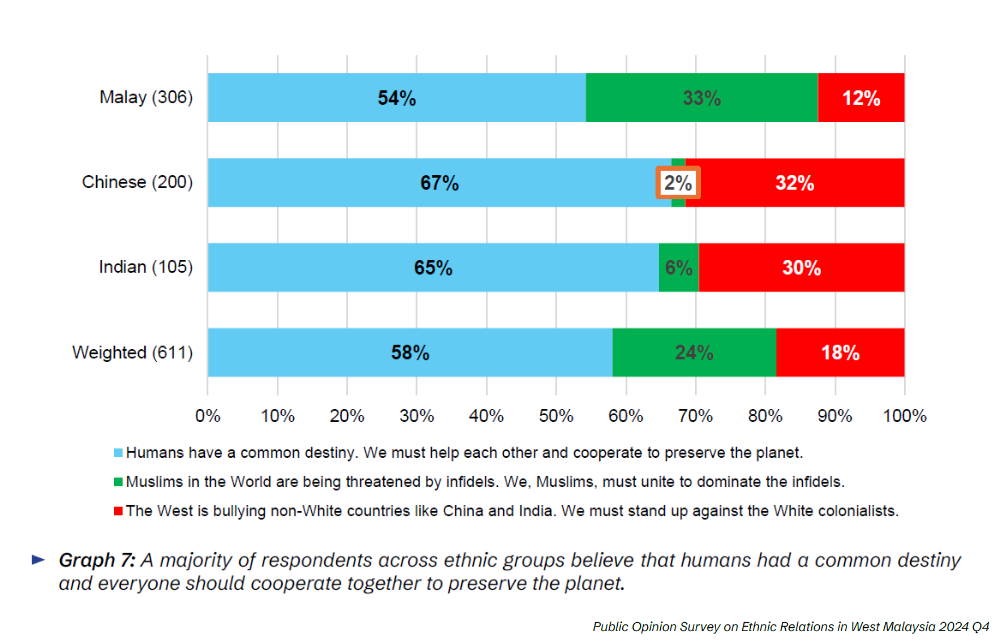
However, nearly half of Malay respondents expressed concerns about global injustice, with 33 percent feeling that “Muslims in the world are being threatened by infidels and... must unite to dominate the infidels,” and a smaller 12 percent seeing non-White countries like China and India as being bullied by the West.
In comparison, 32 percent of Chinese respondents and 30 percent of Indian respondents identified more closely with the non-White anti-colonialist stance.
/file/publisher-c1a3f893382d2b2f8a9aa22a654d9c97/2024/10/3b5d533849ec82b5cd9a55ac29d4adf1.jpg)
/file/publisher-c1a3f893382d2b2f8a9aa22a654d9c97/2024/10/1690a3b2be44386324c02de82d5b1fe8.jpg)
/file/publisher-c1a3f893382d2b2f8a9aa22a654d9c97/2022/08/ac6fad9b9519ce5bfa0f3273c0586284.jpg)
/file/publisher-c1a3f893382d2b2f8a9aa22a654d9c97/2020/01/0749bb9860a89f0920d0e228aa7ee1b3.jpg)
/file/publisher-c1a3f893382d2b2f8a9aa22a654d9c97/2022/09/805335775bd9bf793a741fb6c8027c70.jpg)
/file/publisher-c1a3f893382d2b2f8a9aa22a654d9c97/2024/10/7ff05b0a38da51e752ed4359a8b29498.jpg)


Are you sure you want to delete this comment?
This action cannot be undone.