


Migrant workers: 'Employers' raking in millions through 'A to B' syndicate
EXCLUSIVE | When discussing migrant workers, we often hear two conflicting narratives. One side claims there is an oversupply of migrant workers, while the other insists there’s still a labour shortage.
So, who is telling the truth, and who is lying? Technically, both sides are correct.
How so?
Summary:
Migrant worker syndicate: The "A to B" syndicate exploits government hiring systems by obtaining excessive migrant worker quotas, which are then sold or rented to other industries for profit.
Lucrative operations: Syndicate members earn millions from quota sales and renewing workers' permits. The scheme includes charging employers fees while underpaying workers. Some individuals manage thousands of workers, leveraging political connections or forged documents to secure quotas.
Challenges in enforcement: Despite government restrictions and actions, the syndicate continues due to lenient penalties for colluding officials and systemic corruption.
EXCLUSIVE | When discussing migrant workers, we often hear two conflicting narratives. One side claims there is an oversupply of migrant workers, while the other insists there’s still a labour shortage.
So, who is telling the truth, and who is lying? Technically, both sides are correct.
How so? The answer lies in the "A to B" syndicate that trades migrant workers. Under this syndicate, individuals calling themselves "employers" hold quotas for thousands of migrant workers despite not needing them.
These so-called employers would apply for quotas from the government solely to "sell" or "rent" their migrant workers to others - a lucrative scheme that generates millions of ringgit.
They are exploiting the government's migrant workers hiring system by supplying labour to industries that are facing shortages or to sectors where migrant worker recruitment has been frozen by Putrajaya.
Malaysiakini learned that this syndicate began its activities in 1996 and was purportedly unstoppable with the help of corrupt law enforcement officers.
While several civil servants have been caught for colluding with the syndicate over the years, many of them only got a slap on the wrist with punishments such as getting transferred to another department, which was considered mild in comparison to the hefty bribes they received.
Checks reveal that each of the "employers" can earn hundreds of thousands of ringgit from selling off workers' quotas and renewing their Temporary Employment Visit Passes (PLKS) every year.
What is the ‘A to B’ syndicate?
According to sources who used to be involved with the syndicate, these "employers" are registered companies under the Companies Commission (SSM).
By holding large migrant worker quotas, they sell the quota to third parties at rates ranging from RM4,500 to RM5,500 per worker. The price would depend on which sector that wants to hire them.
"For instance, if an employer sells 1,000 quotas, they can make RM5.5 million.
"After deducting payment for levies, insurance, and other fees, they still get a net profit of between RM2.5 million to RM3 million," the source told Malaysiakini.
On top of this, the source said, the syndicate also makes money from renewing PLKS for the workers, which is an annual requirement. They would charge between RM1,000 and RM2,000 for each worker, it was claimed.
"The third-party employers that purchase these quotas still need the 'original' employers' help to renew PLKS, because the latter are the ones listed in the Human Resources Ministry and Home Ministry's database,” the source added.
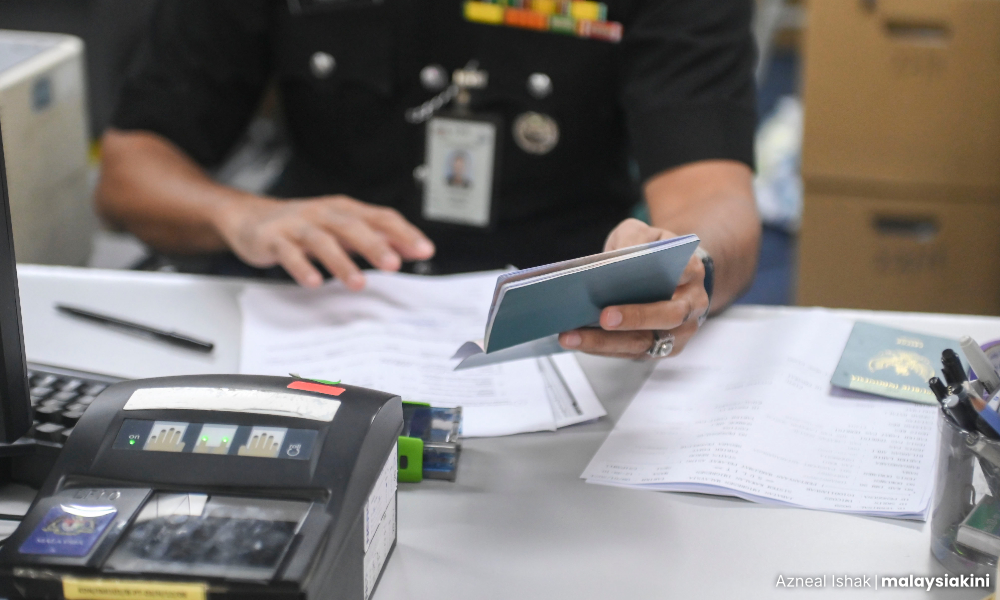
The syndicate can allegedly generate a stable income for up to 10 years for every PLKS they hold.
Thus, the source pointed out that an employer who holds 1,000 permits can earn at least RM10 million in the period.
"Making money in Malaysia is so easy," said the source, who has since quit the scheme after being cheated by an employer.
‘Renting’ workers
According to sources, most of those involved in the syndicate are foreigners, mainly from Bangladesh, Pakistan, and India.
These individuals would marry local women and start businesses under their wives’ names, often donning the “Datuk” title to bolster their credibility with prospective employers.
Another source who is still active in the migrant worker trade revealed another modus operandi by the syndicate, where “employers” with PLKS quota would “lend” their workers to sectors where migrant worker recruitment has been frozen.
This is done by charging the desperate employers a certain amount of fees for the service of each migrant worker. The syndicate, often referred to as Employer A, would then use the fee to pay a lower wage to the workers and pocket the rest themselves.
For example, Employer A can charge Employer B a fee of RM2,500 per worker a month, but they would only pay the workers RM1,800, which allows them an instant profit of RM700 per head.
"So, for an employer that has 1,000 workers, they can easily make about RM700,000 a month,” the source said.
Marrying local women
However, the actual number of quotas that an employer involved has is usually more than 1,000.
Based on Malaysiakini's investigation, where our journalists went undercover as “Employer B” to seek migrant workers from the syndicate, it was learned that some employers were managing as many as 6,000 migrant workers.
One of them is a Bangladeshi national who holds permanent resident status (MyPR) and is known as a “Datuk Seri”. This employer is known to be married to two local women and live in Shah Alam, Selangor.
Through the A to B syndicate, it was learned that he earns nearly RM1.8 million a month. On top of this, he also earns between RM5 million and RM6 million a year from PLKS renewals.
Another employer met by Malaysiakini is a Pakistani national with the title Datuk, who manages 2,000 workers. Based in Kuala Lumpur, he is involved in the cleaning and mini-market sectors.
How do they obtain large quotas?
According to a licensed agent, there are two common ways that employers involved in the A to B syndicate would use to secure migrant worker quotas.
The first one, he said, is by leveraging close connections with politicians to gain access to relevant ministries.
Secondly, they would use forged documents and bribe public officials with a payments ranging from RM500 to RM1,000 per worker.
The private licensing agent explained that many syndicate members have "insiders" within the Home Ministry and Human Resources Ministry, which are directly responsible for migrant worker recruitment.
"Sometimes they would also engage middle persons, such as relatives or friends of politicians.
"They would pay these people once they get the permits approved," the agent claimed.
However, according to the agent, he noticed that such activities have declined since the new government came into power.
"I’m not saying the syndicate is gone, but it’s reduced now."
Quotas of 9,999
Malaysiakini's investigation also found several cases where certain employers received an enormous number of migrant worker quotas, including one where permits for 9,999 migrant workers were granted to a plantation company based in Kuala Lumpur.
The approval was issued on Nov 17, 2022, about a month after then-prime minister Ismail Sabri Yaakob dissolved the Parliament.
Government policy states that plantation companies are eligible for quotas of 9,999 migrant workers if they own, rent, or lease at least 3,330ha of land.
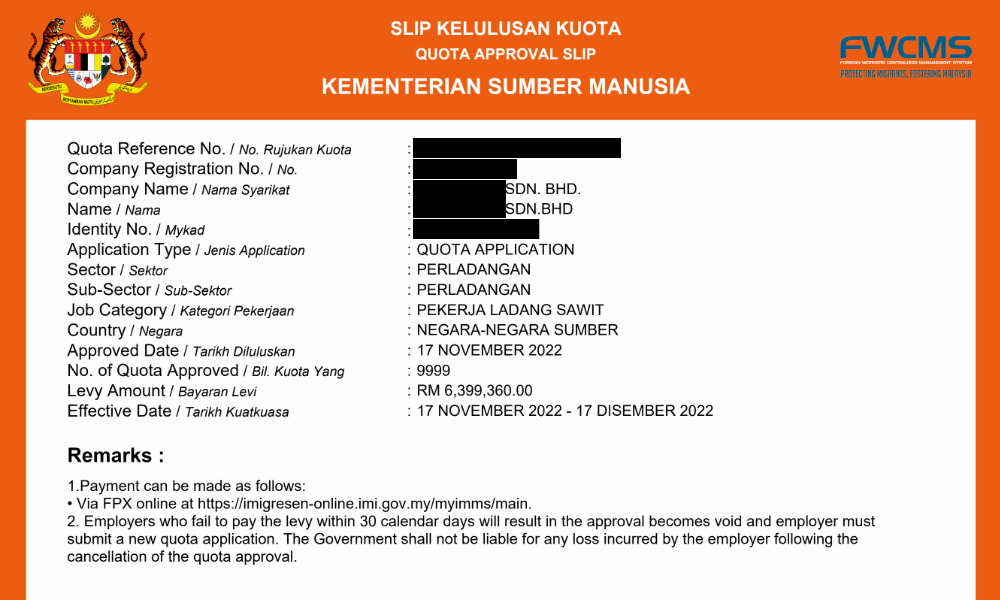
However, checks with government agencies revealed that this company did not own large plantations.
Instead, the investigation revealed that the company is owned by a family from Pahang, with the husband, wife, and their children listed as its directors.
According to an agent, the wife attempted to sell their quota at RM6,400 per worker. She also allegedly asked for a deposit of RM2 million to be paid upfront.
"No one dared to buy it because the total cost would exceed RM64 million," the agent said.
According to the agent, the company then failed to acquire the quota as they could not pay government levies, amounting to RM6.4 million, as no one was willing to pay them.
"How could this company get approval if they couldn’t even afford to pay the levy? Did the approving officials fail to check the company’s background?” the agent questioned.
The agent also revealed that the woman allegedly managed to acquire her quota for 1,500 workers for the service sector (retail and wholesale).
This was instead the fact that no retail chains in the country require such a huge number of migrant workers, the source claimed.
"But she could get approval. This, too, she could not pay the levies before the approval was rescinded," the agent said.
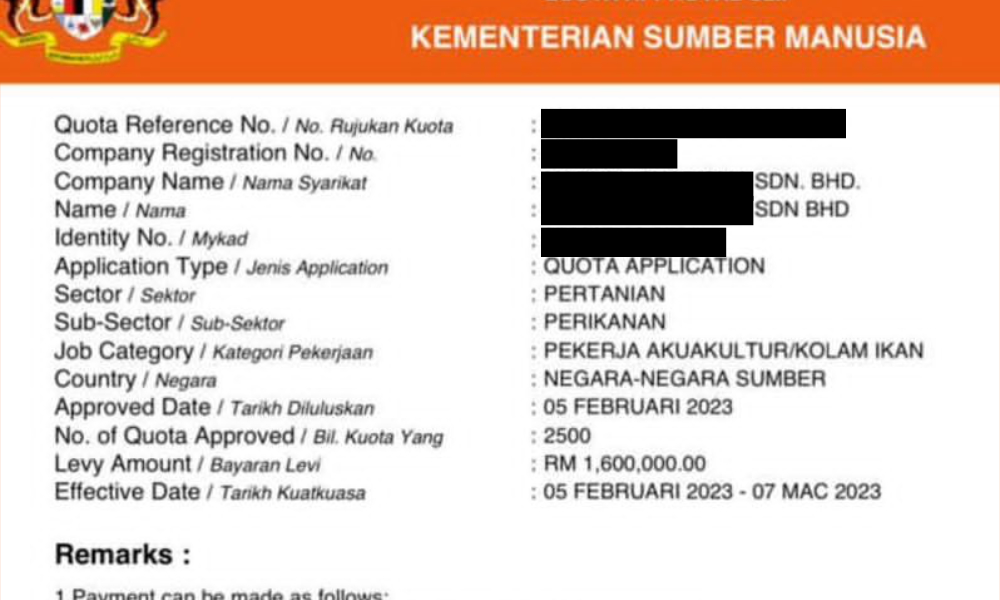
Malaysiakini also discovered that a fishing company in Kampar, Perak received approval for 2,500 migrant workers in the agriculture sector.
The approval was obtained on Feb 5, 2023, when the government introduced the Foreign Worker Employment Flexibility Plan. Prime Minister Anwar Ibrahim had just come into power for about three months then.
On Feb 8, 2023, the Fisheries Department issued a statement, saying 10,000 migrant workers were being employed onboard 3,000 licensed fishing vessels in the country, based on November 2022 statistics.
It projected that some 17,486 migrant workers would be needed to fill demand in the sector in Peninsular Malaysia in the first quarter of 2023. Up to then, a total of 10,063 PLKS have been approved for foreign fishing crews.
This means that the need for migrant workers in the sector then was only around 7,400. Ironically, from this number, about 33 percent of the quota was given to one company.
More surprisingly, the company has also failed to pay the levy before the approval was cancelled.
Syndicate still active
Despite the government having frozen foreign worker recruitment on March 18, 2023 (with exceptions for certain sectors), the syndicate has allegedly remained active.
Recently, a cooperative in Pahang received approval to recruit 1,125 migrant workers for the plantation sector.
The cooperative then collaborated with a migrant worker agency based at a location on the outskirts of Kuala Lumpur.
The agency’s owner, who is an Indian national, claimed they were merely assisting the cooperative in bringing workers for its plantations.
"We’re not involved in the A to B syndicate. We’re just helping the cooperative,” the owner told Malaysiakini.
However, when Malaysiakini journalists went undercover as recruitment agents, they found that at least 200 quotas were available for sale.
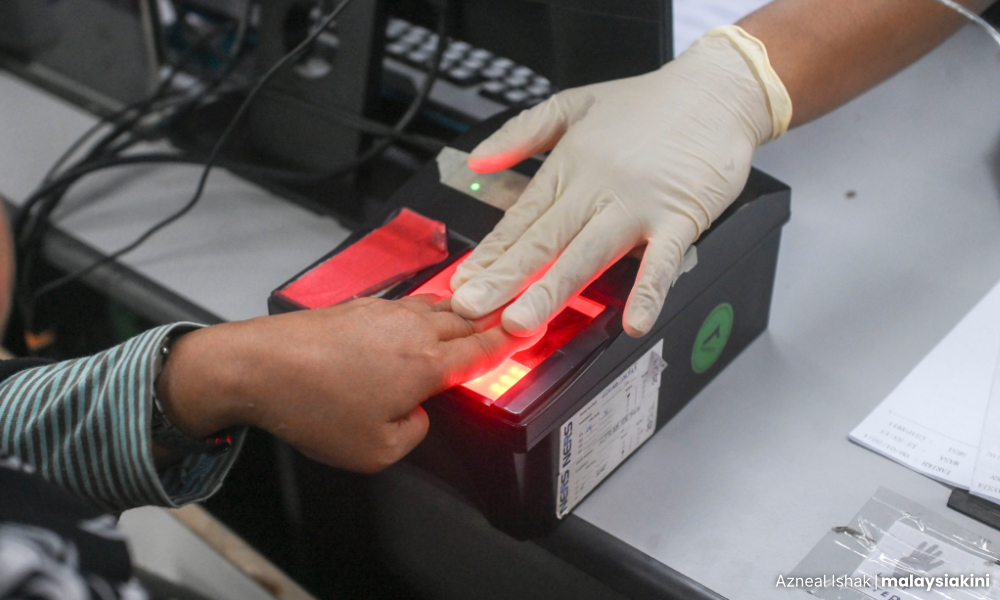
Initially priced at RM6,800 per quota, the agency eventually reduced the price to RM6,400 after negotiations. They also asked for an upfront payment of RM150 per quota.
Why can’t the syndicate be stopped?
Former officials from the Immigration Department and Human Resources Ministry have agreed that the syndicate would continue to exist as long as there are civil servants willing to collude with them.
Furthermore, they said, the mild punishment for those caught working with the syndicate is not deterrent enough to stop them.
"We often read about employers not paying migrant workers or agents arrested for ‘human trafficking offences'.
“But how could this be made possible without the complicity of public officials? And what punishments do these officials face?” asked a former immigration officer.
In most cases, he said, those caught would only be transferred to other departments as a punishment.
"For instance, let's say I am involved and then when I get caught, I will only be transferred. The new officer who replaces me will continue the activity.
"All I need to do is introduce the agents and ‘employers’ to my replacement, and I’ll continue receiving my ‘share’ (bribes),” the former officer said.
Malaysiakini also found that often those prosecuted are only the low-ranking officials, while the higher-ranking ones always get away scot-free.
"You’ve probably heard of this case where a senior official was transferred after being implicated in corruption, only to be promoted to secretary-general less than a year later.
"This is just one example. There are dozens of such cases," he added.


Report this comment
Are you sure you want to delete this comment?
This action cannot be undone.