


/file/publisher-c1a3f893382d2b2f8a9aa22a654d9c97/2022/06/a474372f81621b36e0ceaad79d51a695.jpg)

Remove govt reps for media council's independence - groups
This follows the tabling of the Malaysian Media Council Bill 2024 at the Dewan Rakyat yesterday, after decades of lobbying for media self-regulation as an alternative to oppressive media laws...
Summary:
Groups oppose government-appointed members in the Malaysian Media Council (MMC), citing risks to its autonomy.
They call for repealing outdated media laws to protect press freedom.
They praise provisions in the MMC Bill that include independent leadership and diverse representation.
Several civil society organisations have urged for the removal of government representatives from the proposed Malaysian Media Council (MMC) to ensure its independence.
This follows the tabling of the Malaysian Media Council Bill 2024 at the Dewan Rakyat yesterday, after decades of lobbying for media self-regulation as an alternative to oppressive media laws.
While praising several of the Bill’s provisions as a step forward for the media, the groups expressed concern with some other provisions - especially the presence of two minister-appointed government representatives on the media council.
“The inclusion of two representatives of government appointed by the minister in the board of the MMC with complete voting and decision-making powers goes against the objective and purpose of a self-regulatory body and undermines its independence.
“Despite having two persons appointed to the board, the disproportionate power wielded by the government would potentially lead to government interference in the decisions of the board; affecting the media industry and public interest,” the groups said in a joint statement today.
“It would threaten the essence of democracy and inhibit the MMC from carrying out its original function and intent of ‘promoting media independence’ (in accordance with Section 5(1)(b) of the Bill) and meeting the public interest effectively,” they said.
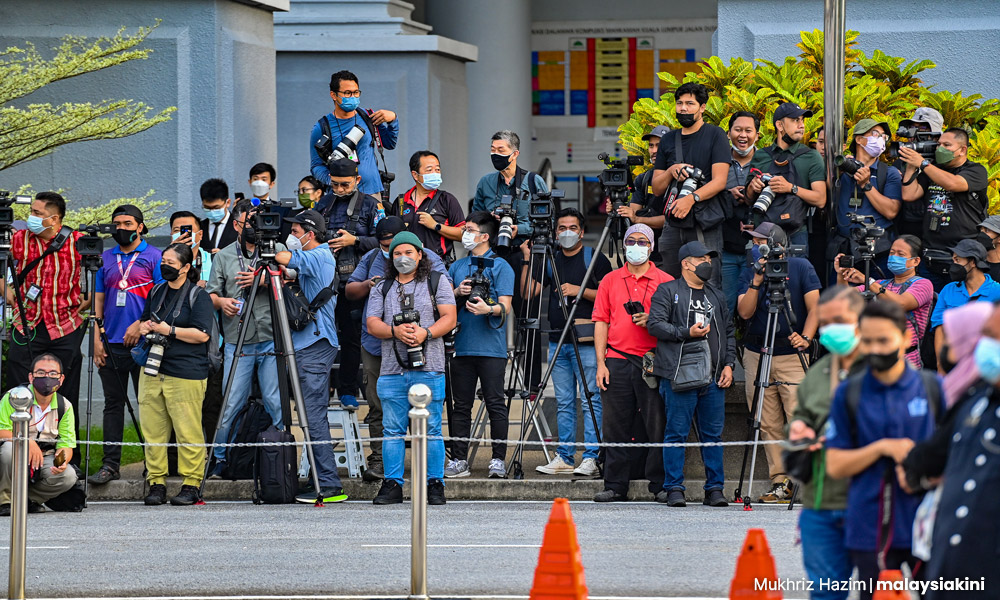
The MMC Bill stipulates that the council should have 21 members, including a chairperson and two government representatives who shall be voting members of the board.
The statement was endorsed by 10 groups: The Centre for Independent Journalism, Gerakan Media Merdeka (Geramm), Sinar Project, Sisters in Islam, Justice For Sisters, Suaram, Article 19, Freedom Film Network, Amnesty International Malaysia, and KRYSS Network.
Recommendation to repeal repressive laws
The groups also highlighted that apart from Section 5(1)(e) stipulating that one of the council’s functions is to “suggest” reforms on media independence, the Bill completely overlooks the MMC pro-tem committee’s recommendation to repeal other media-related laws.
This includes repealing the Printing Presses and Publication Act 1984, and Sections 211 and 233 of the Communications and Multimedia Act.
They urged the government to commit to a complete reform of the “archaic and repressive laws” that undermine media freedom in Malaysia.
Apart from the two laws highlighted by the MMC’s pro-tem committee, they also urged the government to conduct an urgent review to either repeal or amend the Official Secrets Act 1972, Sedition Act 1948, Section 203A of the Penal Code on the disclosure of information, and provisions of the Whistleblower Protection Act 2010 stipulating that whistleblowers will forfeit their protection if they share information with the media.
“The MMC’s role will be enhanced by proceeding with this reform and existing draconian laws will not obstruct this body from protecting media freedom,” they said.
Another provision that could undermine the MMC’s independence is Section 17(5), which stipulates that ministerial approval is required for the MMC to receive foreign funds.
The Bill stipulates that such funding should be unconditional, and to be used for promoting awareness and providing education about the media industry.
The groups proposed that the requirement for ministerial approval should be replaced with a requirement to only notify the minister, especially through an annual audited report.
Positive provisions
Meanwhile, provisions that are seen as positive by the groups include Sections 9(1) and 9(2), which they say ensures the chairperson’s independence.
Sections 15 and 16 also set up a mechanism for handling complaints against the media.
They also lauded that the Bill guarantees various stakeholders will be on the MMC’s board, as well as ensuring diversity among board members.
“As an institution that seeks to represent the voices of all people in the media, as well as the public interest, this results in fairer, more democratic decision-making processes through robust, diverse, and pluralistic discourse containing a variety of perspectives and representation,” they said.
/file/publisher-c1a3f893382d2b2f8a9aa22a654d9c97/2024/09/6a81554f8bc24f438656aa36a4014611.jpg)
/file/publisher-c1a3f893382d2b2f8a9aa22a654d9c97/2023/05/9dc56e6d4ad3e548d272b09047e977dd.jpg)
/file/publisher-c1a3f893382d2b2f8a9aa22a654d9c97/2022/06/a474372f81621b36e0ceaad79d51a695.jpg)



Are you sure you want to delete this comment?
This action cannot be undone.