


/file/publisher-c1a3f893382d2b2f8a9aa22a654d9c97/2024/12/aa51bdd14470e6b3b268504756304a27.jpg)

Jakoa: No complaints from Kg Kelaik of health risk, encroachment
This is regarding purported encroachment, environmental damage, or pollution from mining operations there, leaving villagers fearful of heavy metal contamination in water sources...
Summary
Jakoa denies receiving any formal complaints from the Temiar community about health risks or encroachment of their customary land in Kampung Kelaik.
The department says it can only propose that development initiatives do not negatively impact residents.
Villagers fear the iron mining, suspected to cause river pollution, is poisoning them, following findings of high levels of chromium in one villager’s blood.
The Department of Orang Asli Development (Jakoa) has denied receiving any formal complaints from villagers at Kampung Kelaik, Kelantan.
This is regarding purported encroachment, environmental damage, or pollution from mining operations there, leaving villagers fearful of heavy metal contamination in water sources.
The department acknowledged being informed of a court injunction against mining and other activities filed by the villagers through the Attorney General’s Department.
However, when asked, Jakoa claimed it lacks complete details of the case, raising concerns about its responsiveness to the Orang Asli’s fears of poisoning and land encroachment.
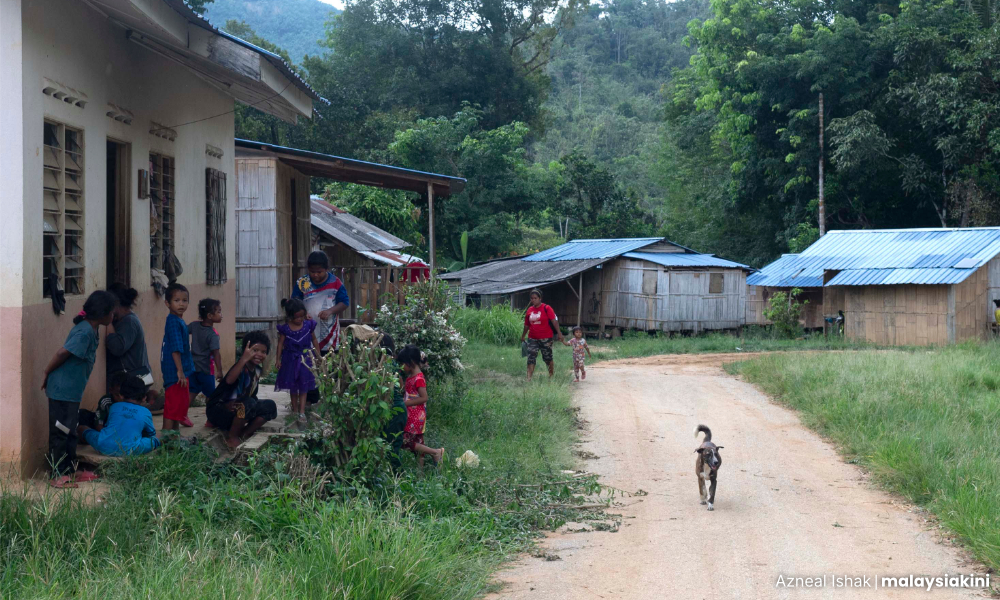
“Based on Jakoa’s state-level review, no complaints have been received from the Kampung Kelaik committee.
“Jakoa has appointed the Orang Asli Village Development and Security Committee (JPKKOA), which includes 15 members representing villages under Pos Blau.
“Kampung Kelaik is one of the villages within Pos Blau,” it said in a written reply to Malaysiakini.
Yesterday, Natural Resources and Environmental Sustainability Minister Nik Nazmi Nik Ahmad announced that a stop-work order was issued to the two iron ore mining operators suspected of causing pollution in Sungai Kelaik.
He said the Department of Environment (DOE) found that Aqua Orion Sdn Bhd’s mine was operating without an approved environmental impact assessment (EIA) report while Redstar Capital Sdn Bhd’s mine was found to be inoperational.
Protective role
“Jakoa’s primary objective is to safeguard the welfare and socio-economic well-being of the Orang Asli community.
“In this matter, Jakoa can propose that development initiatives do not negatively impact local residents,” it said, indicating its limited ability to act decisively in protecting the Orang Asli community.
“The Lojing District Land Office should coordinate with the DOE, Department of Minerals and Geosciences, and other agencies and plantation companies involved,” it said, further highlighting its reliance on other agencies, which may not prioritise the welfare of indigenous communities.
A Malaysiakini exposé last week revealed high levels of chromium - a carcinogenic heavy metal - in the blood of one of six villagers who volunteered for testing.
Multiple villagers were also found to have skin lesions, while a doctor who treated them told Malaysiakini that some also complained of having breathing difficulties after exiting the river.
Responding to Malaysiakini’s article, PSM pointed out that the community’s fight against encroachment and pollution had started more than a decade ago.
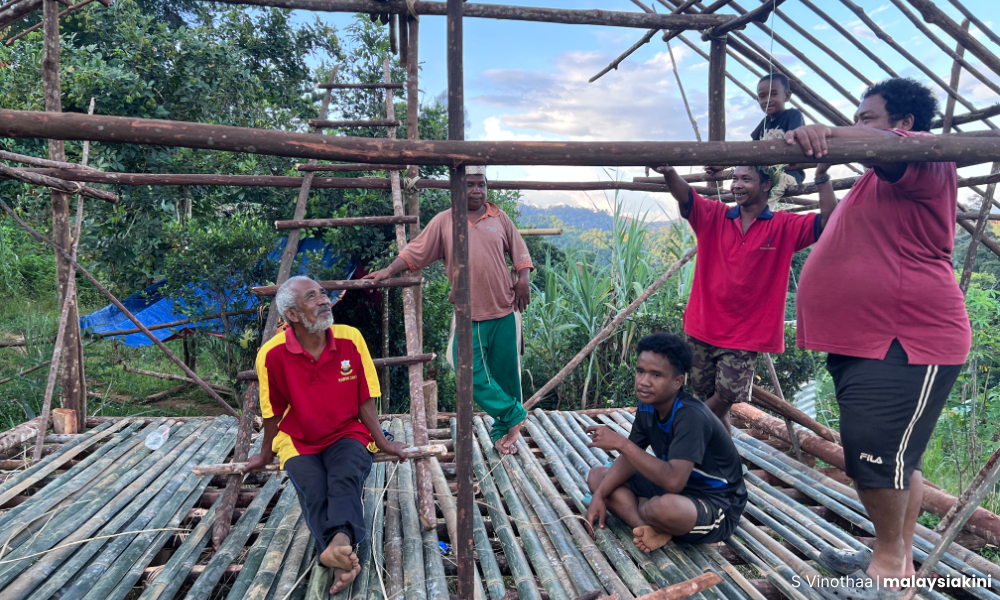
The Temiar community of about 200 villagers in Kampung Kelaik sounded the alarm over environmental destruction and health risks to no avail.
Between 2022 and 2023, they tried to seek a court injunction to stop all activities that changed the landscape of their 8,000ha ancestral land - logging, palm oil and durian plantations, and the mines. But they failed.
Undeterred, they filed a lawsuit against 10 companies, the Kelantan state government, and three government agencies over encroachment into their native land. The community crowdfunded for legal costs and support.
Passing on responsibilities
Asked if Jakoa had conducted any health assessments of the villagers since mining began upstream from their village in 2009, the department said health inspections are conducted by the District Health Office.
“Jakoa will support any health awareness initiatives organised by the District Health Office,” it said, underscoring its limited proactive involvement in addressing environmental health risks to the Orang Asli.
Similarly, when asked if the body would recommend heavy metal testing of the river downstream from mines and parts that pass the Temiar villages, it said mining operations are monitored by the Lojing District and Land Office.
“Any management or inspection matters fall under their jurisdiction,” it said.
Basic right to clean water
The struggle even for the most basic things - water - had worn down the community. They feel they have lost more than just the tranquillity of their forest.
Since the river they used for drinking, bathing, and fishing for generations started turning red, Kampung Kelaik, with the help of the Health Department and NGOs, sourced water from a neighbouring uphill stream.
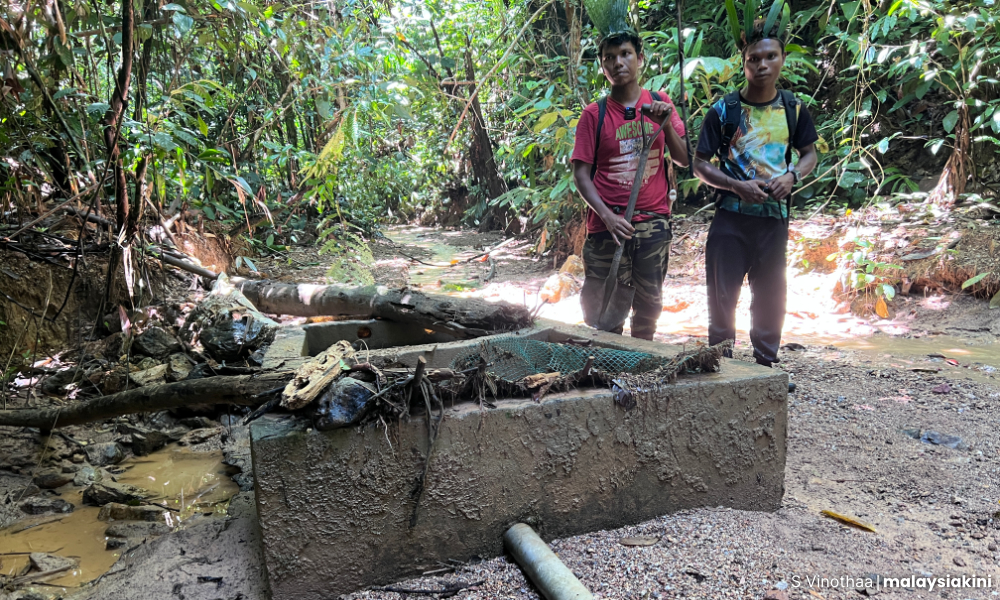
But the villagers shared that during heavy downpours, the gravity pipe system and small reservoir built to source water are clogged by debris, cutting water supply, sometimes for days.
The villagers claim the maintenance of the mini reservoir along Sungai Hug was handed over to Jakoa, but the agency denies this.
“Jakoa has not implemented any projects in Sungai Hug and according to the headperson of Pos Blau, Salleh Angah, Kampung Kelaik villagers do not use water from Sungai Hug.
“Sungai Hug is located 5km away from Kampung Kelaik,” it said.
Water filtration facility
Jakoa said it provided a water pump house at Kampung Kelaik that was operational for 48 months from Dec 1, 2020, until Nov 30 this year.
The department also manages a pump house at the Orang Asli village in Pos Blau.
“Residents use a water catchment system sourced from hill water managed by Jakoa, but not from Sungai Hug,” it reiterated.
Meanwhile, a Treated Water System Repair Project in Kampung Kelaik was carried out between July 8 and Sept 29 by Renok Construction under the allocation for the Treated Water Supply Project in Orang Asli villages.
However, during visits to Kampung Kelaik, Malaysiakini documented an abandoned water treatment facility that had been unused for months with a board describing the maintenance work awarded to one PL Teguh Enterprise.
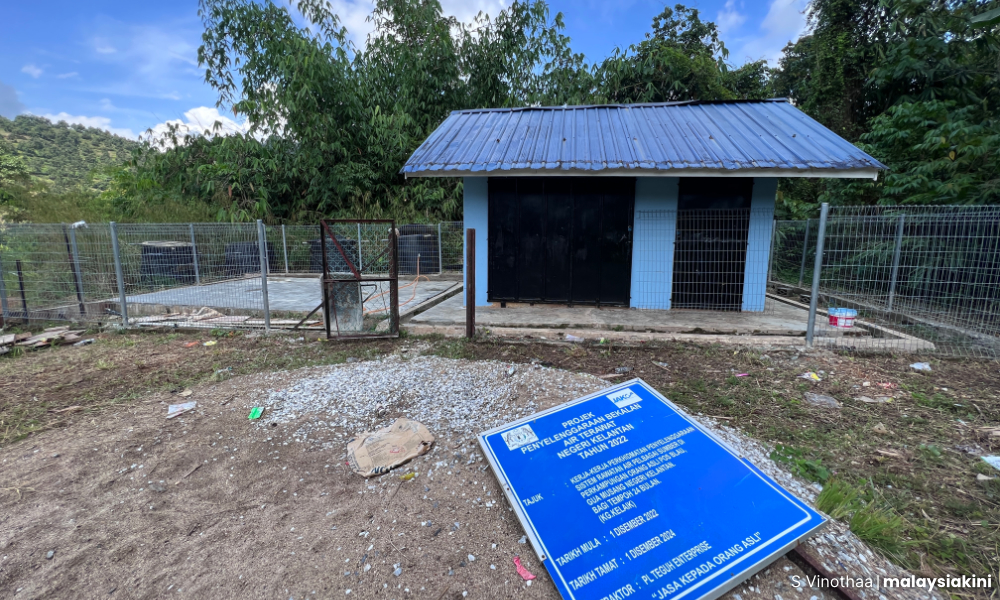
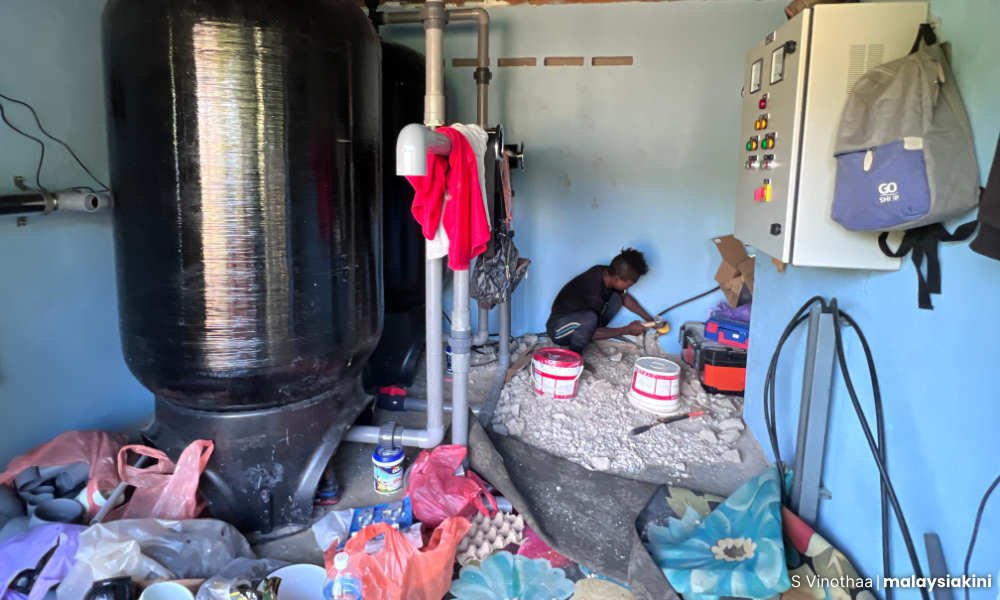
Villagers said the giant black water storage tanks had been left out for more than a year and the facility was not in use.
In October, efforts were underway to operationalise the facility.
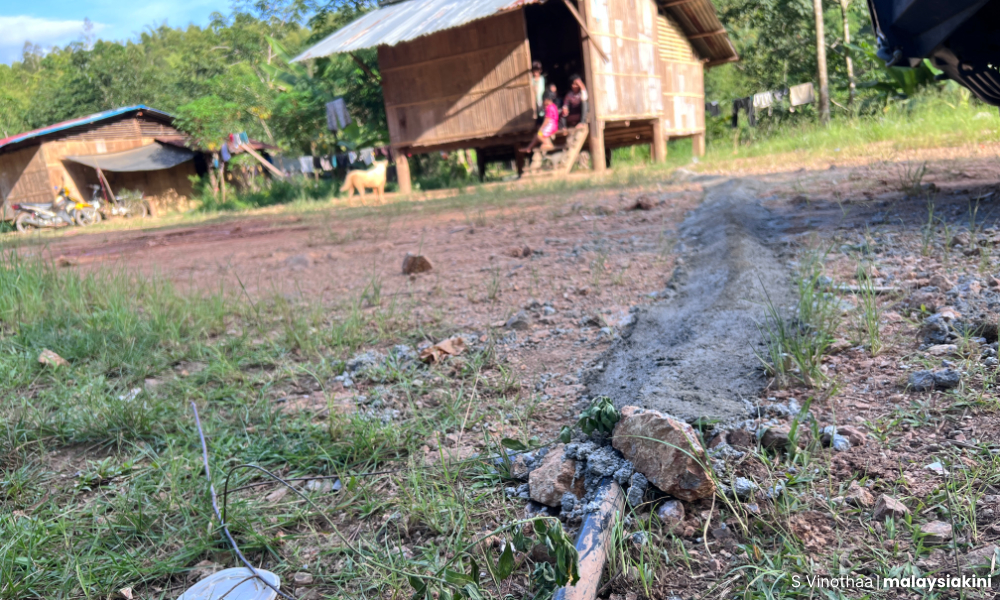
However, the quality of work raised concerns as unskilled workers installed water pipes intended to be buried underground but left them running above ground with only a superficial covering.
/file/publisher-c1a3f893382d2b2f8a9aa22a654d9c97/2024/12/e76631b61c0ff5dc39e7e74fe9de35ed.jpg)
/file/publisher-c1a3f893382d2b2f8a9aa22a654d9c97/2024/12/82001b3376482e62dc2a7298fdd72ea5.jpg)
/file/publisher-c1a3f893382d2b2f8a9aa22a654d9c97/2024/12/948fe37a3e49c13306639bb769c65a8e.jpg)
/file/publisher-c1a3f893382d2b2f8a9aa22a654d9c97/2024/08/395894dfbe4831819042f7451b83c63a.jpg)
/file/publisher-c1a3f893382d2b2f8a9aa22a654d9c97/2023/10/817e44e48fe957913615ae0ccc11c94e.jpg)


Are you sure you want to delete this comment?
This action cannot be undone.