


/file/publisher-c1a3f893382d2b2f8a9aa22a654d9c97/2025/02/9677b57784af7371ad4781ebea316e82.png)

M'sia maintains 57th spot in global Corruption Perceptions Index
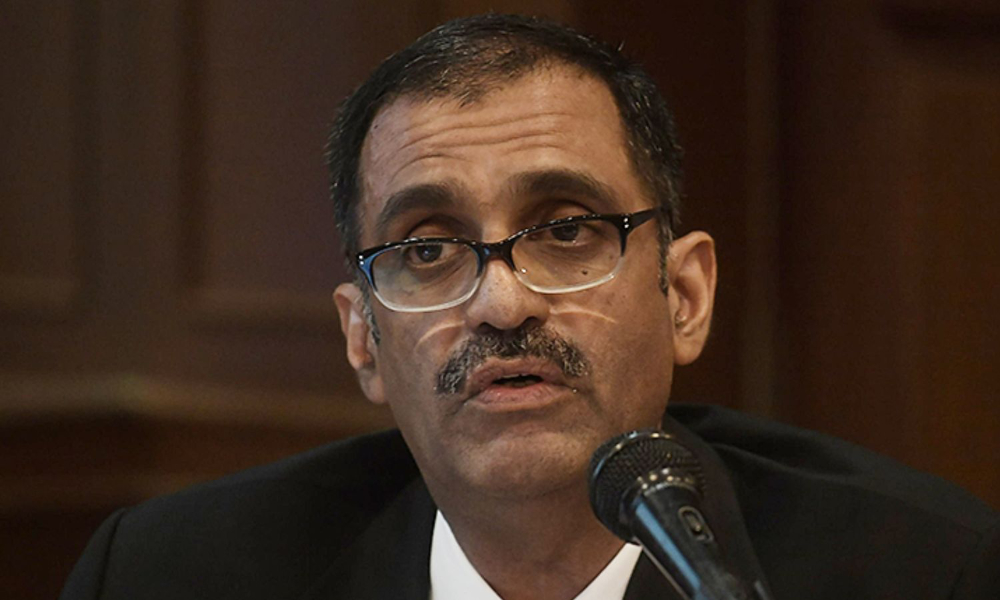
Transparency International Malaysia (TI-M) believes that the ranking might have been affected by a series of “discounts” and discharges not amounting to an acquittal (DNAA) given in high-profile court cases.
Summary
Malaysia remains stagnant at the 57th spot in the Corruption Perception Index for 2024.
Transparency International Malaysia says the ranking could’ve been affected by punishment discounts and discharges in high-profile corruption cases.
Graft watchdog Center to Combat Corruption & Cronyism says the score was unsurprising and the government needs to back up anti-corruption rhetoric with concrete actions.
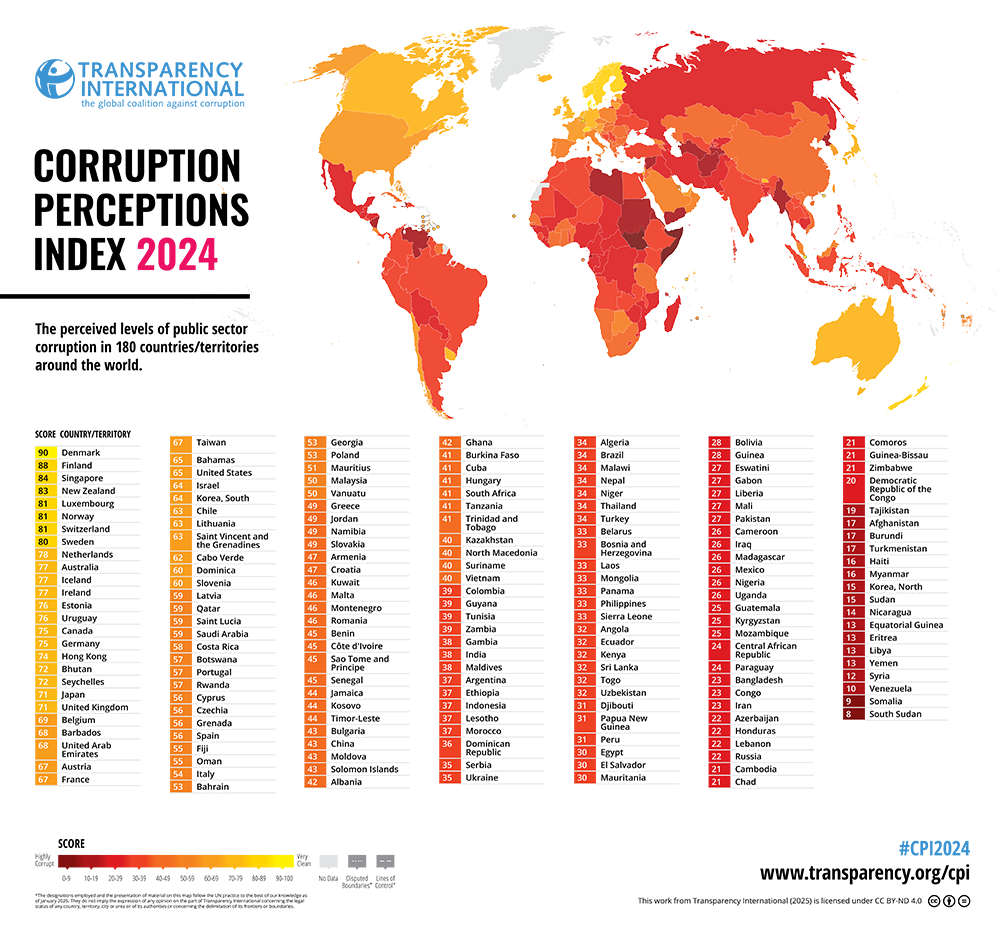
Malaysia’s position in the global Corruption Perception Index (CPI) for last year has remained stagnant at the 57th spot as it again scored 50 out of 100 points.
Transparency International Malaysia (TI-M) believes that the ranking might have been affected by a series of “discounts” and discharges not amounting to an acquittal (DNAA) given in high-profile court cases.
TI-M president Muhammad Mohan said they believe Malaysia could have scored more points to improve its position if the incidents had not occurred.
“...so those kinds of things when you suddenly have (such things happening with) a high-profile case, and especially when the court has already decided at the highest level, I am not challenging the law, but this is perception.
“So people perceive it, even at this level can be given a discount (in punishment), what about ordinary people? That is the issue, so it could have influenced.
“So I agree with you that if that had not happened, perhaps we could have done better,” Muhammad told a press conference after a briefing on CPI 2024 in Petaling Jaya earlier today.
The CPI uses a scale of zero to 100, where zero is perceived to be highly corrupted and 100 is perceived to be very clean.
Malaysia scored 50 last year to climb to the 57th spot in 2023’s CPI, from 47 points in 2022. It had scored 48 points in 2021 and 51 points in 2020.
During the briefing session, Muhammad listed four possible reasons behind Malaysia’s stagnant score, namely:
Businesses still feel corruption is a problem in the public sector;
Slow institutional reforms despite the government’s strong emphasis on good governance and institutional reforms;
Revised jail sentences and fines after conviction on high-profile cases, and
The high number of discharges not amounting to an acquittal (DNAA) given for high-profile cases.
Muhammad said the revised sentences and DNAA had created the perception of political interference in the judiciary.
25th by 2033 is ‘up to govt’
He said TI-M was hoping that Malaysia could score at least two additional points every year, which is what the country needs if it wants to achieve the 25th ranking by 2033 as envisioned by Prime Minister Anwar Ibrahim.

Muhammad urged the government to accelerate institutional and legal reforms that it had promised if it wanted to improve its performance for this year.
They include tabling the planned amendments to the Whistleblowers Protection Act, tabling the Freedom of Information Bill for greater transparency, the Ombudsman Bill (for a central agency to receive complaints), the Parliamentary Services Bill (for power separation between the executives, legislature and judiciary), and the Political Financing Bill to regulate political funding.
Asked whether he thinks Malaysia can reach its target for the 25th spot by 2033, Muhammad said he did not have the answer as it would be up to the government to act.
Backing up the rhetoric
Meanwhile, the Center to Combat Corruption & Cronyism (C4 Center) said the stagnant score was unsurprising.
Its chief executive officer Pushpan Murugaiah said the country’s fight against corruption had not improved despite the amount of government rhetoric.

“So that boils down to issues like institutional reform. I think it tells people that you can say how much you want to say about corruption, but if you don’t back it up with action, reforms, and necessary changes, it will not work.
“So I think that is the message we need to pick up from there.
“So any narratives or anti-corruption rhetoric has to be backed with necessary reforms. That’s the key thing we have to learn from this. Moving forward, as I always mention, C4 has always mentioned reforms on the institutional side,” he told reporters after the briefing.
Pushpan was also not very optimistic about the 2033 target set by the prime minister, saying that “it is a bit difficult to achieve”.
“... unless there are drastic reforms being pushed out with the year and so. Because CPI addresses the perception, as always been mentioned,” he said.
/file/publisher-c1a3f893382d2b2f8a9aa22a654d9c97/2024/09/de50927eabc1f78142492f18d2de40fa.jpg)
/file/publisher-c1a3f893382d2b2f8a9aa22a654d9c97/2025/01/e7ebc15ac82bab0c795b38bfbd585b0a.jpg)
/file/publisher-c1a3f893382d2b2f8a9aa22a654d9c97/2021/11/efecc36beacf3b343a7ba2ae327b22c1.jpg)
/file/publisher-c1a3f893382d2b2f8a9aa22a654d9c97/2025/02/ae95225d26f09de45d4e11d51842b650.jpg)
/file/publisher-c1a3f893382d2b2f8a9aa22a654d9c97/2023/07/500cff3465fd7c31cdbdc932a0b5f11e.jpg)


Are you sure you want to delete this comment?
This action cannot be undone.