


/file/publisher-c1a3f893382d2b2f8a9aa22a654d9c97/2025/02/ff385ffe3e2957fca3f94d88886acd87.jpg)

'Santan storm': Group decries 'made-up' excuses for price hike
Consumer groups are furious over the explanations given regarding the anticipated rise in coconut milk (santan) prices as Ramadan approaches early next month.
The Malaysian Muslim Consumers Association (PPIM) has suggested that these forecasts are deliberately being circulated to condition the public into accepting the inevitable price hike.
Summary
Consumer groups are furious over the explanations given for the anticipated price hike for coconut milk.
Malaysian Muslim Consumers Association alleges that the rising demand and shortage of supply are fabricated excuses.
Federation of Malaysian Consumers Associations recommends stricter price control and calls on the government to immediately import coconuts.
Consumer groups are furious over the explanations given regarding the anticipated rise in coconut milk (santan) prices as Ramadan approaches early next month.
The Malaysian Muslim Consumers Association (PPIM) has suggested that these forecasts are deliberately being circulated to condition the public into accepting the inevitable price hike.
“These reports (on price increases) seem to serve as an early warning, subtly signalling that a hike is unavoidable,” said PPIM secretary-general Maamor Osman.
“As a result, consumers are left with no choice but to accept it,” he added.
Maamor went on to allege that the reasons cited - rising demand and supply shortages - are merely fabricated excuses.
Supply shortage
Recent media reports indicated that the price of coconut milk in several states could soar to RM20 per kg as Ramadan nears due to a continued shortage of coconuts.

This issue has reportedly persisted since early December, causing coconut milk prices to rise from an initial RM9-RM10 per kg to RM17-RM18 per kg.
Speaking to Malaysiakini yesterday, Maamor criticised authorities for failing to manage supply issues in advance.
“This is not a new problem. The relevant parties should have anticipated it and taken action much earlier,” he said.
“They already know the dates of every festive season in this country. So there is no excuse for shortages of essential goods,” he added.
Maamor also dismissed claims of supply shortages, arguing that Malaysia and its neighbouring coconut-exporting countries like Indonesia have not faced any natural disasters that would justify a disruption.
He further expressed concerns that citing supply shortages would only encourage hoarding.
“Traders will hold onto their stock and flood the market only when prices peak,” he warned.
Upward trend
The Federation of Malaysian Consumers Associations (Fomca) confirmed that fresh coconut milk prices have been rising for several months.

Fomca secretary-general Saravanan Thambirajah stated that in November 2024, coconut milk was sold at RM14–RM20 per kg.
By January this year, the price of coconuts had risen to RM2.80 per unit, compared to RM1.80 in September the previous year - directly impacting coconut milk prices.
According to him, the price hike is due to several factors, including local supply shortages caused by weather conditions and insufficient production.
“Our heavy reliance on imports from neighbouring countries like Indonesia and Thailand also affects pricing, especially when import costs increase.
“Additionally, the surge in demand ahead of Ramadan further drives up prices,” he explained.
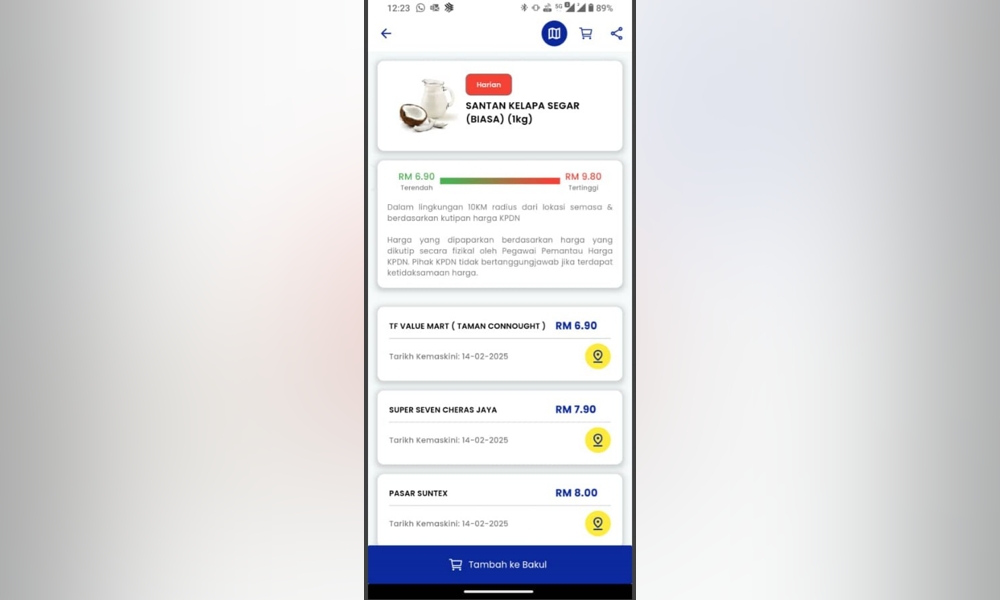
It should be noted that the Domestic Trade and Costs of Living Ministry’s “PriceCatcher” app shows that the price for 1kg of coconut milk remains below RM10 as of today.
Import more
Fomca then urged the government to immediately import more coconuts to address supply shortages and stabilise market prices.
“This step is crucial to prevent consumers, particularly low-income groups and small traders, from being burdened by excessively high prices,” Saravanan emphasised.
“Moreover, efforts to boost local production must be accelerated, including providing incentives to farmers to cultivate more coconuts, reducing our reliance on imports,” he added.
Fomca also recommended stricter price controls to curb speculative price hikes.

“The government must ensure a more efficient supply chain by minimising the role of middlemen, who often drive prices up unnecessarily.
“At the same time, consumers can explore alternative cooking methods that do not require coconut milk or opt for more affordable substitutes should this price increase persist,” he suggested.
/file/publisher-c1a3f893382d2b2f8a9aa22a654d9c97/2024/10/d26238be568e6188376d2dcc46c9a6ff.jpg)
/file/1349/ce4647cb74a3be34e5c3bad88c7d7368.jpeg)
/file/publisher-c1a3f893382d2b2f8a9aa22a654d9c97/2023/04/5beb3a8a2f6892c96cee1ae0964ed49b.jpg)
/file/publisher-c1a3f893382d2b2f8a9aa22a654d9c97/2022/07/d8c646bb755415ddc23fb3efe73d666e.jpg)
/file/publisher-c1a3f893382d2b2f8a9aa22a654d9c97/2023/09/b45e64cd40b7ada5b41c0b6460f77db7.jpg)
/file/publisher-c1a3f893382d2b2f8a9aa22a654d9c97/2025/02/599583facd3376bd62b5b999a11331b7.jpg)


Are you sure you want to delete this comment?
This action cannot be undone.