


/file/publisher-c1a3f893382d2b2f8a9aa22a654d9c97/2020/11/8299b800aa7bf6501c28414ac37d5f29.jpg)

Passing of Pak Lah, father of human capital development
Affectionately known as “Pak Lah”, Abdullah was a pioneer of a way of thinking that emphasises human capital development as the foundation for future generations’ success.
The former prime minister, known for his modest Islamic leader image...
Today, the nation mourns the loss of Abdullah Ahmad Badawi, Malaysia’s fifth prime minister and a pivotal figure who contributed immensely to the development of the country’s human capital, which earned him the title of Malaysia’s Father of Human Capital Development.
Affectionately known as “Pak Lah”, Abdullah was a pioneer of a way of thinking that emphasises human capital development as the foundation for future generations’ success.
The former prime minister, known for his modest Islamic leader image, strongly emphasised the necessity of equipping every human being with positive values such as knowledge, good values, morals, and discipline to complement the development process of an excellent, glorious, and distinguished nation.
Throughout his six-year stint as Malaysia’s prime minister, which began from Oct 31, 2003, Abdullah among other things, established five pillars under his administration, namely the National Mission, the National Integrity Plan, Economic Corridor Development, Human Capital Development, and the Islam Hadhari concept.
Born on Nov 26, 1939, in Bayan Lepas, Penang, Abdullah received his early education at Sekolah Melayu Permatang Bertam before pursuing studies at Sekolah Tinggi Bukit Mertajam, Sekolah Menengah Daeratul Maarifil Al-Wataniah, and Penang Methodist Boys’ School.
Abdullah, who previously served as a teacher, pursued higher education at Universiti Malaya from 1962 to 1964, in the field of Islamic Studies.
He married Endon Mahmood in 1965, and they were blessed with two children, Kamaluddin and Nori.
Endon, however, passed away on Oct 20, 2005, after a long battle with breast cancer, and Abdullah married Jeanne Abdullah in 2007.
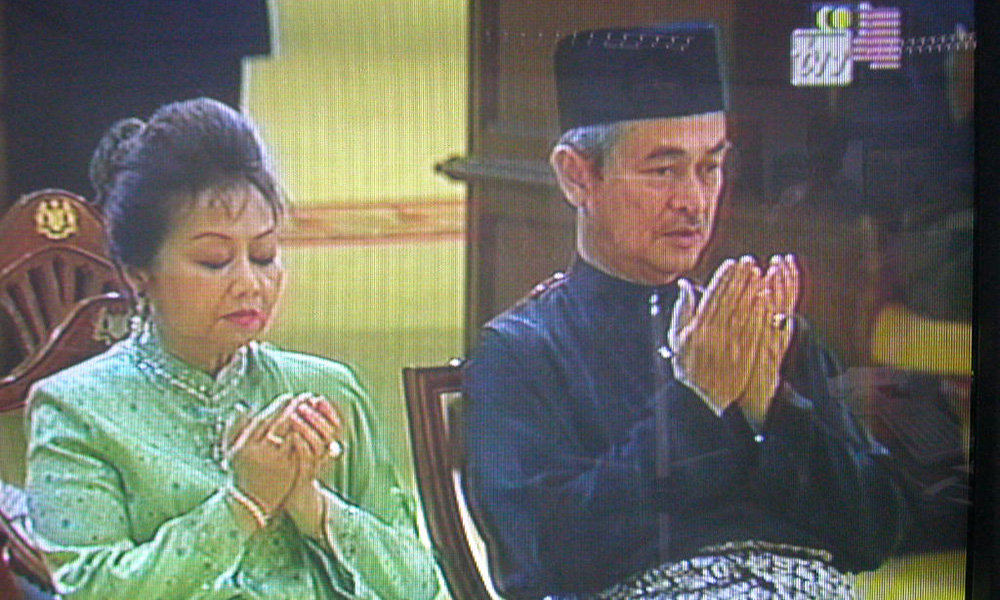
Abdullah began his career as an assistant secretary in the Public Service Department in 1964 before being appointed as principal assistant secretary of the Security Council under the National Operations Council (Mageran) in 1969.
In 1971, he took on the role of the director of youth at the Culture, Youth, and Sports Ministry, and in 1975, he was promoted to deputy secretary-general of the ministry.
Despite having joined Umno in 1965, Abdullah’s active involvement in politics began after winning the Kepala Batas parliamentary seat in the fifth general election in 1978, and he was elected as Umno vice-president in 1984, 1987, 1990, and 1996.
Abdullah held several key positions in the cabinet, including as the Federal Territories deputy minister in 1980, education minister 1984, defence minister (1986-1987), foreign affairs minister (1991-1999), as well as deputy prime minister and home affairs minister in 1999.
He took on the role of Umno deputy president from 2000 to 2003, before assuming the party’s top post as the president from 2003 to 2009, following Dr Mahathir Mohamad’s announcement to step down from all his positions in Umno, BN, and the government.
Born into a family of Islamic scholars, Abdullah’s father, Ahmad Badawi Abdullah was a prominent religious figure, which mainly influenced Abdullah to incorporate Islam Hadhari values into his leadership style.
Islam Hadhari and anti-corruption
During an exclusive interview with Bernama in conjunction with the Maal Hijrah 1426 celebration in 2005, Abdullah shared that the introduction of Islam Hadhari was intended to foster shifts in the community’s way of thinking and attitudes.
“Islam is, of course, Islam, but when it is used together with the word ‘hadhari’, it stresses that Islam is a civilised (religion) that can contribute towards human civilisation because Islam is a religion that is relevant at all times.
“It’s a religion that teaches us to acquire knowledge so that we can improve ourselves to become a good person, one who is successful, respected, and capable of bringing development to the ummah and country - one that can further enhance the position of Islam,” according to Abdullah.
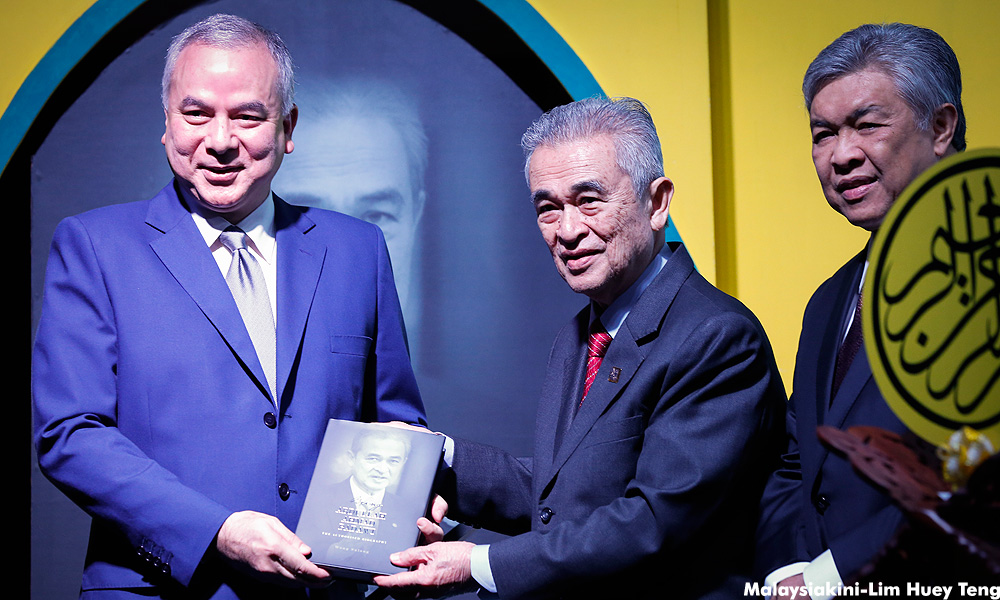
On April 23, 2004, he launched the National Integrity Plan with the primary focus of cultivating a culture of integrity within society, which led to the establishment of the Malaysian Institute of Integrity to oversee the implementation of the plan.
The country’s serious efforts to eradicate corruption inspired the Abdullah-led government to establish the Malaysian Anti-Corruption Academy, which serves as a regional centre for initiatives to enhance capacity and capability in the fight against corruption.
Economic corridors
In terms of national economic development, Abdullah also introduced the implementation of five regional corridors, including the Northern Corridor Economic Region (NCER) and the East Coast Corridor or East Coast Economic Region (ECER), to bridge the income gap between the people.
The implementation of regional corridors involves, among others, the provision of infrastructure and resources in rural areas with the aim of improving socioeconomic status and being part of the initiatives under the Ninth Malaysia Plan.
Abdullah stepped down as prime minister on April 3, 2009, and was conferred the country’s highest award - the Seri Maharaja Mangku Negara (SMN) - which carries the title of Tun, in the same year.
- Bernama
/file/publisher-c1a3f893382d2b2f8a9aa22a654d9c97/2025/04/c3110a30a98398fae5d0e5e7b3d29a72.jpg)


Are you sure you want to delete this comment?
This action cannot be undone.