


/file/publisher-c1a3f893382d2b2f8a9aa22a654d9c97/2024/03/ecf58b694a252a2fb9a0f9e8096f0697.jpg)

Changing demography challenge, lifeline for SJKCs - paper
This is according to a paper by Singapore-based Iseas-Yusof Ishak Institute published on Tuesday, where the think tank’s visiting fellow James Chai presented findings based on a survey and data compiled from multiple sources.
The paper argued that while the student population in SJKCs are shrinking...
Summary
A study by the Iseas-Yusof Ishak Institute found that while enrolment in Chinese national-type schools (SJKCs) is declining, a rising number of Malay students is helping sustain them.
The trend has sparked debate within the Chinese community over cultural identity, as schools adapt to accommodate non-Chinese students amid growing Malay preference due to academic reputation.
The changing student demography at Chinese national-type schools (SJKCs) in Malaysia is a lifeline for such institutions as student enrolments dwindle, but this also poses existential questions for the Chinese community in the country.
This is according to a paper by Singapore-based Iseas-Yusof Ishak Institute published on Tuesday, where the think tank’s visiting fellow James Chai presented findings based on a survey and data compiled from multiple sources.
The paper argued that while the student population in SJKCs are shrinking, a growing proportion of the new students are Malay.
This influx of non-Chinese students has helped prop up schools and slowed their decline, but the schools themselves have to take measures to accommodate such students.
These include offering extra tutorial hours, halal food options, prayer rooms, avoiding brewery logos, as well as adopting bilingual communications during classes and parent-teacher association meetings.

Chai observed that the phenomenon has riled Chinese education purists who fear excessive accommodation could threaten the schools’ cultural identity, while realists counter that the schools face the threat of closure due to low student numbers if they cannot accommodate non-Chinese students.
“Of course, there is a middle ground that is most likely to be realised in the medium-term, even if the enrolment trend continues: Adaptation to Malay students will happen but not in a wholesale manner, and efforts to maintain cultural integrity will always be attempted since Chinese features in SJKCs are still dominant,” Chai added.
Chinese cultural dilemma
The paper also noted the “ironic twist” that while the student population in SJKCs is increasingly diverse, national schools have become ethnically monolithic. This could shield SJKCs from calls to abolish them, made by those who perceive vernacular schools as a barrier to national identity and unity.
READ MORE: ‘Whither Integration?’ How our children are growing up in separate bubbles
“However, this will bring us to a larger existential question for the Chinese community; and this concerns whether preserving vernacular schools at the expense of their core cultural mission represents a genuine victory or a hidden loss,” the paper stated.
The paper argued that the decline in SJKC student population is, on one hand, likely driven by declining birth rates among Chinese Malaysians and their increased preference for international schools.
On the other hand, there is increased interest from Malay parents in SJKC schools.

The paper emphasised that the two phenomena “are separate and not causal or correlated”.
Chai conducted a survey that mostly targeted educated, married, middle-class Malays, where respondents were presented a series of hypothetical schools - two at a time - with varying attributes in terms of language of instruction, academic reputation, discipline, facilities, and location.
They were asked to choose which school they’d prefer for their children and gauged what factors would change their minds.
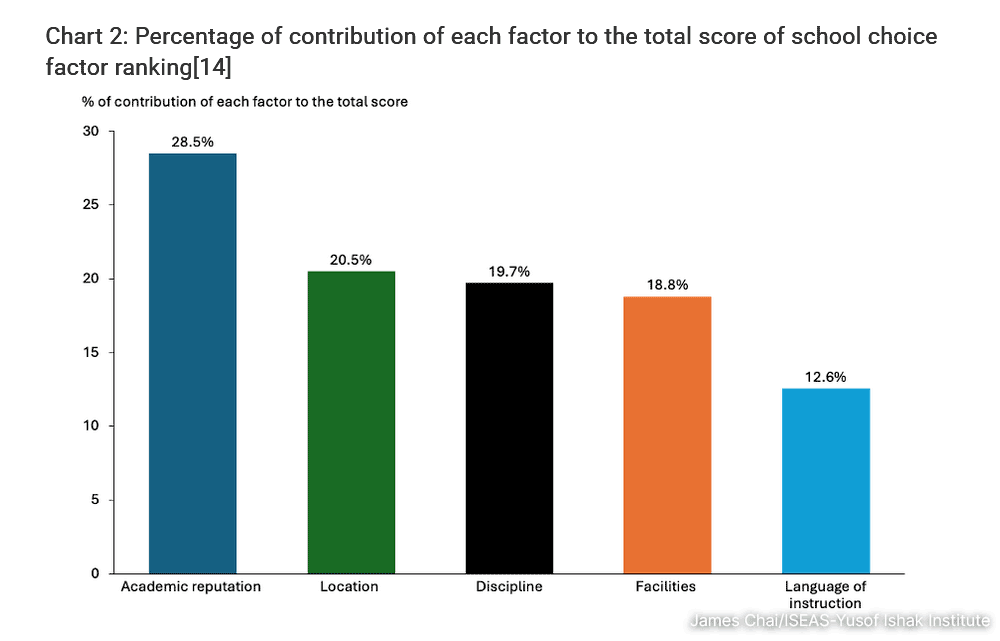
He surmised that for 69 percent of the 928 respondents who preferred an SJKC over a national school, it is because the former is perceived to have a better academic reputation, and respondents would still choose the hypothetical SJKC even if it only has basic facilities.
Academics the driving factor
The school’s language of instruction was found to be the least influential factor in the respondents’ choices, contributing to only 12.6 percent of a school’s score, compared to 28.5 percent for a school’s academic reputation.
“This preference likely indicates a declining perception of academic quality in national schools among Malay parents.
“On the flipside, if a national school comparator had a better academic reputation, two-thirds of the Malay respondents would choose it over a Chinese school, even though the latter may have better discipline, facilities, and is closer to home.
“In summary, this survey data indicates that the perceived academic reputation is the driving factor behind a Malay parent’s choice of a Chinese school, and other commonly cited reasons like facilities, location, and discipline were good-to-haves, which were typically offered by a Chinese school,” Chai wrote.
Based on data Chai compiled from various sources, in certain years where data is available, the student population at SJKCs grew from 567,803 in 1989 to as high as 609,673 in 1999, and then declined to 509,589 in 2020.
The non-Chinese portion of that population, however, grew nearly five-fold over the same period, from 17,309 students in 1989 to 101,011 in 2020.
By 2020, they make up nearly one-in-five SJKC students, with 15.3 percent of the total student population being Malays.
In smaller SJKCs, Malay students may make up the majority of its students.
Examples cited by the paper include SJKC Chi Sin in Batu Kikir, Negeri Sembilan, where 62 out of its 66 students are Malay, and SJKC Panching in Kuantan, where 80 percent of its students are Malay.
“Kedah is a standout state where the total SJKC population has 28 percent students who are non-Chinese, and five out of seven SJKCs in Baling have a Malay majority.
“These schools typically have fewer than 100 students, and thus, for SJKCs with declining Chinese students, it is the non-Chinese intake that has ensured that the school population has not fallen even lower,” the paper stated.
/file/publisher-c1a3f893382d2b2f8a9aa22a654d9c97/2025/02/684186bc35b07a391b7d5d51aa1c7fea.jpg)
/file/publisher-c1a3f893382d2b2f8a9aa22a654d9c97/2023/11/51af6e716239a5b81fce78dfab03dd39.jpg)
/file/publisher-c1a3f893382d2b2f8a9aa22a654d9c97/2024/07/be3414f8b63af4be0d7f466bcc45173e.jpg)
/file/publisher-c1a3f893382d2b2f8a9aa22a654d9c97/2023/10/b4e65638cb4139d5e7b5bd397dba7ae2.jpg)


Report this comment
Are you sure you want to delete this comment?
This action cannot be undone.