


/file/publisher-c1a3f893382d2b2f8a9aa22a654d9c97/2025/06/e88eecc5b5c10b71bb3c665fe58fe79a.jpg)

UMS protester: Anwar burned Tunku's book as a student in the 70s
Suara Mahasiswa UMS spokesperson Fadhil Kasim compared the act to the prime minister’s days as a student activist half a century ago.
He said the act, which he carried out with another protester, echoed the fiery demonstrations once led by...
Summary
A UMS student defends burning an Anwar Ibrahim caricature during a protest, comparing it to the prime minister’s student activism in 1970 when he burned a book by Tunku Abdul Rahman.
Suara Mahasiswa UMS spokesperson Fadhil Kasim says critics of the protest were more concerned with decorum than public wealth being looted and an unresolved water crisis at UMS.
He criticises Anwar for shifting his rhetoric on corruption in Sabah since coming into power.
A final-year student from Universiti Malaysia Sabah (UMS) has defended the recent burning of a caricature of Anwar Ibrahim during an anti-corruption protest in Kota Kinabalu.
Suara Mahasiswa UMS spokesperson Fadhil Kasim compared the act to the prime minister’s days as a student activist half a century ago.
He said the act, which he carried out with another protester, echoed the fiery demonstrations once led by Anwar himself in 1970 during his time at Universiti Malaya (UM).
“Anwar, as the president of the UM Malay Language Society, once led a protest to burn ‘13 Mei’, a book written by Tunku Abdul Rahman.
“To him and his peers, the book was ‘subversive’,” said Fadhil in a statement.
Tunku Abdul Rahman, Malaysia’s founding prime minister, led the country from 1955 to 1970, with his final year marked by the May 13, 1969 racial riots, which he chronicled in the book “13 Mei: Sebelum dan Selepas” (13 May: Before and After).
“They even held a symbolic burial of the book and burned it in public. Today, those who now rally around Anwar - leaders in Abim, PKR Youth, and various other organisations – have lost sight of this historical nuance,” claimed Fadhil, who also shared images taken from UM’s Malay Language Society magazine published in 1970.
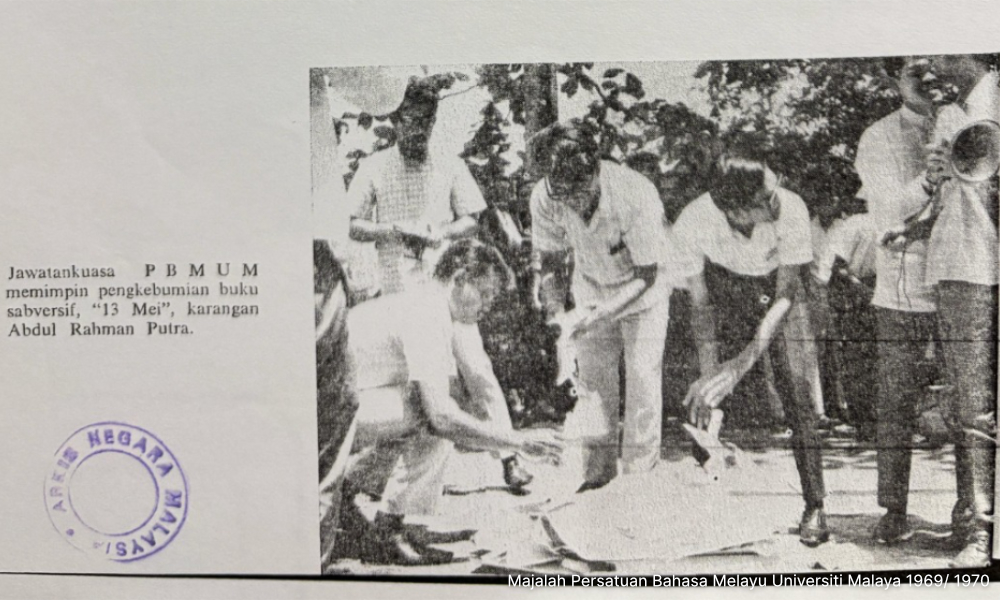
Fadhil was part of the organisers of last weekend’s rally at Lintasan Deasoka on Gaya Street, a popular tourist destination.
He derided critics of the demonstration for failing to grasp the spirit of student activism and instead focusing on decorum and image management.
Other than Anwar, the protesters also targeted Sabah governor Musa Aman and others in the state administration led by Chief Minister and Gabungan Rakyat Sabah president Hajiji Noor.
“They are more concerned that a caricature of their leader was set aflame, rather than the fact that public wealth is being looted or that the water crisis at UMS remains unresolved,” claimed Fadhil.
The caricature, labelled “Madani Pelindung Perasuah Sabah” (Madani - Protector of Sabah’s Corrupt), was torched in protest of the government’s alleged failure to address systemic corruption in the state.
Fadhil said he believed Anwar would understand the symbolism of the act, having once walked a similar path.
“I imagine Anwar might be moved watching our video
(and be) reminded of his days at Universiti Malaya in the 1970s. But that’s just a feeling.
“The reality is, Anwar is now the prime minister, not a student activist.”
PKR leaders have spoken against the burning, with PKR Youth chief Kamil Munim condemning the stunt as attention-seeking and failing to properly convey the protesters’ points.
Tuaran PKR chief Razeef Rakimin described the stunt as a “desperate act” after the rally purportedly saw a lacklustre participation of fewer than 100 supporters.
Razeef further claimed that Fadhil and his fellow firestarter endangered not only themselves, but also visitors to the rally site.
Tune on Sabah has changed
Fadhil criticised the prime minister’s stance on Sabah, claiming Anwar’s rhetoric had shifted since joining the government.
“When he was in the opposition, Anwar would come to Sabah armed with his five favourite narratives – Musa, timber concessions, road projects, corruption, and Sabah rights.
“But now, it seems he is more concerned with preserving GRS’ position in the Madani coalition, even as the coalition is engulfed in extraordinary corruption scandals,” Fadhil claimed, alluding to the Sabah mining licence scandal that implicated several elected representatives.
The group previously also said their actions were in response to Anwar’s statement urging youths to take up the fight against corruption.
Earlier today, UMS condemned the incident and filed a police report. The university stressed that it had no involvement - direct or indirect - with the protest.
/file/publisher-c1a3f893382d2b2f8a9aa22a654d9c97/2025/06/b4699ea2ec9a764cfaed7cb33dd02792.jpg)
/file/publisher-c1a3f893382d2b2f8a9aa22a654d9c97/2025/06/ed14a5e557c63a4d4629f47507fc3131.jpg)
/file/publisher-c1a3f893382d2b2f8a9aa22a654d9c97/2025/06/7942c681d3f1fb862bd515ed91e3c51f.jpg)


Are you sure you want to delete this comment?
This action cannot be undone.