


/file/publisher-c1a3f893382d2b2f8a9aa22a654d9c97/2024/10/8c63d5745181d2aed4f4b5a6f8aa2a4f.jpg)

Putra Heights inferno: Ex-minister says Petronas still liable
The Occupational Safety and Health Department’s (Dosh) findings that the Putra Heights inferno was caused by ground instability do not excuse Petronas from liability, said former environment minister Yeo Bee Yin.
While agreeing with Dosh’s assessment that there were no elements of sabotage or criminal intent, Yeo, who has worked as a field engineer in the oil and gas industry, disagreed that there was no negligence.
Summary
Former environment minister Yeo Bee Yin argues that Petronas is still liable for the Putra Heights gas pipeline fire, even though Dosh found ground instability to be responsible.
Yeo, a former oil and gas field engineer, says Petronas is responsible for ensuring its assets are in good condition.
The Puchong MP adds that the national oil and gas company should compensate those affected by the fire.
The Occupational Safety and Health Department’s (Dosh) findings that the Putra Heights inferno was caused by ground instability do not excuse Petronas from liability, said former environment minister Yeo Bee Yin.
While agreeing with Dosh’s assessment that there were no elements of sabotage or criminal intent, Yeo, who has worked as a field engineer in the oil and gas industry, disagreed that there was no negligence.
“As the owner of the pipeline, Petronas should have ensured that all its assets were maintained in proper condition.
“Underground conditions should not be an excuse for a large-scale structural failure of this magnitude.
“Therefore, Petronas must take full responsibility for the losses caused by the Putra Heights fire,” said the Puchong MP in a statement today.
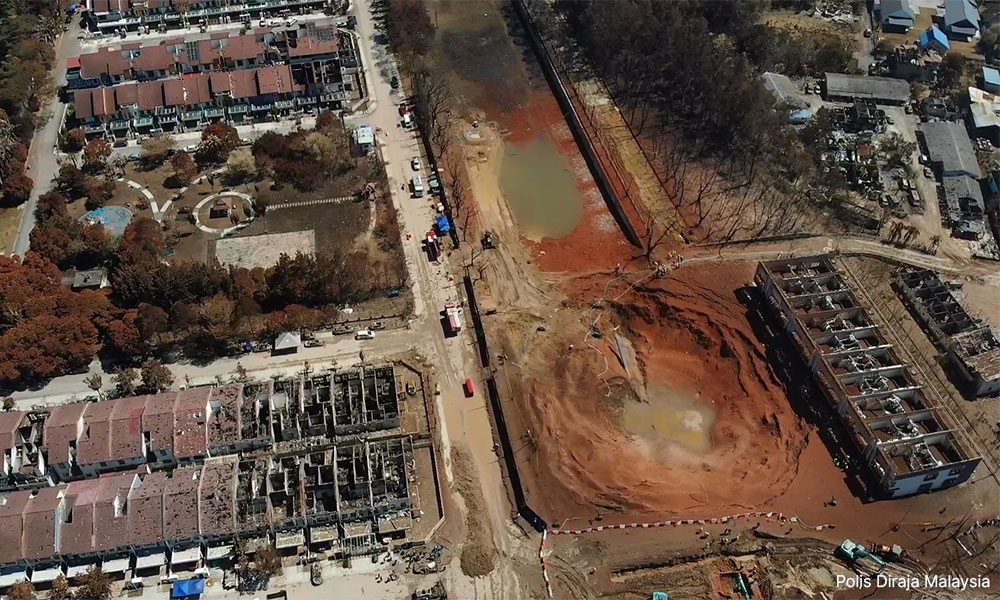
The fire involving the Petronas gas line on April 1 saw flames shooting more than 30m into the air, with temperatures reaching 1,000 degrees Celsius, transforming the surrounding landscape into a large crater.
Yesterday, Dosh said the pipe involved was not fully supported by the soil around it due to cyclic loading, causing a weakness in the welded joint that broke apart and started the fire.
The disaster destroyed 81 houses with structural damage exceeding 40 percent, while another 81 were partially damaged. Fifty-seven houses were affected but not burned.
Yeo said that while various forms of financial aid were given to the victims, it was not enough to compensate for the physical, mental, and psychological losses they suffered.
“I call on Petronas to accept its responsibility and provide full compensation to all victims of the Putra Heights fire, reflecting their actual loss.
“Additionally, Petronas must immediately conduct comprehensive structural assessments of the entire 2,623km Peninsular gas pipeline network to ensure such incidents never occur again,” she said.
NGO claims Petronas pipes exploded before
Meanwhile, environmental NGO RimbaWatch urged authorities to investigate Petronas and relevant government agencies for negligence in monitoring the pipeline and ensuring its safety.
In a statement, it raised questions over the Dosh report that found no element of negligence in the April 1 blast.
According to RimbaWatch, Petronas previously advertised that their pipelines are monitored and controlled around the clock, and they were able to pinpoint the exact location in case of abnormalities.
“Given that the subsidence occurred over a long period of time, why did Petronas’ various 24/7 safety measures, such as the ‘pigging’ method, aerial inspections with helicopters, ground surveillance, and alleged state of the art technologies such as the PiriGIS (Realtime Petronas Geographic Information System), fail in detecting such a significant occurrence of soil subsidence in such a high-risk area?” the statement read.
Adding further, the NGO pointed out that Petronas has experienced serious safety issues with pipeline subsidence in the past.
They include at least four explosions and multiple leaks involving Petronas’ Sabah-Sarawak Gas Pipeline (SSGP) since 2014, which were mostly attributed to soil subsidence, RimbaWatch said.
“Given that the SSGP suffered various explosions and leakages from soil subsidence leading up to the Putra Heights Incident, did Petronas not implement more stringent subsidence monitoring, especially for pipeline sections in high-risk areas?
“Given that, under existing laws, pipeline operators could be liable for damages related to the construction and operation of pipelines, how does failure by Petronas in the planning and monitoring of the PGU (Peninsular Gas Utilisation) Pipeline not constitute negligence?
“Further, beyond the operator, should negligence extend to include a multitude of government agencies and local authorities who are also responsible for monitoring and communicating geological and environmental risks to pipeline operators, as well as overseeing pipeline operators?”
/file/publisher-c1a3f893382d2b2f8a9aa22a654d9c97/2025/06/905a3e6c53a22bb4114cd9e131401288.jpg)
/file/publisher-c1a3f893382d2b2f8a9aa22a654d9c97/2025/04/a70532435863ff53e5ad94dcc4f8391c.png)
/file/1156/3318743ae92961a9ddd0cc59dc302d43.jpeg)
/file/publisher-c1a3f893382d2b2f8a9aa22a654d9c97/2025/04/307ccfa7c3b00825b9019ea21c140e19.jpg)
/file/publisher-c1a3f893382d2b2f8a9aa22a654d9c97/2025/04/7f927ff1fd57c249dcfd494f00c27e6a.png)
/file/publisher-c1a3f893382d2b2f8a9aa22a654d9c97/2025/04/8254e2a794a743baf6cbb0b33441c644.jpg)


Are you sure you want to delete this comment?
This action cannot be undone.