


/file/publisher-c1a3f893382d2b2f8a9aa22a654d9c97/2025/07/0d01c2681316346814d7d33542325165.jpg)

Activist calls for fairer, multiethnic Sarawak assembly amid expansion
With a redelineation exercise placing an additional 17 assemblypersons in the Sarawak assembly, representation and long-term goals under the Malaysia Agreement 1963 (MA63) must improve, an activist said.
Peter John Jaban said the bigger Sarawak assembly should reflect the state’s racial diversity and address local issues.
“This redelineation should not just be bigger, it must also be better.
Summary
A Sarawak activist says the state’s proposed redelineation - which adds 17 new assembly seats - must enhance representation, particularly in line with MA63 goals.
Jaban highlights that Sarawak’s voter demographics have shifted, with rising urbanisation and a more ethnically diverse electorate, making the old race-based approach outdated.
He stresses the need for a multiethnic, responsive and balanced assembly that addresses pressing 21st-century issues.
With a redelineation exercise placing an additional 17 assemblypersons in the Sarawak assembly, representation and long-term goals under the Malaysia Agreement 1963 (MA63) must improve, an activist said.
Peter John Jaban said the bigger Sarawak assembly should reflect the state’s racial diversity and address local issues.
“This redelineation should not just be bigger, it must also be better.
“It must look at the challenges and issues that the people are facing and give the state assembly the best chance of addressing these.
“The rakyat must be represented in the state assembly – that is the only purpose of the house. So let us hope for a multiethnic, responsive and relevant state assembly that we all deserve for the next decade,” the Saya Anak Sarawak founder said in a statement today.
Proposed increase
Yesterday, Bernama reported that the Sarawak government had tabled the Dewan Undangan Negeri (Composition of Membership) Bill 2025, proposing to increase the number of elected representatives in the state assembly from 82 to 99.

The bill, tabled by Sarawak Tourism, Creative Industry and Performing Arts Minister Abdul Karim Rahman Hamzah, reportedly aims to reflect demographic changes, urban expansion, and the growing need for equitable representation in the state.
Karim added that the new composition, once passed and gazetted, would be implemented in time for the next state election.
He said that the proposed amendment would also repeal the current Dewan Undangan Negeri (Composition of Membership) Ordinance 2014 (Cap 70), which fixed the number of seats at 82.
Changing voter dynamics
In his statement, Jaban said the voter population and its dynamics have changed with the increasing migration to urban centres.
“We no longer live in a time when most Dayaks are living in their traditional ancestral communities. There has been massive rural to urban migration, sometimes by choice, sometimes by necessity.
“Some estimates suggest that Sarawak is now up to 65 percent urbanised, and the majority of those migrants have been Dayaks.

“The voter landscape of both our rural and our urban areas is increasingly complex and can no longer support the simplistic, race-based system of a decade ago,” he added.
Besides that, he called on the parties in the ruling coalition to better represent the population of their constituencies.
He also expressed hope that the redelineation would meet the needs of rural communities.
“We are seeing new issues for the 21st century affecting ordinary Sarawakians – lack of infrastructure, urban deprivation and poverty, rural connectivity and livelihoods, loss of culture and community.
“These are the concerns that our new elected representatives must address, and the redelineation must allow them to do so without political or racial bias,” he said.
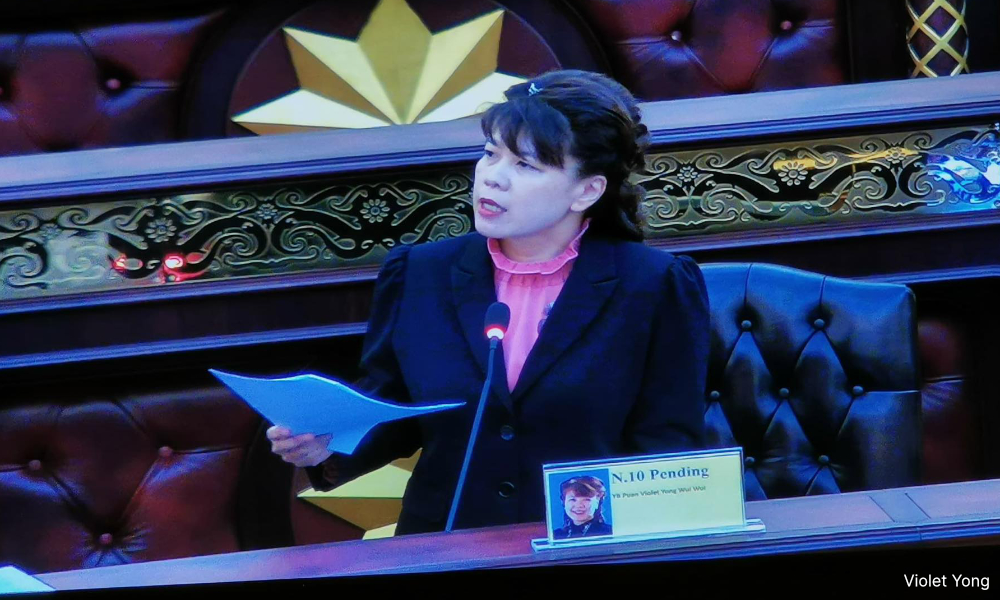
Yesterday, DAP’s Pending representative Violet Yong accused the Sarawak government of gerrymandering.
According to The Borneo Post, during a debate on the bill’s amendment, she lamented that the redelineation is “not only untimely, but unfair, unnecessary and politically motivated”.
She said it shifts focus away from urgent rakyat issues such as poverty, high cost of living, poor infrastructure and lack of basic amenities.
/file/publisher-c1a3f893382d2b2f8a9aa22a654d9c97/2024/07/8386472bd46eec1a705e1882cb4b9bee.jpg)
/file/publisher-c1a3f893382d2b2f8a9aa22a654d9c97/2024/12/a139658a18e99b8578bb520629e6604d.jpg)
/file/publisher-c1a3f893382d2b2f8a9aa22a654d9c97/2020/09/91f765531b48fffe04c92d2afb18eb38.jpg)
/file/publisher-c1a3f893382d2b2f8a9aa22a654d9c97/2021/12/f95b496000e730730a6260be51ec9a6f.jpg)
/file/publisher-c1a3f893382d2b2f8a9aa22a654d9c97/2022/10/e9a20afafb0ad26e1794279529ce97d7.jpg)


Are you sure you want to delete this comment?
This action cannot be undone.