




Poll sees rise in corruption cases
The majority of Malaysians see the worsening of corruption in the country in the next three years although they also opine that the government has been effective in combating graft, according to a new global survey.
The majority of Malaysians see the worsening of corruption in the country in the next three years although they also opine that the government has been effective in combating graft, according to a new global survey.
A total of 63 percent of Malaysians who took part in the survey, called ‘Global Corruption Barometer 2007' commissioned by corruption watchdog Transparency International (TI), were of the opinion that corruption cases would increase in the next three years.
Another 18 percent, however, felt such cases would drop while 19 percent said they would remain.
The survey findings were released by TI-Malaysia at its office in Kuala Lumpur this afternoon.
Despite foreseeing that corruption cases will go up, the interviewees in the same survey nevertheless rated the government’s efforts in fighting corruption as ‘effective’, against 37 percent who disagreed and 10 percent who remained neutral.
The response placed Malaysia - in the public’s eyes - as the third most effective country in the Asia Pacific region in fighting graft after Singapore and Hong Kong.
Prime Minister Abdullah Ahmad Badawi, who took office in 2003, has vowed to put the fight against corruption on his top agenda but critics said such efforts so far appeared to have only targeted the small fry, not the big fish.
Police ‘most corrupted’
Meanwhile, six percent of the respondents admitted to have paid bribes - either they or their family members - in the past one year.
The police force and politicians continued to top the list of those perceived to be most corrupt.
The survey, which involved 1,250 Malaysians, was conducted by Zurich-based polling outfit Gallup International Association as part of its ‘Voice of the People’ survey and meant to evaluate how and where corruption affects the daily lives of ordinary people.
TI-Malaysia president Ramon Navaratnam who was present at the presentation of the findings this afternoon said the results showed, among others, the need to make the Anti-Corruption Agency (ACA) independent.
“We also need to bring in place the Whistleblower Protection Act,” he told the 50-odd people at the event.
The ACA is currently placed under the Prime Minister’s Department and consistent calls to put it under the purview of Parliament has been turned down.
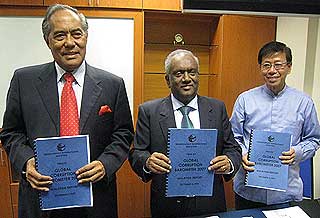 Ramon also stressed on the need to get rid of money politics - which he described as the “mother of all corruptions”.
On the same note, TI-Malaysia exco member Megat Najmuddin Megat Khas who was also present described the problem of money politics as having reached a stage of “endemic”.
“I sat on the Umno disciplinary board and I saw hundreds and hundreds of corruption cases being reported,” he said, adding that the same problems were also found in other ruling parties including PAS, which ruled Kelantan.
In relation to that, Megat advocated the idea of public and corporate funding for political parties on the condition that the source of funding must be made known to promote transparency.
Malaysia was ranked 43rd of the 180 countries polled in last year’s corruption perception index, which was also released by TI annually. In 2005, the country was ranked 44th.
ACA chief Ahmad Said Hamdan was quoted in a Bernama report today as saying that he hoped Malaysia will break into the top 30 nations on the index in the next few years.


Are you sure you want to delete this comment?
This action cannot be undone.