
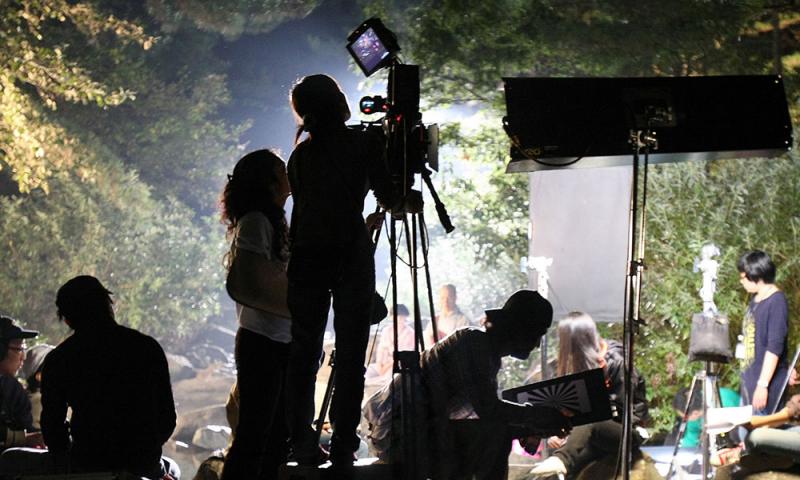
Use empathy when making movies on taboo subjects, filmmakers say
Filmmakers say it remains crucial to tell stories about taboo and sensitive topics touching on religion, royalty, race, and LGBTQ+, even when such subjects invite backlash - but the key lies in empathy, not outrage.
Speaking at the Asean Creative Youth Forum held today at Akademi Seni Budaya dan Warisan Kebangsaan (Aswara), panellists said controversial themes can still resonate with audiences if told with care and understanding.
Filmmakers say it remains crucial to tell stories about taboo and sensitive topics touching on religion, royalty, race, and LGBTQ+, even when such subjects invite backlash - but the key lies in empathy, not outrage.
Speaking at the Asean Creative Youth Forum held today at Akademi Seni Budaya dan Warisan Kebangsaan (Aswara), panellists said controversial themes can still resonate with audiences if told with care and understanding.
The session, titled “Film Without Fear: Creative Freedom in the Asean Storytelling Space”, featured local film editor Affandi Jamaluddin, Indonesian screenwriter Jujur Prananto, and Fat Bidin Sdn Bhd co-founders Zan Azlee and Sheril Bustaman, who discussed how Southeast Asian filmmakers navigate censorship, social taboos, and creative risks in their work.
Zan, who also dabbles in independent filmmaking, said the challenge is not whether filmmakers should tell difficult stories, but how they tell them.
“When I was younger, I was angry. Everything that felt wrong, I wanted to fight it.
“But if you go in too hard, people stop listening,” he said.

Zan said years of experience taught him that confrontation rarely changes minds. Instead, empathy and subtlety can open space for conversation, especially in a region where political, religious and cultural sensitivities run deep.
“When you are older, you find a different approach. Because in content production and storytelling, you must have multi-pronged approaches if you want to get to different people,” he said.
Free speech comes with accountability
His partner, Sheril, claimed that people often conflate the definition of creative freedom with unrestricted expression, stressing that creative freedom also comes with accountability and openness to criticism.
“There’s a misconception that creative freedom means everyone has to agree with you, but that’s not the case. You can make whatever you want, political, sexual, or racial, but you have to be ready for disagreement.
“That’s what real creative freedom means, it’s supposed to be able to hold space for every kind of opinion,” she said.

The producer highlighted that disagreement is inevitable as there will always be people who are not ready to accept or understand a message, or who simply hold different beliefs and ideologies.
She also questioned whether artists who cannot accept criticism are truly advocating for creative freedom or merely seeking validation in an echo chamber.
“If you’re not ready to accept that (criticism), are you really advocating for creative freedom? Or are you just trying to make a vacuum where everybody only says nice things about you and your film?” she asked.
Adding to the discussion, Affandi said empathy and subtlety are powerful ways to handle controversial topics, citing how his past works with late director Yasmin Ahmad showed how compassion could cross divides and spark reflection, even on issues of race and religion.

He claimed that one of Yasmin’s movies, “Sepet”, depicting a love story between a Chinese boy and a Malay girl, was heavily criticised, with claims that the film “disrespects culture” due to its portrayal of interracial relationships.
Times have changed
Adding on his experiences with taboo subjects, Jujur said that in the 1990s, he could write stories featuring LGBTQ+ characters without public backlash. However, that seems to no longer be the case.
“Back in the 1990s, I wrote a television series featuring a transgender character who worked in a salon, and the audience was excited.
“I could freely tell the story of this character’s life without touching a taboo subject, and there was no resistance from the audience.
“But if I were to do the same thing today, I’m sure the public reaction would be different,” he said.

He said this change reflects how public attitudes in Indonesia have hardened since the fall of former dictator Suharto in 1998, with extremist voices becoming more vocal in the reform era.
Censored? Just look elsewhere
Moving on to a lighter note, Sheril highlighted the unique opportunities for filmmakers within the Asean region, claiming that if a subject is considered taboo in one country, audiences can often find stories exploring the same themes elsewhere.
“If something is censored in one region, you can go find it in another region. I think that’s the beauty of being in Asean,” she noted.
She illustrated how regional diversity allows for varied storytelling by citing that there is an abundance of Thai films that explore LGBTQ+ themes and the Indonesian film “Two Blue Stripes”, which deals with topics of teen pregnancy.
“So, in an Asean context, if something is taboo in your country, just look to your neighbours, and you will probably find representation there.
“Hopefully, when that progresses, it will spread to all the countries in the region, in hopes that we don’t have to look elsewhere anymore,” she said.
/file/publisher-c1a3f893382d2b2f8a9aa22a654d9c97/2020/06/755716177fc68e769227be5a88d18a7e.jpg)

/file/publisher-c1a3f893382d2b2f8a9aa22a654d9c97/2025/10/8bfee372565896d452ab838c640b28e2.jpg)
/file/publisher-c1a3f893382d2b2f8a9aa22a654d9c97/2020/01/9cc13a45716906d2d5337226273f17f8.jpg)
/file/publisher-c1a3f893382d2b2f8a9aa22a654d9c97/2025/09/b803e379c4263676c8101dd3f9aebf6c.jpg)
/file/publisher-c1a3f893382d2b2f8a9aa22a654d9c97/2025/08/36ea6435b218ac16eec064f03418ba95.jpg)
/file/publisher-c1a3f893382d2b2f8a9aa22a654d9c97/2025/07/42ec8b33339e717be9c12d2c2cfd2035.jpg)
/file/publisher-c1a3f893382d2b2f8a9aa22a654d9c97/2025/07/d627a690c6e3562181f2b0404dc0deca.jpg)
Are you sure you want to delete this comment?
This action cannot be undone.