


/file/publisher-c1a3f893382d2b2f8a9aa22a654d9c97/2025/11/f11b2cb2a74702b732fb2417db7fbee6.jpg)

Lahad Datu and Kinabatangan: A tale of two districts
Along the fractured spine of eastern Sabah, the long, weather-beaten route running from Beluran into Kinabatangan and onward toward Bukit Garam and Lahad Datu is more than a transport link.
For many residents, it symbolises decades of neglect...
Sabah’s Jalan Bulan binds two of the poorest districts and seven state seats in a shared struggle for roads, housing and basic services.
Along the fractured spine of eastern Sabah, the long, weather-beaten route running from Beluran into Kinabatangan and onward toward Bukit Garam and Lahad Datu is more than a transport link.
For many residents, it symbolises decades of neglect: unreliable infrastructure, development promises that falter, and housing assistance intended for the poor but often received first by those already in stable public-service jobs.
Although geographically vast and home to forest reserves and oil palm estates, much of the economic activity across Kinabatangan and Lahad Datu is controlled by large companies, with limited gains reaching the rural communities living around them.
For many residents, this contrast between visible wealth and lived poverty is an everyday reality.
Across Lamag, Sukau and Kuamut in Kinabatangan, and on the Lahad Datu side in Segama, Tungku, Silam and Kunak, the complaints seldom vary.
Roads break, ambulances struggle to reach patients, and state assistance arrives slowly, if at all.
For families living along Jalan Bulan, the distance between villages may be great, but the problems are nearly identical.
'Houses promised, but not delivered'
Near Kota Kinabatangan, a foodstall owner in her 60s, Aminah Chin, said she has spent years applying for a PPRT house or a Rumah Mesra SMJ. Each attempt ends in disappointment.
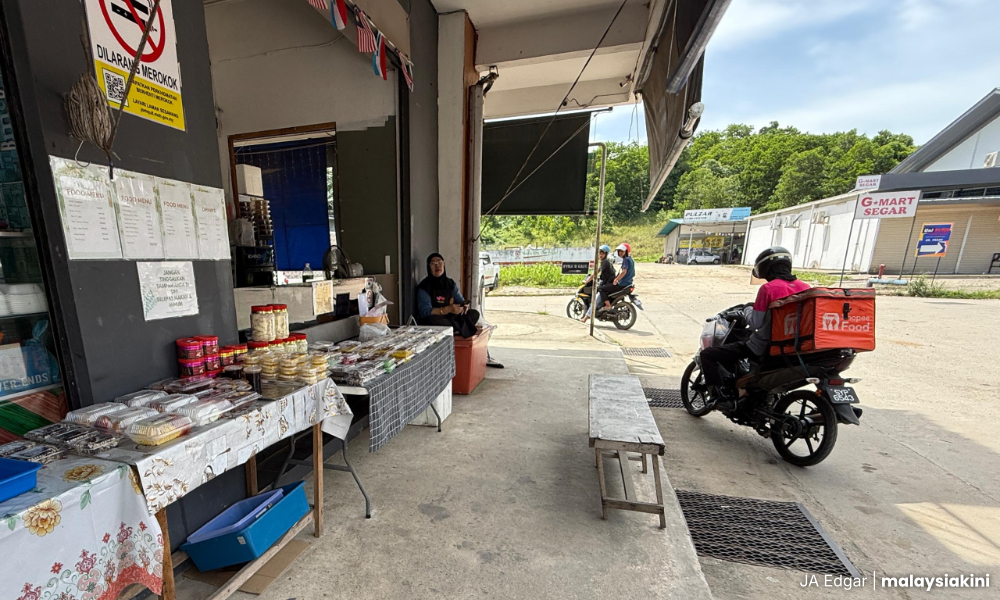
“People like us, who truly need it, should be the ones to receive it. But sometimes those who already have a house get another. It feels unfair,” she claimed.
She believes many successful recipients in her area are police, teachers or hospital staff, a pattern several other residents say they have also observed.
The state lists eligibility criteria based on income and household needs, but residents interviewed feel the system disadvantages them.
Junaidi Apdhal, 32, a Brunei Sungai worker, said he was rejected despite being listed under e-Kasih.
“When I applied, everything was in order. But I was rejected because I don’t have children.
“Meanwhile, government officers seem to get units easily. We don’t ask for much, just proper roads and a chance to start life with some stability,” he said.
Caught between duty and decline
For many in Lamag, the condition of the roads remains a major obstacle. Heavy rain often makes it difficult even to reach the nearest town.
Lamag has long been associated with veteran Umno figure Bung Moktar Radin, who is defending the state seat for a second term, but has represented Kinabatangan in Parliament since 1999.

But the constituency is overwhelmingly young: more than half its voters are under 40. Many work in low-wage jobs while supporting large families.
Salleh Ramlan, 20, earns RM1,700 a month in a retail shop and has already become his family’s main breadwinner. His father, formerly a tour-bus driver, lost his job during the pandemic and is now almost blind due to diabetes.
His mother is a housewife, and five younger siblings are still in school.
“Some of my friends left to study or work elsewhere. Maybe my time will come, but for now, I have this responsibility,” he said.
Living on the edge
Further downriver in Sukau, far from the main junctions and better-connected settlements, many residents said they can only hope their circumstances will eventually change.
Politically, they know they are outnumbered.
However they vote, they remain a small cluster of families scattered along remote riverbanks, overshadowed by the much larger communities upstream.
Daily life depends on the river and the fragile machinery that powers their homes.
In Kampung Dagat, Radhima Kasran monitors orangutans and maintains the village’s solar system. Twenty homes rely entirely on solar power for lighting, television and phone charging.
A new internet tower was recently built, but Radhima says it frequently goes offline because monkeys climb the mast and chew through the cables.
Rising costs and thin incomes shape decisions along the river.
Haslina Bidasan, who leads a women’s economic group, said fisherfolk must borrow fuel at high cost from middlepersons, then sell their catch back at reduced prices.
“By the time the fish reach Kota Kinabalu, the price has tripled,” she said.
Her neighbour, Mariana Ida Marat, described a community that relies more on one another than on public services.
“If someone is sick, we help each other without payment. We’re all family here,” she said.
Despite having more than 16,500 registered voters, with over 54 percent under 40, the far-flung river communities of Sukau remain politically marginal, with numbers close to 2,000, too small to influence decisions, shaped further upstream.
Abandoned promise of transformation
In Kuamut, held by incumbent Masiung Banah, residents recalled being told that a proposed cement plant in Kampung Kawayoi Pinangah would bring jobs, roads and electricity.

The project, introduced as a private investment several years ago, has since stalled. The investor reportedly withdrew after the company was found to be in weak financial condition.
In the state assembly, Bung questioned the project’s feasibility. Locals said they were unsurprised. Promises of large developments that never materialise, they argue, are a familiar pattern in districts like theirs.
Crossing from Kinabatangan into the wider Lahad Datu area, the conditions change a little.
In the state constituencies of Tungku, Segama, Silam and Kunak, young voters again make up the majority.
Yet road conditions remain precarious, especially along the Bukit Garam-Lahad Datu stretch, which regularly floods and isolates entire villages.
Plantation trucks carrying palm oil worth billions move daily to the Palm Oil Industrial Cluster, while nearby communities struggle with water access, inconsistent electricity, and long journeys to clinics.
Residents recounted similar difficulties in emergencies. In Pitas Laut, a 42-year-old man died after falling severely ill. His family had planned to take him by boat to Sandakan, but he collapsed before they could begin the journey.
As in Kinabatangan, villagers here also said housing assistance frequently goes to public-sector employees rather than poorer families.
Nooralinah Bakar, a masseuse in Lahad Datu town, said the district may appear busy, but the poorest residents often feel overlooked.
“I have two children and a husband with documentation problems. I’ve applied for Rumah SMJ for years, but I was always rejected.
“Housing seems to go to public servants, not people who truly need it. I still stay with my elderly mother,” she said.
/file/publisher-c1a3f893382d2b2f8a9aa22a654d9c97/2020/09/597c34182eb5117b4197a53ca074e57c.jpg)
/file/publisher-c1a3f893382d2b2f8a9aa22a654d9c97/2025/10/b28a548587bb6d7b0b3eb674b138b555.jpg)
/file/publisher-c1a3f893382d2b2f8a9aa22a654d9c97/2020/09/0a0bbfe986f7295bcc811e63472c819b.jpg)
/file/publisher-c1a3f893382d2b2f8a9aa22a654d9c97/2024/05/8fd3587862da174453cd906c72d2c0ba.jpg)
/file/publisher-c1a3f893382d2b2f8a9aa22a654d9c97/2020/09/ce36450f341c86ff318ba5c58b84b432.jpg)


Are you sure you want to delete this comment?
This action cannot be undone.