




First Indian woman rep bemoans racial politics
These days Ganga Nayar, the first Indian woman to be elected to a legislature in Malaysia, spends her time mostly with her brood of grandchildren who visit her often at her home in Seputeh in Kuala Lumpur. She has nine from eight children.
These days Ganga Nayar, the first Indian woman to be elected to a legislature in Malaysia, spends her time mostly with her brood of grandchildren who visit her often at her home in Seputeh in Kuala Lumpur. She has nine from eight children.
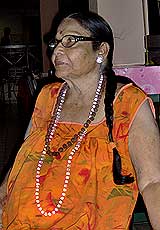 The 84-year-old Ganga was elected to the Serendah state seat in Selangor in the 1969 general election on a Parti Gerakan Rakyat ticket. That year the ruling Alliance coalition comprising Umno, MCA and MIC were deadlocked 13-13 with opposition parties - DAP and Gerakan - in the Selangor state assembly.
Immediately after the election, Ganga was the target of overtures from Umno to cross over but she declined though a Gerakan colleague did so, tilting the balance in favour of the Alliance which then went on to rule Selangor state under Menteri Besar Harun Idris’s mantle.
Ganga’s triumph at Serendah - a town about 50km north of Kuala Lumpur - was at the expense of MCA’s Lim Tze Hou who going into the election was regarded as unbeatable. Thus her upset victory thrust her into the limelight as a rising Malaysian woman politician among a greatly strengthened opposition.
Speaking to Malaysiakini in the immediate prelude to the 12th general election to be held on Saturday, Ganga said she felt sad that the multi-racialism of the Gerakan has gone out of fashion.
“Those days the Gerakan was the party of the future that drew its membership from all races,” she said.
“Now it has become another version of the MCA and that I find that a sorry end to the hopes the party raised when it was first formed,” she added.
Ganga became active in politics in the late 1950s when she joined the Socialist Front, a left-wing party that controlled municipal councils in Penang and Malacca, besides being represented in Parliament by leaders such as Ahmad Boestamam, Lim Kean Siew and V David.
In the early 1960s, the Socialist Front bifurcated into two wings: Parti Sosialist Rakyat Malaysia, catering to the Malay peasants and fishermen in rural areas, and the Labour Party, appealing to the largely Chinese working-class in urban centres.
The front ranks of both parties were decimated by ISA detentions that occurred during Indonesia’s Konfrontasi (Confrontation) campaign launched by Sukarno in 1963.
BN’s machinery too strong
Seeing no future in the party, some of the Labour Party’s leading lights, such as Dr Tan Chee Koon and V David, decided to join Gerakan when it was formed by a slew of intellectuals, academicians and professionals led by Syed Hussein Alatas and Dr Lim Chong Eu.
“I too was persuaded by Chee Koon and David to join Gerakan to which I was attracted because of its multi-racialism,” said Ganga. “Those were exciting times,” she recalled.
Ganga said she expected the Barisan Nasional to retain power but with a reduced majority in Parliament. She declined to be drawn on whether a reduced majority would entail loss of BN’s two-thirds’ dominance.
“The BN’s machinery is too strong and it dominates the media. It will be very difficult to beat them.”
On the way Indian Malaysians would vote, Ganga said from what she reads in the New Straits Times , Star and Malaysia Nanban , it does not seem that the BN has substantially lost the Indian vote, hitherto a sure thing for the ruling coalition.
“But I sense Indians are unhappy but I think discontent is not just confined to them,” she concluded.


Report this comment
Are you sure you want to delete this comment?
This action cannot be undone.