




Questions for MCA and its president
analysis It is said that a politician will do anything to keep his job - even become a patriot.
But MCA president Ong Ka Ting has refashioned this cynical statement. It is not patriotism but political survival that keeps him in the post.
A top editor-cum-commentator of a MCA-owned newspaper describes the scenario in adoring terms, as though it is a unique accomplishment in that the president and his deputy Chan Kong Choy both do not hold a portfolio in the current cabinet.
analysis It is said that a politician will do anything to keep his job - even become a patriot.
But MCA president Ong Ka Ting has refashioned this cynical statement. It is not patriotism but political survival that keeps him in the post.
A top editor-cum-commentator of a MCA-owned newspaper describes the scenario in adoring terms, as though it is a unique accomplishment in that the president and his deputy Chan Kong Choy both do not hold a portfolio in the current cabinet.
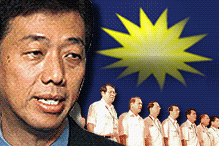 Will Ka Ting’s hasty decision not to accept a ministerial post cause a backlash within the ranks during the upcoming party elections?
To many observers, Ka Ting’s absence in cabinet means more than the breaking of a traditional link.
Was it a wise decision to opt out of the cabinet when he remains party president? Was it a correct and ethical approach to keep his presidency, even while justifying collective responsibility and accountability for the party’s losses in the 12th general election?
Wouldn’t it be more appropriate for him to step down as MCA president, thereby walking his own talk on a “healthy political culture”?
If not, is he capable in introducing effective reform in MCA in view of the changing political landscape when the electorate has revealed a revolutionary mindset? The party is in danger of being ‘marginalised’ amidst a definite push for societal change toward true multi-racialism.
A MCA life-member, who joined in 1979, said the party needs a dynamic leadership comprising charismatic leaders from a younger echelon.
But in politics, one can never be sure that a good candidate will make a good president.
“He (a political leader) serves his party best who serves his country best,” former US president Rutherford B Hayes once said.
 When a political party and its candidates have been overwhelming rejected by voters, the president’s role, capability and leadership can be legitimately questioned.
Tony Khoo, managing director of a retail company, observes: “The MCA has a membership of some 1.3 million. When the popular vote hovers around 600,000 for example, it means that less than half (after deducting non-Chinese voters) of the party’s own members voted for its candidates.
“The majority voted against the party. Resignation is the only honourable way as shown by Gerakan acting head Dr Koh Tsu Koon, who took accountability for his party’s electoral losses.”
Irritated voters
Critics feel that Ka Ting has been manipulative in fighting back. A silent central committee has not discussed the possibility of his resignation.
After a recent briefing for rank-and-file members, they were directed not to ask questions about the party’s poor performance in the polls.
A party insider who attended the briefing quoted Russian revolutionary leader Leon Trotsky who said: ‘In inner-party politics, these methods lead to this: The party organisation substitutes itself for the party, the central committee substitutes itself for the organisation, and finally, a dictator substitutes himself for the central committee’.
The insider said this scenario “sounds like MCA, look like MCA but is definitely not the MCA”, parodying lawyer VK Lingam’s testimony before the royal commission of inquiry.
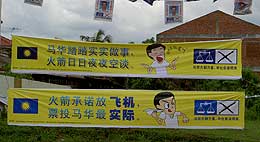 As the party leadership awaits electoral feedback from the respective states, pours over polls figures and mulls over its massive losses, political observers are generous with analysis and perceptions.
“During the campaign, some MCA candidates used the ‘wedge’ politics of fear and hate against opposition candidates. Now the party is riddled with such toxins,” said a researcher.
A blogger wrote: “Ka Ting was quoted as saying that the political, economic and social status of the Chinese has improved since independence. This has caused much irritation among many voters. They want a prospectus of the future, a political vision, and not reminders of the past.
“More importantly, the MCA is perpetually in self-denial mode, it has been treating voters as though they had amnesia after the 2004 polls - nothing improved in the country.”
Scots physician John Arbuthnot once warned: “All political parties die at last swallowing their own lies.”
The general election has brought home some key lessons to Malaysians:
• Firstly, the ballot is more powerful than the bullet.
• Secondly, politicians keep their balance by doing the opposite of what they say.
• Thirdly, voters have learnt that ‘a society of sheep must in time begets a government of wolves’.


