




Suhakam plan for new panel fails to impress
The Human Rights Commission (Suhakam) decision to set up a committee to address civil and political rights issues has gone down like a lead balloon with one NGO.
The Human Rights Commission (Suhakam) decision to set up a committee to address civil and political rights issues has gone down like a lead balloon with one NGO.
Amnesty International (AI) Malaysia, in an immediate reaction, showed little enthusiasm for the idea.
 “Yes, it sounds good. But that is as far as it can go - sounds good,” said AIM coordinator K Shan, when contacted.
The plan, as reported in English-language dailies today, is for the committee to address civil and political rights over the next two years.
To be established and chaired by Commissioner Michael Yeoh, it will hold dialogues with political parties, parliamentarians, civil society organisations and the public.
New political realities after the 12th general election held on March 8 have re-emphasised the importance of human rights, according to the New Straits Times report based on a Suhakam statement.
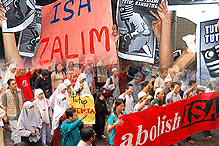 Shan said Suhakam can set up as many committees as it wants and cover as many rights issues as possible but, as long as it has no authority to act on abuses, all this comes to nothing.
He placed the commission in the “rights-negligent equation” since it has been slow to lobby for enforcement powers on its on behalf, in order to act against violations of human rights.
“People are getting tired of Suhakam’s inability to act on complaints of human rights abuses. This announcement appears to be additional ‘window dressing’,” he added.
‘Reform frenzy?’
He also expressed doubt as to whether there will be room for consultation, given that all 16 commissioners have had their term of office renewed for another two years.
“Did they consult with civil society groups or the public (in the past)?” asked Shan.
 He added that Suhakam seems to be caught up in the “reform frenzy” ostensibly sweeping into government institutions like the Anti-Corruption Agency. Judicial appointments are also set to go through an advisory panel for greater transparency.
Civil society groups have repeatedly called for the Suhakam appointment process to be made more democratic, to ensure that those with a strong human rights track-record serve on the commission.
Malaysia’s record on human rights remains a lop-sided one, with civil and political liberties being severely constrained by a slew of oppressive laws and administrative policies.
While Suhakam has offered recommendations to improve the environment, the government has thus far given scant attention to its proposals.
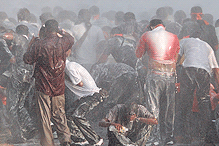 Accumulated public angst over these and other neglected issues spilt over at two street protests late last year. One was called by
electoral reform group
Coalition For Free and Fair Elections, while the Hindu Rights Action Force saw strong support for its claims of “discrimination and marginalisation” of the
Indian community
since colonial days.
Accumulated public angst over these and other neglected issues spilt over at two street protests late last year. One was called by
electoral reform group
Coalition For Free and Fair Elections, while the Hindu Rights Action Force saw strong support for its claims of “discrimination and marginalisation” of the
Indian community
since colonial days.
Voters had their say when the general election came around. They denied the Barisan Nasional its traditional two-thirds majority in Parliament and handed over five states to the opposition Pakatan Rakyat coalition.


Are you sure you want to delete this comment?
This action cannot be undone.