




Political agenda behind UiTM 'uprising'?
First it was the continuation of a RM100 million modern pig abattoir initiated by the previous state government, followed by several smaller incidents and the latest being the gathering of about 3,000 Universiti Teknologi Mara (UiTM) students on Tuesday in a public display of ‘contrived outrage’ against the Selangor Menteri Besar, Abdul Khalid Ibrahim.
comment First it was the continuation of a RM100 million modern pig abattoir initiated by the previous state government, followed by several smaller incidents and the latest being the gathering of about 3,000 Universiti Teknologi Mara (UiTM) students on Tuesday in a public display of ‘contrived outrage’ against the Selangor Menteri Besar, Abdul Khalid Ibrahim.
Khalid, it appears, is being watched like a hawk by evidently sore losers seeking to capitalise on any excuse to embroil him in one public controversy after another to stigmatise his administration.
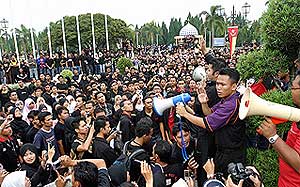 It would be hard to ignore that a political agenda is at work here to destabilise the Pakatan Rakyat government in Selangor. There are shades of the same pattern of public bad-mouthing initiated by former Prime Minister Mahathir Mohamad against the Sabah state government from 1985 to 1994 when it was under the Joseph Pairin Kitingan administration.
Khalid’s latest ‘sin’, unpardonable obviously, was his call last Sunday for ten percent of the seats at UiTM to be filled by non-bumiputera students and foreigners, "in order to provide a more competitive environment for the students and get them used to being with others".
This was enough to get UiTM vice chancellor, Prof Dr Ibrahim Abu Shah, and his students all riled up. In a TV interview, the vice-chancellor warned unnamed parties not to look for trouble and pledged to defend the university as "the last Malay bastion".
Dr Ibrahim estimates that UiTM students comprise only 35 percent of the university student population in the country, and "this shows that Malays are still far behind other students".
Veiled threats
Government universities reserve 55 percent of their seats for bumiputera students. In recent years, the figure has even touched beyond 60 percent, according to complaints by MIC and other non-Malay bodies and NGOs.
President of the Federation of National Writers Associations (Gapena), Professor Emeritus Dr Ismail Hussein labeled Khalid’s suggestion as "being in tune with Pakatan Rakyat’s attitude of ignoring Malay problems".
Malaysian Youth Council president, Shamsul Anuar Nasarah, regarded Khalid’s suggestion as "not in the Malay interest", while president of the Federation of Peninsular Malay Students (GPMS), Reezal Merican Naina Merican regarded the MB’s action as "betraying the Malay trust".
"UiTM is one of the special privileges of the Malays under Article 153 of the Federal Constitution and that’s why the chancellor is the King himself," Dr Ibrahim was quoted as saying, while denying that he had encouraged the demonstration in any way.
"If they cannot mix around with others – as implied by Khalid – how come they do well in their careers?"
He also claimed that UiTM graduates were the first choice of employers in the private sector, both in the country and abroad, and that many of them have emerged as corporate leaders. Dr Ibrahim vowed to seek an audience with the King as soon as possible to brief the ruler on the latest development at UiTM.
"The King should advise him (Dr Ibrahim) not to make a mountain out of a molehill," said one ex-UiTM graduate who has been unemployed for 18 months like many of his varsity mates and is helping out at his uncle’s restaurant. "In cases like these, it’s better to engage with all the parties concerned. That is not happening."
In addition, Dr Ibrahim has warned that the estimated 119,000 UiTM students throughout the country and its graduate population of 350,000 are upset with Khalid for his alleged interference in the internal affairs of the university, "especially when the bangsa asing (foreigners, in this case, non-Malays) themselves did not ask to be admitted to the Malay university".
What happened to civil debate?
In short, there was no telling what the UiTM population would do if Khalid’s suggestions were implemented. Many see this as a thinly-veiled threat blowing the issue out of all proportion.
Not to be outdone, UiTM undergraduates have warned that they would proceed with further action following their submission of a memorandum of protest to the MB’s office.
"The purpose of the memorandum is to demand that he (Khalid) withdraw his statement because it violates the principles on which UiTM has been founded as an institute of higher learning to turn out bumiputera professionals," explained chairman of the Student Representative Council, Luqmannulhakim Mohd Idris, after handing over the memorandum.
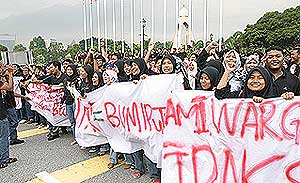 The students at the gathering shouted themselves hoarse as they held aloft various slogans hastily scribbled on flimsy placards to express their feelings on the matter:
Selamatkan
UiTM
(Save UiTM); UiTM
untuk bumiputera
(UiTM for bumiputeras);
Hidup
UiTM (Long Live UiTM);
Kami pertahankan hak bumiputera
(We are defending bumiputera rights);
Kami bantah buka
UiTM
kepada bukan bumiputera
(We oppose opening UiTM to non-bumiputera); and UiTM
hak bumiputera
(UiTM belongs to bumiputera), among others.
The students at the gathering shouted themselves hoarse as they held aloft various slogans hastily scribbled on flimsy placards to express their feelings on the matter:
Selamatkan
UiTM
(Save UiTM); UiTM
untuk bumiputera
(UiTM for bumiputeras);
Hidup
UiTM (Long Live UiTM);
Kami pertahankan hak bumiputera
(We are defending bumiputera rights);
Kami bantah buka
UiTM
kepada bukan bumiputera
(We oppose opening UiTM to non-bumiputera); and UiTM
hak bumiputera
(UiTM belongs to bumiputera), among others.
The students plan to send follow-up memorandums to the King and the prime minister. Luqmannulhakim said, "We want the meddling in UiTM to stop. This is not healthy. Although we are all bumiputera, we have been educated to respect the religions, customs and beliefs of others.
"It’s not true that we cannot interact with other communities just because UiTM has only bumiputera students." He thinks the question of admitting foreign students should be considered as a possibility but in the remote future.
"It seems that no one can make any suggestions these days without inviting public demonstrations at the drop of a hat," noted a retired teacher. "No one thinks of engaging in civilised debate anymore. Obviously, these students are being educated beyond their intelligence. Why the emotional response?"
The fact that Khalid was merely voicing conditional support for the original proposal by Dr Halimah Ali, chairman of the Permanent Committee on Education, Higher Studies and Development of Human Capital, was conveniently ignored.
Dr Halimah had ventured that UiTM be opened to other communities if it wanted to create an atmosphere of healthy competition. Her comments, which were widely reported in the mainstream media, did not draw even a peep from anyone.
Khalid’s caveat on the suggestion that it needs to be studied from all aspects to ensure that it did not conflict with the policy behind the formation of UiTM as it pursued the goal of producing a generation of educated bumiputera, was conveniently forgotten.
Tepid response from non-bumiputera
Already, MRSMs (Maktab Rendah Sekolah Menengah) throughout the country, except in Sabah and Sarawak, allow ten percent of their seats to be filled by non-bumiputera students. This is a figure that the MRSMs have difficulty in filling.
Now, the Ministry of Education allows some of the MRSMs to have more than ten percent, in fact up to 30 percent and more, to encourage non-bumiputera students to sign up.
The 10 per cent intake was not motivated by sudden feelings of compassion and altruism on the part of the authorities but to ensure that bumiputera students have a more competitive environment to work in. The question is whether the MRSMs, being feeder colleges for UiTM, are also channeling their non-bumiputera students to the university.
UiTM, records show, began as Dewan Latihan Lembaga Kemajuan Perusahan dan Kampung, the British-initiated Rural and Industrial Development Authority’s training centre in November 1956 in Petaling Jaya, offering preparatory courses for rural students in the English stream.
In June 1965, it was placed under the Majlis Amanah Rakyat (Mara) and its name changed to Maktab Mara. In 1967, it became Institut Tekologi Mara (ITM). Its status was raised to university level in 1996 and the name changed to UiTM in 1999.
Initially, the federal government resisted awarding university status to UiTM, pointing out that a university must be open to all. This seems to have been overcome despite not complying with the worldwide definition of what constitutes a university. UiTM must be the only university in the world which is not open to all and thereby not deserving of the universal status.
Historian, Professor Emiritus Khoo Kay Kim has the last word. "Khalid’s suggestion should not be an issue," he said.
"It had been raised and tried to be implemented before. It was not well received by non-bumiputeras as they would not feel comfortable in a university dominated by one race."
JOE FERNANDEZ is an educationist and former newspaper editor and ex-civil servant who feels compelled to put pen to paper when something doesn’t quite jell with his weltanschauung (worldview).


Are you sure you want to delete this comment?
This action cannot be undone.