




UUCA amendments half baked
While certain quarters say that the amendments to the Universities and University Colleges Act 1971 (UUCA) are refreshing and will give more freedom to students, not everyone feel the same way.
While certain quarters say that the amendments to the Universities and University Colleges Act 1971 (UUCA) are refreshing and will give more freedom to students, not everyone feel the same way.
Interestingly, those most vocal against the act come from the university academics and students.
In a seminar held at Universiti Malaya today, academics from Pergerakan Tenaga Akademik Malaysia (Gerak), Persatuan Kakitangan Akademik UM (PKAUM), Persatuan Kakitangan Akademik dan Pertadbiran USM (PKAPUSM) and International Islamic University Malaysia Academics and Staff Association (IIUMASA) described the amendments as "insufficient" and give "too much power to the minister".
And if they had their way, the small group of scholars and several students would rather do away with the act itself.
Nevertheless, the professors agreed that would be impossible for now and will instead redress some of their concerns about the amendments.
Stifles growth of students
First vice-chancellor Universiti Malaysia Sarawak (Unimas) Dr Mohamad Zawawi Ismail, who spoke on the changing roles of universities, said that UUCA has stifled the growth of students and academic thought.
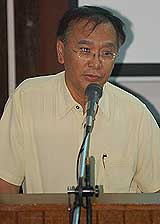 Recalling the times when it was first introduced by then Education Minister Dr Mahathir Mohamad, Zawawi (
left
) said the manifestations of the law had culminated in policies which are more detrimental than the act.
Recalling the times when it was first introduced by then Education Minister Dr Mahathir Mohamad, Zawawi (
left
) said the manifestations of the law had culminated in policies which are more detrimental than the act.
Student movements used to be free and were able to articulate their views properly, the Unimas head said, adding that university education is not just about being a bookworm but campus life should also be about character development and leadership training.
"The UUCA has stifled many academics and stunted the growth of Malaysian students unlike those who study overseas," said Zawawi.
"So much so, you find that big corporations like CIMB Bank now prefer to hire overseas graduates instead of local ones," he lamented.
According to Zawawi, there are four criterias for improving universities – right strategy and intent, defining its role in society, strong leadership (ie vice-chancellors and the board) and student leadership.
No freedom of expression
One of the forum panelists, law professor Azmi Sharom (PKAUM), said the amendments were not enough.
He also described the amendment pertaining to the appointment of vice-chancellors as vague.
"Although the minister is to be advised by a search committee during the appointment of the vice-chancellors (Article 3 (4a), the amendment does not state that he is bound take the advice.
"Furthermore, there also seems to be a lack of information on how the search committee should work," said Azmi.
Another bone of contention is the definition of students, which in the proposed amendments will encompass all types of students regardless of whether they are post graduates or post doctoral students.
When read with Article 15, which prohibits students from joining political parties, it would deter many working adults from joining the university, explained Azmi.
"It would also be near impossible to force all my post graduate students to surrender their party membership cards before they enter the campus."
This, he added, seems to contradict the freedom of association under the Federal Constitution.
Some of the amendments seem like a half-hearted attempt to open up the universities and that will not help anyone, said Azmi.
Another "unfair" amendment to UUCA is the proposal to suspend students when they are charged for a crime.
One student asked if that was fair as the student should be innocent until proven guilty.
"Going by this amendment, the student will be punished in the university before he is even convicted," the student argued.
The seminar on UUCA amendments and the shifting role of universities also had Hashim Hussin Yaacob (PKAPUSM), Petaling Jaya MP Tony Pua (DAP) and Malaysiakini Bahasa editor Fathi Aris Omar. The session was moderated by Faridah Manaf (IIUMASA).


