




Will new MCA boss nominate Chua as minister?
The future destiny of MCA will not be determined by 2,400 party’s central delegates but 11 million eligible Malaysian voters in the next general election.
The future destiny of MCA will not be determined by 2,400 party’s central delegates but 11 million eligible Malaysian voters in the next general election.
Indeed, the ‘308 political tsunami’ leaves newly-elected president Ong Tee Keat only one choice if he was to save the party - to embark in reforms and restore MCA relevance to the community it claims to represent for more than half of the century.
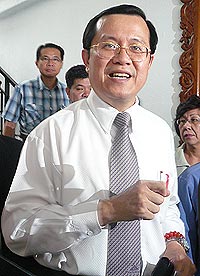 In the March 8 general elections, the party faced the grim reality of only 35 percent of Chinese Malaysian voters backing the ruling Barisan Nasional, which indirectly showed an outright rejection of MCA, having won only 15 out of 40 parliamentary seats and 31 out of 90 state seats.
Will Ong, who inherited the mantle of the party leadership on Oct 18, be able to pass this crucial test in bringing change to his party?
Should he continue give in to old thinking, ignore negative practices and the ‘political warlordism’ that the party has been poisoned for so long?
More importantly, will Ong be able to salvage the ‘sinking ship’ by introducing drastic changes to MCA despite resistance from certain quarters within his party?
When the list of party office bearers was publicly announced last week, political pundits were caught by surprise. They focused on the reaction of his estranged deputy, Chua Soi Lek, instead of the direction set by Ong with his political appointments.
Making matters worse, Ong's cursory and nonchalant responses also added fuel to open speculations of a hidden agenda to weaken the influence and political support of the party’s No 2.
A frenzy of verbal jousting
Certain quarters viewed the exclusion of Chua from the state chiefs line-up, especially in Johor, as a move to curb his political rise while his supporters whip up dissatisfaction on the ground to justify their next move.
Generous criticisms and snide remarks were circulated in short-text messages (SMS) alleging that Ong's appointments constituted the growing power of the ‘Hainanese clan’ and that the newly-minted president was protecting his own vested interest.
The past week also saw a frenzy of verbal jousting between the MCA president and his deputy, Chua.
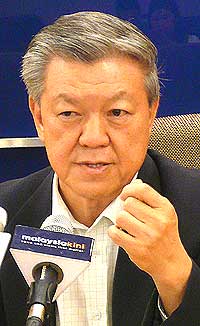 When Chua apologised to the party for not able to play a fuller role as he was given "limited space" as a bureau chief responsible for monitoring government policies, Ong brushed aside Chua’s grouses, warning his deputy not to “twist and turn” his decision in making the appointments.
Ironically, Chua was also previously appointed by former president, Ong Ka Ting, to the same bureau, called the ‘government affairs bureau’. It was claimed that Chua did not called a single meeting of the bureau during his two-year term.
On the appointment of office-bearers, certain quarters raised a number of controversial questions: Was it a deliberate move by Ong to marginalise his deputy in order to consolidate his own turf?
Was it an abuse of personal power when the president (using his presidential prerogative powers) appointed himself as Johor state chief despite being sanctioned in the party constitution?
Conversely, several counter-questions were also posed: Why would a leader who had promised 'direct elections" of state chairmanship and the president post suddenly become the target of criticism and accused of abusing powers?
Should Ong, who is championing new values and exhibited bold courage to institute changes, continue to support leaders lacking integrity or with tainted background and nominate them to high-level posts in government?
Can he engineer the rebirth of MCA?
Ong agreed that the changing political environment must necessarily entail a changing of values. His party appointment has to a large extend reflect a younger generation of leaders determined to tap a new kind of politics and are receptive to injecting fresh ideas into the party's ideology and policies
"Ideally, most members agree that the party's rank-and-file must comprise leaders of all ages - a harmonious mix of the ‘older or experienced’ and younger generation of leaders. But very often it is the older generation of leaders who are resisting changes," a Youth state leader said.
"Embroiling in the dispute on party appointments and the squabble on whether Chua should or should not be nominated to a government post will not move the party forward."
A party veteran provocatively said, "The future of one man must give way to the destiny of a community or nation. Obsession with one tree (leader) could endanger a forest (party)."
Seen in this perspective, the question arises: Will Ong's wisdom prompt him to nominate Chua for a government post?
The answer is simply ‘no’. The truth will eventually be told - Chua's future role in government couldn't be more remote in Ong’s mind.
 Time is running out as the next general election will be held within the next three years.
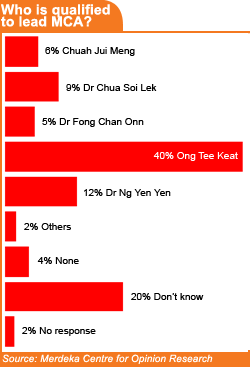
Merdeka Centre for Opinion Research's recent survey findings, which revealed that 76 percent of 1,002 respondents having a positive impression of Ong and 40 percent supported him as party president, was an indication that he must fulfil his election pledges.
Ong's promises to usher in new values within the party can only be achieved if he is politically able to engineer an emergence of a new ‘MCA’, or in short, a process of ‘rebirth’ for the party.
Outdated mindsets have failed the party
The ‘old MCA’ is dead and buried in the ‘308 political tsunami’, said Tony Khoo, a supporter of Ong's reformation efforts. "The president should be the agent of change," he said.
Khoo added, "Indeed, history is full of examples of great leaders being agents of change. Leaders of Peoples' Action Party (Singapore), Kuomintang of Taiwan, Communist Party of China and the newly-elected Barack Obama of America have shown the path to profound changes in their nations.”
Others concurred.
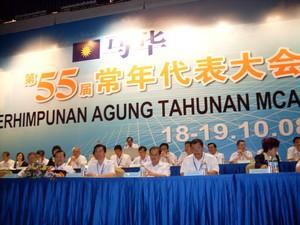 "The old MCA leaders with outdated mindsets have failed the party and the Chinese community. Those clinging onto power must step down, changes should be made to the party's electoral system and even the party constitution must also be amended to reflect the changing environment," said retiree TS Hew, 62.
"The process of change is a fact of life. With the coming of younger voters into the mainstream, one of the contributing factors to the survival of MCA as a political party must ensure its leadership comprises of younger leaders capable of new ideas and thinking out of the box," said chartered accountant Annabelle Wong.
"Many of us who are not party members are sick and tired of hearing the same game of old MCA leaders fighting for power and positions. It's time for the president to change its leaders," she said in response to recent tiff between Ong and Chua.
The disgust expressed by Wong will be a thing of the past, provided of course Ong's determination and political will to change the party continue to stay on course.
"Change will not come if we wait for some other person or some other time. We are the ones we've been waiting for. We are the change that we seek," so said Obama in his victory speech.
In the months ahead, Ong too will face his own leadership test.


Are you sure you want to delete this comment?
This action cannot be undone.