




Chua: Why skilled M'sians don't come home
The government has failed dismally in attracting skilled Malaysians to return home from abroad to serve the country, said MCA deputy president Dr Chua Soi Lek.
The government has failed dismally in attracting skilled Malaysians to return home from abroad to serve the country, said MCA deputy president Dr Chua Soi Lek.
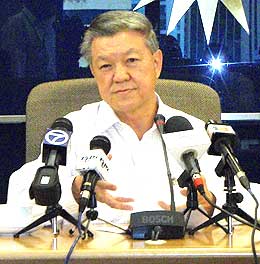 “As at the beginning of last year, there were 985 applications, of which 485 were approved. Of those approved, only 330 Malaysians have returned,” Chua told a press conference yesterday.
“On average each year, only about 50 Malaysians have returned to work here.”
Chua, who heads the MCA Government Policy Monitoring Bureau, blamed the failure of the programme - launched in 2001 - on various factors including implementation weaknesses and red tape.
“The 2009 budget allocated RM47.7 billion or about 23 percent of the total for education and training. In 2008, the government sponsored 17,000 students in universities abroad,” he said.
Despite this, the government has failed in stemming the brain-drain, resulting in many Malaysians preferring to live and work abroad.
“There is no systematic human capital retention programme in terms of job placement and career development. Very often these students, including post-graduate students, feel frustrated and disappointed with their job-postings,” Chua said.
“Frustration and disappointment are the driving factors of the brain-drain.”
 As early as 2005, the human resources minister had reportedly said the programme had been unable to entice professionals to return.
Only 665 applications had been received, of which 279 were approved - comprising 94 in the medical sector, 59 in Information Technology, 50 in accountancy and finance, and 12 in science and technology.
Many applications were rejected because these did not meet the criteria or were from fresh graduates.
‘Introduce holistic package’
Chua proposed that the government should re-examine related policies and programmes.
“There are two main programmes targeting the repatriation of human capital. The first is to encourage citizens with expertise residing overseas to return to Malaysia.
The other, involving the Ministry of Science, Technology and Innovation, is the ‘brain gain’ programme to increase the number of researchers, scientists and engineers (RSE).
The plan is to achieve a ratio of 50 RSE:10,000 labour force in priority areas by 2010. The programme, launched in December 2006, “suffers similar weaknesses”.
Chua said the government has not addressed the reasons why these offers have not been taken up.
“If their families’ needs are not looked after, the workers will not return,” he said.
Bureaucratic procedures and the time taken for approval of applications are another setback.
“The process can take more than six months (to apply for tax exemption and permanent residence for non-Malaysian spouses and children).
“Malaysian scientists working in developed countries expected salaries five times higher than that paid locally. Also, the lack of sophisticated scientific facilities or state-of-the-art equipment, laboratories and facilities are disincentives.”
He suggested a holistic and a more attractive package that includes opportunities for career advancement and job satisfaction.
“An open economy with investor- and business-friendly policies is more likely to attract them back. Establish world class research centres and ensure our universities are free from overt controls,” he added.
“The package of incentives must also encompass assistance for job searches, business start-ups and family relocation.”


Are you sure you want to delete this comment?
This action cannot be undone.