




Rights commission to document influx of illegals
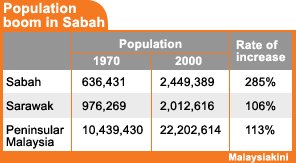
Human Rights Commission vice-chairperson Simon Sipaun wants those with documentary evidence of the extraordinary rise in the state’s population in recent decades to come forward and lodge reports with Suhakam in Kota Kinabalu.
Human Rights Commission vice-chairperson Simon Sipaun wants those with documentary evidence of the extraordinary rise in the state’s population in recent decades to come forward and lodge reports with Suhakam in Kota Kinabalu.
"Such documentation, in the absence of a royal commission, is the next best way to get a clear picture of the growing illegal population in Sabah," said Sipaun.
"The public update yesterday from the federal government on the number of unrecognised refugees in the state, although disputable, will add to our body of knowledge on the problem."
He was commenting on a disclosure by the Special Task Force in the Prime Minister’s Department that Sabah currently hosts 93,000 foreigners – 81,000 Filipinos and 12,000 Indonesians – who hold IMM13 documents issued by the Immigration Department.
 The task force, under director Misri Barham, has been under pressure for months to provide an update on the issue following the commencement of a crackdown against the several hundred thousand illegals in the state.
So far, added Sipaun ( right ), his office in Kota Kinabalu has gathered various documents including academic studies on the illegal influx in Sabah. These include "When States Prefer Non-Citizens Over Citizens: Conflict Over illegal Immigration into Malaysia" by Kamal Sadiq and "Stateless in Sabah" by Vanitha Nadaraj.
Sipaun pointed out that there is a common thread running through these documents and two earlier books by MD Mutalib, "Projek IC" – a reference to genuine identity cards issued through the back door to illegals during the administration of Dr Mahathir Mohamad and "Lelaki Malaysia Terakhir".
 "I have personally witnessed many events - the issuance of personal documents to illegals and illegals on the electoral roll - as described in the two books," said Sipaun, a former Sabah state secretary during the PBS administration.
"Allegations contained in the books have never been challenged by those named in the books."
Both the academic studies, made available by Sipaun, allege that illegal immigrants played an important part in the electoral process in Sabah.
Just how "visible" is the presence of illegal immigrants in Sabah?
Worried "locals" have this to say according to Sadiq: "Ours must be the only place in the world where illegals have the courage to walk about in the streets with impunity, commit crimes, use our overstretched government hospitals, steal our water, attend our schools and milk us of our resources in numerous ways."
Do illegal immigrants have more rights?
While the Nadaraj study echoes much of what Sadiq has to say, the author warned that "a social volcano is brewing in Sabah, where about 300,000 stateless people have no rights, no voice, and no avenue for redress, breeding bitterness and anger".
Even so, Nadaraj pointed out that from the 1970s until 1984, many stateless people were given Malaysian identity cards that offered privileges in exchange for votes.
 "Malaysia uses census practices and documentation to incorporate an illegal immigrant population from the Philippines," wrote Sadiq.
"Illegal immigrants play an electoral role in Sabah because of the loosely institutionalised nature of citizenship."
"So, why should a state give non-citizens preference over native citizens? Why is being native not enough? These facts are in direct contrast to what most scholars know about Malaysia: that it is a multiethnic country with successful preferential policies for its natives, the sons of the soil.
"Yet by encouraging illegal immigration, Malaysia was privileging non-citizens over citizens in certain situations."
Sadiq also observed that ironically, illegal immigrants were taking part in the electoral process (in Sabah) even as many natives continue to have no documents proving their citizenship.
According to him, "illegal immigrants were being welcomed and afforded the rights of citizens by sections of the Malaysian state over the opposition of many native citizens".
"Illegal immigration to Malaysia from the Philippines and Indonesia highlights the paradox of states actively admitting illegal immigrants."
Holders of the IMM13 have the right to reside and work in Sabah without a work permit.
Most of them work as labourers, fishermen or small-time traders at night markets.
Their children can study at Malaysian schools upon payment of an annual fee of RM120 for primary and RM240 for secondary schools.
Holders have to renew the IMM13 annually and pay a RM90 fee but they have no right to travel outside the state.
"Refugee figures in Sabah are an important barometer of the extraordinary rise in the state’s population in recent decades although the figures themselves may be in dispute. The IMM13 holders themselves are only a fraction of the illegal immigrant population in Sabah," added Sipaun.
"In fact, the authenticity of these IMM13 documents themselves can be questioned since quite a number may have been falsified. We have come across such cases before."
Sipaun also questioned Malaysia’s divergent approaches in dealing with the problem of ‘refugees’ in Sabah and Peninsular Malaysia, where an estimated 25,000 Rohingyas from Burma have been denied the IMM13 document and its attendant privileges.


Report this comment
Are you sure you want to delete this comment?
This action cannot be undone.