




Mixed reactions to stimulus plan
While outgoing Prime Minister Abdullah Ahmad Badawi assured that the government's RM60 billion stimulus package is strong enough to boost the economy for the coming years, not all are convinced.
While outgoing Prime Minister Abdullah Ahmad Badawi assured that the government's RM60 billion stimulus package is strong enough to boost the economy for the coming years, not all are convinced.
 “The second stimulus package covers all sectors... if it is executed well it will help our economy and provide our economy with enough strength and hopefully it does not bring us close to recession,” Abdullah said at a press conference after the announcement was made.
He further said that execution must involve both government and private sectors.
Parliamentarians across the political divide gave mixed reactions to the government's RM60 billion stimulus package. Below are their responses:
Muhyiddin Yassin, International and Trade Industry Minister and Pagoh BN MP
 The stimulus package includes retraining of workers and this is a positive step for the employers to hire retrenched workers.
Therefore, I would welcome the RM700 million allocation for this measure as this would be a positive help for the people who have been retrenched.
Besides that, I am grateful for the attention given to Small and Medium Industries (SMIs) as this is the most badly-affected sector in this economic situation.
I am also thankful for the billion-ringgit fund to dilute capital for the companies who do not have enough capital for their own development.
Ahmad Shabery Cheek, Information Minister and Kemaman BN MP
 For me, this is not a mini budget anymore, but a midi budget. That means, it is more than a usual budget. This is not a very small amount for a small stimulus package as we had predicted before, but this goes to show that the government is really helping the people in the wake of the economic crisis.
The people now should support the government and some quarters should stop diverting the people’s attention so that we can all face the problem together.
In this context, the amount of this second stimulus package is something extraordinary and we hope that it will stimulate the economy so that we do not end up as one of those countries whose economic growth has plunged to negative levels like Japan and Singapore.
Tony Pua, DAP National Publicity Secretary and Petaling Jaya Utara MP
 In a crisis budget there are two aspects for us to look at. One aspect is to look at short-term measures and secondly long and medium-term measures.
I see quite a few medium to long-term measures but there are none in the short-term period.
In times like this it is important for us to put money in the pockets of the people, especially for the people in need of them to spend.
I don’t see any unemployment benefits and even the conventional measure such as food stamps or coupons for the people to purchase goods.
These are the type of measures that will have an immediate impact on our crisis. We cannot wait for our measures to have its impact after 12 months.
We need measures that have an immediate impact within next month therefore that bit is particularly disappointing.
But I am happy with the long-term measures, but for the short-term measures when we are facing a crisis it is still lacking.
It is not a people-friendly budget...it is very corporate since RM25 billion out of RM60 billion goes to guarantee schemes for corporation, it is not wrong because corporations are the ones that are employing people but this type of measures are for the longer term.
We actually need to relieve the burden of the people. There can be some tiny short-term measures. For example, if one is retrenched, the retrenchment compensation bar can be raised from RM6,000 to RM10,000.
A deficit of 7.6% is acceptable
Also, we must keep in mind that some projects take time to get off the ground and when they start to make a lot of profit, the profits get tapped by shareholders and it does not filter down to the people on the ground.
The GDP growth which now ranges between -1 percent to 1 percent...I think it is a good range to work with and I think it is good to know where our baseline is so that we can move forward from there instead of being in a denial syndrome.
As for the deficit of 7.6 percent, I find it a little low compared to what they plan to spend and the type of revenues that would face a shortfall in the current year.
The main revenue shortfall is coming from the fall in oil prices from the anticipated US$125 per barrel to US$40 per barrel today. I think that would have created a short fall of RM20 billion to RM25 billion.
Under a crisis situation, a deficit of 7.6 percent is acceptable but I think it would be higher by the end of 2009...I think it will be closer to 10 percent.
A deficit of 10 percent is not really healthy as it would create problems for our currency. It would create problems for our long-term rating for bonds but in a crisis situation it is something we would have to tolerate.
I think they should adjust the structure of the stimulus package. More of it should have been available to the people through direct grants.
Khalid Ibrahim, Selangor Menteri Besar and Bandar Tun Razak PKR MP
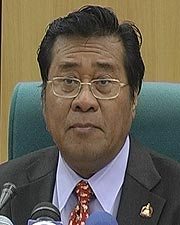 Among the projects is the clean-up of the Sungai Klang. We thought it is a very good idea in this downturn. Second would be enhancing the transportation system in the whole of Klang Valley. The third one, with the water project, we need to make sure the pipes are properly replaced so that there will be little leakage.
We’d also like to work with the federal government with regards to the redevelopment of town centres like Petaling Jaya, Klang and Kajang.
I think I have made a statement, anything below RM50 billion will not be a good start, but I think they have exceeded that. I think the question is not so much how the plan is implemented but how the contracts are given out. That is the worry we have.
Lim Guan Eng, Penang Chief Minister and DAP Bagan MP
 As I have said earlier, the amount should be more than RM30 billion, it seems that Najib has listened to us about this as he has announced a figure of RM60 billion to boost the economy within two years time.
But if we look at the economic crisis now, we can only achieve economic growth between negative one percent to positive one percent. And I’d like to stress that in a bad case scenario, if Malaysia achieves only positive one percent, it looks like recession to me.
This is because we are used to economic growth at about five percent. That is why I feel that Najib has to be more bold with the amount. Instead of RM60 billion, he should have unveiled RM100 billion with RM50 billion for each year just like we have suggested before.
If we really want to stimulate the economy, we should give the money directly to the people who needs it.
So for the next two years, the situation will worsen. And I feel that if we want to achieve our objective, not only should the plan stimulate the economy, but also help poor families so that they can have money to survive daily.
We are a bit disappointed because there is no direct help from the government to the affected people.
If we want this to be effective, we would like to know three criteria, first whether it is comprehensive, second, whether it is fair, third, whether it is democratic and I think that is the yardstick for this stimulus package.
Bernard Dompok, minister in the Prime Minister's Department
 Injecting such a fund to spur further the national economy is well and good. In fact, it is a must.
My main concern is the implementation. It is my sincere hope that the additional budget will reach the intended target promptly with minimal bureaucracy.
Every now and then, most of the complaints I received from the ground are related to slow implementation of policies and projects.
It is therefore a challenge to the delivery system to ensure that the policies and action approved by Parliament are translated into action.
Dr S Subramaniam, human resources minister and MIC secretary-general
The additional RM50 million allocated by the federal government under the second economic stimulus package or mini-budget will be utilised to rebuild another 40 Tamil schools.
 MIC had requested for the additional allocation. We are thankful to the government for approving our request.
In the first economic stimulus package, the government allocated RM50 million for Tamil schools, while another RM30 million was approved by the Finance Ministry before the March 8 general election through the efforts of the then works minister and MIC president S Samy Vellu.
In total, we now have RM130 million to be spent on rebuilding Tamil schools. The allocations would be disbursed through the Public Works Department.
The initial amount of RM50 million (under the first stimulus package) and the RM30 million has been disbursed through the PWD to rebuild more than 60 Tamil schools.
MIC will continue to upgrade and rebuild more Tamil schools in line with the party's commitment towards modernising Tamil schools.
We have identified the Tamil schools that needs to be upgraded in terms of infrastructures such as new buildings.


Are you sure you want to delete this comment?
This action cannot be undone.