




A commuter's view of the budget (Pt 1)
The goals and vision for public transportation in Malaysia, as expressed by the government and DAP respectively in their budget proposals, are under the microscope here. This is not a political analysis.
The goals and vision for public transportation in Malaysia, as expressed by the government and DAP respectively in their budget proposals, are under the microscope here. This is not a political analysis.
What Budget 2008 says:
The government recognises the importance of an efficient public transportation system, especially for the low income group, and to overcome traffic congestion and improve productivity...Over the next four years, RM12 billion will be expended to improve the public transportation system in Kuala Lumpur and Penang. To alleviate traffic congestion in Penang, the Penang Outer Ring Road will be implemented on a tender basis shortly. Public transportation in other major cities will also be improved.
My observations:
I was immediately disappointed by the words of the prime minister when he began describing the public transportation sector. He made clear (by the choice of words used) the association between public transportation and the 'lower income' group. Some effort was made to point out the other advantages of public transportation (overcome traffic congestion, increase productivity), but I believe that these words were really empty additions.
In fact, the lack of information within the budget just shows how the government has mishandled this aspect.
The government and society in general have long denied the full economic and social value of public transportation, which builds and connects communities. It is a great leveler, encouraging people of all races, ages, economic status, and income levels, to interact.
Some may argue that people do not want to use public transportation and that only 'lower income' people use such services. However, they are simply re-stating their assumptions. The truth is that, even in Malaysia, users of public transportation come from a variety of income levels.
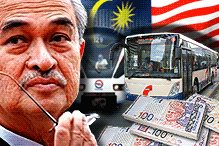 If the government keeps on associating public transportation with the 'lower income' group, then a vast majority of Malaysians will be disassociated with public transportation, believing that it is not for them.
This would be a big disappointment, given the intention to spend RM12 billion over the next four years (in addition to money spent already, about RM2-3 billion). Building more 'comprehensive' networks would be great, but it may not be enough if Malaysians don't think that public transportation is for them.
The government needs to take positive, pro-active steps to encourage Malaysians to use public transportation, and to emphasis that it is for everyone. I hope that the government considers this in the future.
What DAP's Shadow Budget 2008 says:
The ability of our transport infrastructure to support massive movements of goods, services and people at a minimal cost is crucial in sustaining Malaysia's productivity and competitiveness. There are many examples of which great empires and cities that have been founded upon their ability to transport goods and services efficiently to the intended markets. One such example was the port of Malacca in the 15th century. It was considered by historians to be one of the world's richest trading posts at the time.
 Malaysia is rapidly running out of space in the urban centres to build new roads and parking bays to cope with the rapid increase in vehicles. In the first half of 2006, there were 27 million more vehicles using the tolled highways, bringing the total to 545.1 million vehicles, up by 5.2 percent from 518.1 million in the same period the year before. Malaysia also has one of the highest per capita car ownership ratio in the world at 67 pecent behind only New Zealand, South Korea and Australia.
This has to a large part been caused by the lack of efficient public transport alternatives in urban centres to cope with the accelerating demand. During the same period, the number of riders on the urban rail services increased by only 3 million or 3.9 percent, from 76.4 million to 79.4 million. This number would have been larger if the network had expanded at a faster rate.
These trends are expected to continue well into the future and our transport infrastructure, especially in the major urban areas, is already showing signs of severe congestion and unreliability. To ensure the viability of our networks, investments in transport infrastructure would need to be increased in line with the increasing demand. In view of this, DAP intends to allocate a total of RM13.6 billion...., an increase of 21.3 percent or RM2.4 billion from 2006. The bulk of the increase is allocated to development expenditure for transportation, which increased from RM7.3 billion to RM9.5 billion.
Key attention will be paid to the most notorious cities in terms of traffic congestion, particularly in the many suburbs of the Klang Valley such as Jalan Kelang Lama-Puchong, Cheras-Kajang Corridor and the KL-PJ-Damansara Corridor, in Penang as well as in Johor Bahru. Expansion to existing rail networks as well as new networks of light rail transportation system shall be conducted aggressively.
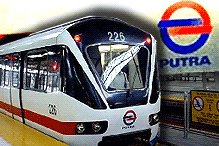 The DAP will also commence feasibility studies to improve inter-suburban connectivity via the rail transport system, which will bypass the city centre and hence further reduce congestion in Kuala Lumpur. The 'Circle' LRT line will seek to connect Petaling Jaya, Puchong, Sri Petaling, Cheras, Ampang, Setapak, Gombak, Sentul and Kepong suburbs.
Urgent studies should also be conducted on the lack of connectivity between the disparate rails systems in the Klang Valley, particularly between Komuter, Star and Putra LRT lines, and the KL Monorail. The Klang Valley rail network should cope with double our current rail users at approximately 160 million users by 2012.
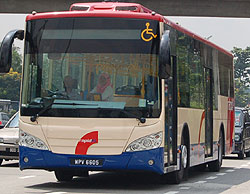
Focus shall also be given to an efficient bus transportation system in secondary cities to check the rapid rate of vehicle growth and ensure that they do not suffer the same fate as the larger cities today. These cities will include Ipoh, Seremban and Malacca. DAP intends to achieve the 15:15 objective, whereby a person would need to walk no more than 15 minutes to the nearest bus stop. Commuters need wait no more than 15 minutes for a bus.
My observations:
The length and level of detail within these proposals seem to suggest that the DAP is paying greater attention to the public transportation sector than the government. The party quotes interesting statistics about the rate of vehicle growth and lack of corresponding growth in public transportation, proposes what appear to be firm numbers for additional funding, and gives achievement targets.
 Yet, the DAP seems to suffer from a similar misunderstanding of public transportation. It mentions the economic value of a full and complete transportation network, but says nothing about the specific economic gains to be reached. The history lesson, while interesting, is somewhat misplaced. As well, there is no mention of any social or environmental features, which deserve consideration in this day and age.
Effectively, the DAP has failed to show us that it has a clear understanding of the advantages of public transportation or what an improved and complete network can do for Malaysia. The proposals approach this idea but do not explain it.
The DAP get points, however, because their proposals are somewhat concrete. It would spend RM13.6 billion (although details are unclear). It would expand the railway networks "aggressively" especially to meet the needs of "suburban areas" in the Klang Valley and Penang, and invest in bus transportation in secondary cities.
It is necessary to address the fact that Malaysia needs a complete national public transportation network, and this network needs to include fast, integrated passenger rail networks at the national (e.g. KTM), regional (e.g. KTM Komuter), and local (e.g. LRT and 'rapid transit') levels.
A commuter's view of the budget (Pt 2)
MOAZ YUSUF AHMAD, a regular user of public transport, is deeply concerned that government plans to encourage the use of public transport will ultimately fail because of poor planning and lack of support from the public.


Are you sure you want to delete this comment?
This action cannot be undone.