




Migrants encouraged to use mother tongue
AFTER visiting the Islamic college, our group had the opportunity to interview the Southern Australia Culture Minister Michael Atkinson.
The minister filled us in on the policies governing immigrants and refugees in Australia and the great extent the Australian Government went through to help migrants settle down in the country.
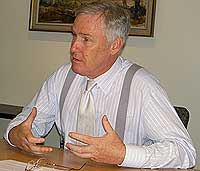 One striking point which we learned from him was the government's encouragement to the migrants to learn their mother tongue.
"This is why those who had settled down in Australia for 50 years are still communicating with each other in their mother tongue," Atkinson said.
"The government is helping other ethnic groups who wish to learn their mother tongue to do so. They can even apply for government's financial assistance to learn their language," he added.
Later, I was to experience what the minister said first hand on a Sydney Street.
No matter where you are, in buses and trains, in eateries or on the street, you will be able to hear people communicating in all kinds of languages.
 I heard many Australians conversing, not in English, but Cantonese and Dutch and also some languages which I was not able to comprehend.
Socialize with others
According to Atkinson, the Australian government had made several plans to help refugees and migrants to adapt to the life in Australia where they will be assisted to learn their cultures and languages.
He reiterated that the government has always encourage migrants to socialize with people outside of their own group. The government also helps these ethnic groups to organise their festive celebrations and cultural activities.
Among the more recent migrants to Australia are ethnic groups from Sudan, Afghanistan and Iraq. These groups also receive government assistance to assimilate into the Australian way of life.
However, Chinese from all over the world remain the top immigrant group to Australia. For the past century, from 1901 to 2001, people from China were the majority group of migrants and they were still among the top five countries of Australia migrants in recent years.
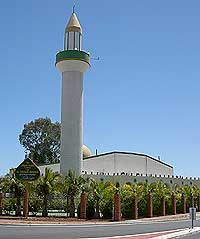 Since the 911 Incident in the US, the Australian government had paid close attention to the needs of Muslims. Conditions were made easy for Muslim ethnic groups to settle down in the country.
The government's move not to give reasons for Muslim groups to get dissatisfied is only a natural one in order to prevent negative or extremist thinking from penetrating them.
Senior and older migrants are also well taken care of in Australia. For example, nurses were trained to speak their mother tongue in order to communicate with them
On top of that, efforts were made to provide these senior citizens with traditional food from their homeland so that they could feel a sense of belonging to Australia.
Unique broadcasting service
After the meeting with Atkinson, our group visited what I would describe as the 'unique' Special Broadcasting Service (SBS) headquarters in Sydney.
 SBS is the only media organisation Down Under to provide multilingual programmes where its TV stations, airing in more than 60 languages, are also adopted in various programmes under the SBS setup.
For radio stations, 68 languages are adopted in various programmes and online programmes have more than 50 languages.
SBS which is fully supported by the government aims to provide different channels for different ethnic groups to voice out their opinions and comments to reflect Australia's multi-cultural society.
As SBS is providing various channels for different ethnic groups, how do they divide the air time for every different language?
SBS insists on a fair division as air time is restructured every four years following feedback from a census conducted.
Even the smallest ethnic group in Australia is not forgotten - there will be a programme arranged for them at least one hour a week.
Currently, the five major languages used over SBS are Italian, Greek, Mandarin, English and Arabic.
 According to SBS executive director Nicola Joseph, SBS also provides the platform to establish mutual understanding between ethnic groups especially when dealing with sensitive issues.
"No, we will not avoid sensitive matters. In fact, SBS will initiate discussions among the different groups on sensitive issues now and again in order to promote greater understanding among them." she explained.
Issues such as international terrorism and problems of Muslim ethnic groups being humiliated in Australia were among the topics discussed.
"The most significant part of SBS is that people such as Islamic religious teachers and priests not fluent in English can explain the real meaning of Islamic teachings via different language channels to clarify the public's prejudice and misunderstanding of Islam," Nicola added.
Part 1 Aussies are tolerant folk
KUEK SER KUANG KENG was a member of the Malaysian media team who joined the AMI tour to Australia last September.


Are you sure you want to delete this comment?
This action cannot be undone.