




Visit Malaysia Year meets An Inconvenient Truth
VISIT Malaysia Year 2007 has attracted 8.9 million tourists in the first five months of the year - a 25 per cent increase from the same period last year and is expected to draw a total of 20.1 million tourists by the year end. But behind these booming growth figures are less auspicious ones testifying to the tourism industry's contribution to climate change.
2007 is also a year that is seeing an unprecedented awakening in the evironmental consciousness of many people in Malaysia and around the world that is sparked by the movie An Inconvenient Truth". So how can the contradicting agendas of tourism and environmental preservation be reconciled?
 The Conference on Environmental Management Practices in
the Hospitality Industry, jointly presented by the Nilai International
University College (NIUC) and Oxford Brookes University, UK, on June 11 in Kuala
Lumpur, investigates this inconvenient conundrum at a time when the climate
change issue burns on everyone's lips and the Sipadan Island barge and Tioman
Island airport controversies are still fresh in our memories. The conference is
also held in conjunction with the launch of NIUC's B.A. (Hons) in Business &
Hospitality Management Studies.
The Conference on Environmental Management Practices in
the Hospitality Industry, jointly presented by the Nilai International
University College (NIUC) and Oxford Brookes University, UK, on June 11 in Kuala
Lumpur, investigates this inconvenient conundrum at a time when the climate
change issue burns on everyone's lips and the Sipadan Island barge and Tioman
Island airport controversies are still fresh in our memories. The conference is
also held in conjunction with the launch of NIUC's B.A. (Hons) in Business &
Hospitality Management Studies.
A research team comprising Matt Todd, Dr Rebecca Hawkins ( right ) and Dr Bella Davies from the Centre for Environmental Studies in the Hospitality Industries (CESHI) of Oxford Brookes University, UK, presented the European perspective on a universal problem. In Europe, the legislation works to prevent pollution rather than to penalise polluters after the fact.
For example, in the UK, the Landfill Tax is charged to landfill operators for every tonne of waste disposed of at the landfills. This helps to reduce the amount of waste being landfilled in the UK, promote re-use and recycling, and provide funding for research into more sustainable ways of managing waste. The Climate Change Levy, on the other hand, taxes energy consumption in the non-domestic sector (industry, commerce, and the public sector) and encourages these sectors to improve energy efficiency and reduce emissions of greenhouse gases.
Legal loopholes
 In Malaysia, environmental legislation is lacking and this
sentiment is surprisingly shared by the hospitality industry as indicated by a
telling survey conducted by the Malaysian Association of Hotels (MAH) on 100
four and five star hoteliers in Malaysia. 82% of hoteliers agree that legal
restrictions are the only way to control pollution and damage to the
environment.
In Malaysia, environmental legislation is lacking and this
sentiment is surprisingly shared by the hospitality industry as indicated by a
telling survey conducted by the Malaysian Association of Hotels (MAH) on 100
four and five star hoteliers in Malaysia. 82% of hoteliers agree that legal
restrictions are the only way to control pollution and damage to the
environment.
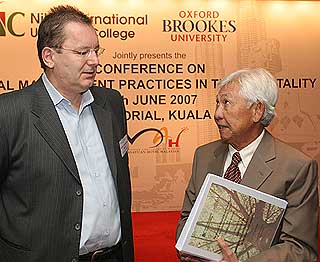
Herbert Laubichler-Pichler ( left in photo with Shamsul Bahrin, President of NIUC ) who presented the results of the survey on behalf of MAH believes that the lagging environmental legislation of developing countries encourages foreign corporations to exploit the legal loopholes in developing countries while meeting the stringent environmental standards of their home countries.
The practice of double environmental and social standards by foreign corporations is exemplified by news reports last year that exposed how companies in Europe and America are dumping their wastes into Africa. Similar stories of exploitation are played out in the hospitality industry.
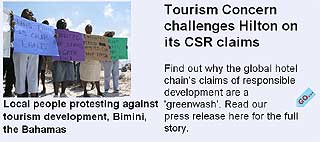 Last year, the Hilton Hotels Corporation and Hilton
International was accused by UK-based tourism watchdog, Tourism Concern of short
changing local communities and contributing to habitat destruction in Bimini in
the Bahamas and Mandhoo island in the Maldives. Closer to home, we hear
disturbing news that more than two years after the tsunami, local
communities in Sri Lanka, Thailand and India remain displaced because they are
not allowed to rebuild their homes in coastal land earmarked for high-end
tourism development.
Last year, the Hilton Hotels Corporation and Hilton
International was accused by UK-based tourism watchdog, Tourism Concern of short
changing local communities and contributing to habitat destruction in Bimini in
the Bahamas and Mandhoo island in the Maldives. Closer to home, we hear
disturbing news that more than two years after the tsunami, local
communities in Sri Lanka, Thailand and India remain displaced because they are
not allowed to rebuild their homes in coastal land earmarked for high-end
tourism development.
Apart from compliance to regulations and avoidance of bad PR, the hospitality industry in Europe is also driven to address the environmental agenda by the savings in operational costs as a result of investments in energy and waste management systems and the growing trend in responsible tourism or eco-tourism. Surveys in Europe have shown that approximately 70% of holiday makers claim that they would prefer to stay in accommodation that does not damage the environment; more than 50% claim that they would be willing to pay more for such accommodation; and more than 80% of consumers will not return to destinations that are "polluted". This trend is especially true for high-end and experienced travellers who make environmental travel choices because they believe that a better environment equates to a better quality holiday experience with the added bonus of a clear conscience.
A hotel going green
Results of the MAH survey show that local hoteliers recognise this trend and 78% of those surveyed agree that being environmentally friendly gives them an edge over their competitors. The downside of this is that hoteliers cashing in on the trend tend to indiscriminately slap on the green label as there is no standard of benchmarking for responsible tourism or eco-tourism in this region. That is why Wild Asia, a conservation group based in Malaysia, is blazing a trail in the wilderness of Responsible Tourism (RT) by providing RT reviews, assessments and best practice training to tourism operators as well as running an annual RT awards to acknowledge operators who are making a difference with their RT efforts.
 So how does a hotel begin to go green? The research team
from Oxford Brookes recommends the following actions:
So how does a hotel begin to go green? The research team
from Oxford Brookes recommends the following actions:
- Set up a Green Team to champion the environmental cause
- Write an environmental policy statement which becomes the bedrock for all
environmental initiatives
- Obtain commitment from the board
- Set and monitor targets, for e.g. commit to reductions in energy, water and waste and check your targets against monthly utility bills
- Invest in environmental management technologies but focus on techniques rather than technologies at the beginning (refer to At A Glance below).
- Make it fun and reward employees who get involved
The conference in choosing to focus on the environmental practices of hotels scrapes but a slice of the climate change iceberg in the tourism industry. The entire tourism value chain from food and beverage to construction, from tour operators to transportation, is intimately linked to the climate change phenomenon. We need forums that bring together academia and industry from the entire breath of the tourism value chain to jointly solve the climate change problems.
"There is growing consensus, political pressure and urgency for action. The tourism sector must play its part in finding solutions to climate change, in the same way as all other sectors. This will mean mitigation & adaptation across the entire tourism chain transport, accommodation, ground services and the like." - Professor Geoffrey Lipman , Assistant Secretary-General, World Tourism Organisation (UNWTO) during the World Tourism Conference held in Kuala Lumpur on 4-6 June 2007.
At A Glance
Quick wins for the environment
Your hotel can already start applying these simple and cheap techniques to fight climate change and save on bills before even investing in environmental management technologies:
Energy
Adjust your thermostat. Increase the temperature of the air-conditioners of all offices and common areas and increase the default temperature of all guest rooms. Saves up to 2% of electricity cost for every degree you raise.
"Switch off" campaign. Train staff and encourage guests to turn lights and
electrical equipment off whenever they are not in use. Saves up to 10% of electricity cost.
Energy-saving lights. Replace conventional lamps with energy saving equivalents. Energy saving bulbs use 80% less energy than conventional ones and last 15,000 hours.
Good maintenance. Ensure that all major energy-consuming equipment is well
maintained and that faults are reported and rectified immediately. Saves 2% or more of energy cost.
Water
No leaks. Check pipes and fittings for leaks and seal them immediately. A leaking tap can waste over 12 litres of water a day and a leaking toilet can waste up to 750 litres a day.
Cistern dams. Fit cistern dams or bags in all toilet cisterns to reduce amount of water required per flush (while maintaining the adequate level of hygiene of course!). Saves 3 litres of water per flush.
Full load. Train staff to operate dishwashers and washing machines on full load
only. Saves up to 20% of water.
Bucket wash. Train staff to clean bathrooms using a bucket rather than letting the taps run. Saves up to 20% of water.
Reuse towels. Encourage guests to hang their towels up if they wish to reuse them.
Waste
Recycle. Contact local recycling services for collection of glass, cardboard, plastic, aluminium and electrical appliances.
Multi-use products. Replace disposable products with multi-use alternatives and ask your suppliers to provide items in minimum or reusable packaging.
Reduce. Efficient food purchasing, storage and meal planning reduces food waste.
Donate. Donate textiles and furniture to local charities and community groups.
Source: Compiled from research by the Centre for Environmental Studies in the Hospitality Industries (CESHI) of Oxford Brookes University, UK.
SHIRENE CHEN is a restless pilgrim taking a rest from the corporate world to read, write and live. Comments can reach Rentakini by emailing francis@malaysiakini.com


Are you sure you want to delete this comment?
This action cannot be undone.