




Hear the deaf
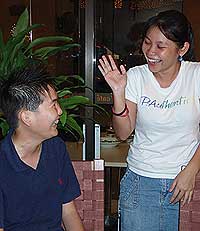
Friends Rachel Lam and Kenneth Foo speak excitedly to each other using their hands. Their conversation is punctuated by laughter. Conversation amongst the hearing impaired is often on low volume but it is no less animated or devoid of expression.
FRIENDS Rachel Lam and Kenneth Foo speak excitedly to each other using their hands. Their conversation is punctuated by laughter. Conversation amongst the hearing impaired is often on low volume but it is no less animated or devoid of expression.
Every now and then, Kenneth pauses to give me a summary of what they were talking about.
Rachel became deaf at a young age due to an unfortunate Walkman earphones accident. This likeable 23-year old exudes a cheerful, magnetic zeal.
Kenneth can hear. This friendly, young man is what most people would call "normal." His fluency in sign language often leads people to mistake him for a deaf person.
"Sometimes on the LRT I can hear families, a mother telling her daughter, 'Oh, they cannot talk.' People think I cannot hear," says nineteen-year-old Kenneth.
 "I just smile at them."
Theirs is a remarkable story of friendship.
Kenneth and Rachel (left) are classmates at a graphic design course. They are also partners in an interesting language exchange. Kenneth had taught himself to sign the alphabets in high school. Since he and Rachel met in college, she has been teaching him to sign a new word almost every day.
He often plays the role of her interpreter, a role he appears glad to hold. He is fluent in basic sign language but believes there is more to learn to interpret better.
"Learning a new language is an experience," he smiles.
Although Rachel clearly enjoys her course and intends to pursue it further, she often gets bored while her lecturers are teaching. Since she cannot hear, she has to wait for them to finish addressing the class before they write down lessons for her.
When asked about her friends, she explains "There is interaction but no meaningful communication."
Harry Ong and Stephen Mills face similar communicational barriers.
They communicate with their colleagues using pen and paper. As such, it is often delayed and prone to interruptions, Harry explains.
At work Harry, 38, mostly sits by himself. His job involves cutting and pasting labels on bottles.
"It's not something I look forward to but I try to cope with it. Tolerance," he says.
'Cannot make ends meet'
When asked what he would suggest to his employers to improve his work environment, Harry fell silent. It had not occurred to him to give suggestions. But Harry does not want to dwell on it. Someday, he hopes to start his own business. He is a qualified graphic designer and wants to put his artistic talents to good use.
Harry, who lost his hearing at age five from illness, laments that his salary and career prospects are pale compared to his hearing counterparts.
Stephen, 35, an employee at a printing factory, agrees, "With this salary, we cannot make ends meet." He hopes for better wages for deaf employees to offset the pressures of raising a family in an economy where prices are constantly rising.
Stephen mainly communicates with his hearing wife and children through sign language. He has taught his wife some basic signs. He needs her to facilitate communication with his young children, who only know minimal sign language.
Mohammad Kham Johari and Munah Uri also have a family to raise. They have been married for four years and are expecting their second child in a few months.
All this 28-year old father wants is the right conditions for deaf people to stand on their own feet. While Munah, 32, simply wishes for a healthy and beautiful baby.
Kham and Munah met at a social event that brought together their schools from different states. Munah only completed three years of high school and does not have pleasant memories of it. She feels that the education system had given up on deaf students like herself.
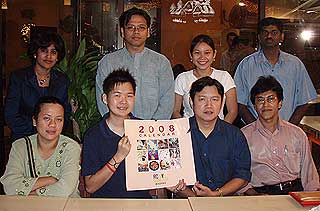 This group
(left)
has come together for a deaf art calendar project with the assistance of RC Deaf Missions, an organisation focused on employment and skills development for the deaf community.
This group
(left)
has come together for a deaf art calendar project with the assistance of RC Deaf Missions, an organisation focused on employment and skills development for the deaf community.
The works of Rachel Lam, Harry Ong, Mohd Kham and two other deaf friends Lim Anuar, 38 and Peter Lau, 28 are featured in the 2008 Deaf Art Wall Calendar. Kenneth, the only hearing member of this calendar team, was invited to contribute ideas.
Rachel mainly uses digital illustration to express her art (pix) while Kham loves painting scenery. He has been painting from a very young age after his elder sister taught him the skills. He went on to vocational training in pottery and aspires to have an artistic career.
The calendar has been well-received, selling more than 1,300 of the 2,000 printed. Stockists include Times Bookshop, Silverfish Books, First Edition Bookstores, Readers' Corner and Mentor Bookstore.
Employment for the deaf
Agnes Peter, co-founder of the RC Deaf Missions, is delighted that the calendar project and press coverage has generated much curiosity and awareness among employers, deaf people and concerned individuals.
According to Agnes, about ten employers have expressed interest in hiring and working with deaf people. One such organisation is Youth Malaysia, an internet youth portal that has offered freelance writing opportunities to deaf people.
Agnes welcomed that offer but explained that deaf people have very different grammars because the structure of sign language is considerably different to English. Nevertheless, there is a small percentage of deaf people who can write well, she added.
In sign language, the topic usually comes first. As an example, Agnes demonstrated that the sentence "I am afraid of that dog" is expressed as "That dog, I fear" in sign language.
Mario Peter, co-founder of RC Deaf Missions, explained that each deaf person is identified with a special name sign instead of having to spell out a person's name. The name sign may comprise the person's initials, a prominent characteristic or both. Mario's name sign is the letter M, indicated using the middle three fingers, moved along his hair. It is an interesting combination of the first letter of his name and his wavy hair.
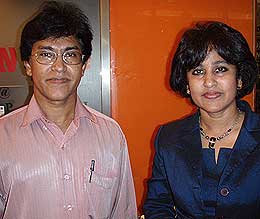 Agnes and her brother Mario
(photo at right
), both fluent sign language interpreters, founded the RC Deaf Missions a year ago. They both hold full time jobs in addition to running the Mission. Agnes has been working with the deaf community for more than 15 years but in the last five years, her emphasis has been on the employment of deaf people including career and business opportunities, consultancy, training, community awareness projects and sign language courses.
Agnes and her brother Mario
(photo at right
), both fluent sign language interpreters, founded the RC Deaf Missions a year ago. They both hold full time jobs in addition to running the Mission. Agnes has been working with the deaf community for more than 15 years but in the last five years, her emphasis has been on the employment of deaf people including career and business opportunities, consultancy, training, community awareness projects and sign language courses.
Agnes is very clear about the Mission's objectives. She stresses that it is not their intention to protect the deaf from the harsh realities of society. Instead, they hope to empower deaf people and prepare them for challenges in employment as well as living in a hearing society.
There are an estimated 25,000 to 26,000 registered deaf people with varying degrees of hearing impairments in Malaysia.
Agnes acknowledges that there are many interested employers out there and those who attempt to make their working environment disabled-friendly, nevertheless there are still those with attitudinal barriers.
Agnes often assists deaf people with their job search and interviews. She is often told "We don't hire this kind of people. I'm sorry."
"There is a lot of imbalance for the disabled community in general. Many deaf (people) are at the mercy of employers," Agnes says.
Thus, the Mission is working to raise awareness among employers and to bridge gaps in understanding and in communication. They are also concerned that the deaf are being disadvantaged in terms of salary and career prospects.
"Developing countries take longer. We have a long way to go in terms of equal rights (and) sustainable livelihoods," says Agnes.
For more information on the 2008 Deaf Art Wall Calendar and the RC Deaf Missions, visit their website
CHUA SUE-ANN is an intern with Malaysiakini


Are you sure you want to delete this comment?
This action cannot be undone.