


/file/publisher-c1a3f893382d2b2f8a9aa22a654d9c97/2026/08/95a858878a0707c237fb7b80d558c1d4.jpg)

Solar savings for Malaysian homeowners: With vs without BESS
Solar Savings Are No Longer Just About Generating Power
For many Malaysian homeowners, rooftop solar has become an effective way to reduce electricity bills and gain greater control over energy usage.
However, under Malaysia's current Solar ATAP framework, the value of solar is no longer determined solely by how much electricity is generated, but also by how much of that energy is consumed within the home.
This is why two homes can install similar solar systems but see very different savings.
For homeowners today, the question is no longer just, “Should I install solar?”
It is also, “Is solar alone enough, or should I consider solar with Battery Energy Storage System, or BESS?”
The answer depends on how the household uses electricity.
Solar Savings Depend on Your Timing
Solar panels generate electricity during the day, making rooftop solar especially useful for households with higher daytime energy usage such as households with people working from home, retirees, or families using air-conditioning and appliances during the day.
But many Malaysian homes use more electricity in the evening, after solar production has dropped. This is when air-conditioning, water heaters, washing machines, kitchen appliances, televisions and chargers usually come on.
This creates a timing gap.
According to the Solar ATAP Programme Overview by TNB, while excess solar energy can be exported to the grid, homeowners often gain greater savings by using the energy directly.
This matters even more as electricity cost adjustments continue to change. In June 2026, Malaysia’s AFA rate increased to +2.59 sen/kWh, compared with +1.38 sen/kWh in May. These AFA charges are applicable on all electricity pulled from TNB.
For homeowners, this is a reminder that electricity costs can shift from month to month and relying fully on the grid means being exposed to those changes.
Where BESS Changes the Equation
Battery Energy Storage Systems (BESS) helps close the timing gap.
BESS stores excess solar energy generated during the day so it can be used later, especially at night or during higher-usage periods.
In simple terms, solar helps you generate electricity. BESS helps you use more of it when your home needs it.
This can mean more effective usage of solar power, lower reliance on grid electricity, backup power during outages, and better control over long-term energy costs.
But this does not mean every home automatically needs the biggest battery system.
The right choice depends on the household’s usage pattern, budget, and long-term energy goals.
Comparing Solar-Only and Solar + BESS Systems
The difference becomes clearer when comparing potential return-on-investment (ROI) scenarios.
Example ROI Comparison Table
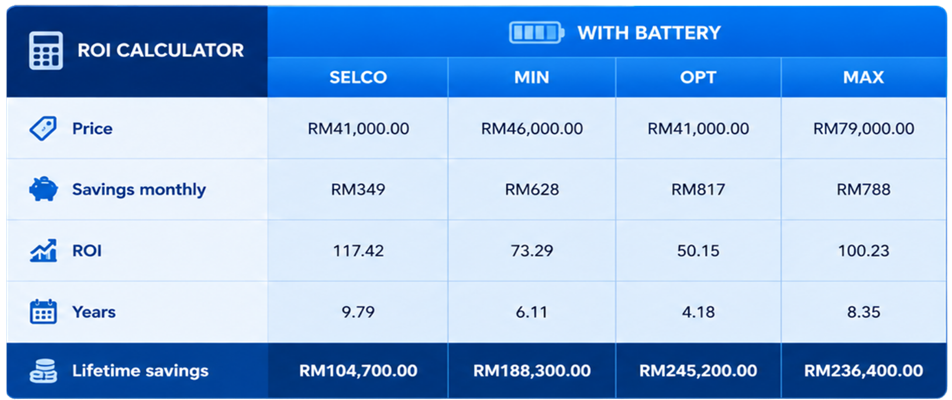
Based on the ROI simulation, the Self-consumption (SELCO) option – wherein solar only generates during daytime – shows a system price of RM41,000, with estimated monthly savings of RM349 and a payback period of 9.79 years.
Meanwhile, the optimized Solar + BESS option also shows a system price of RM41,000, but with estimated monthly savings of RM817 and a shorter payback period of 4.18 years.
The MAX option shows a higher upfront cost of RM79,000, with estimated monthly savings of RM788 and a payback period of 8.35 years.
This is why system design matters.
The right solar solution is not always the cheapest. It is also not always the biggest. It is the one that gives the best balance between cost, savings and how the household actually uses electricity.
Choosing the right solar solution for your home
Solar-only systems can still be suitable for many homes, especially those with strong daytime usage and a lower upfront budget.
But for households that use more electricity at night, Solar + BESS may offer stronger long-term value by allowing more solar energy to be used after daytime generation ends.
Before accepting any solar package, homeowners should ask a few important questions:
How much electricity does my home use during the day?
How much do we use at night?
Is the system sized based on my actual bill?
What is the estimated monthly savings in ringgit?
How long is the payback period?
What is included in the package?
A cheap offer may look attractive at first. But if the system does not match how the household actually uses electricity, the savings may not turn out as expected.
For Malaysian homeowners, solar is no longer just about reducing the electricity bill. It is about choosing a system that fits how the home lives, uses energy, and plans for the future.
Solar helps generate clean energy. BESS helps maximize when that energy is used.
To better understand how solar and battery storage can support your household’s actual energy usage, visit www.unitedsolarenergy.com.my and explore solutions by United Solar Energy Malaysia (USEM).
This Sustainable Energy Series is in collaboration with United Solar Energy Malaysia (USEM).
The views expressed here are those of the author/contributor and do not necessarily represent the views of Malaysiakini.


