




The spring of our discontent
Kalau sesiapa YB atau Menteri datang sini, saya tampar muka mereka betul-betul. (If any Minister or legislator comes here, I'm going to slap them properly.)
Pak runs a little ramshackle foodstall, cocooned by the sky-high low-cost flats of Pantai Dalam. I drop in, on occasion, sitting on shaky stools while waiting for friends to finish their political work nearby.
It is here, in the constituency of Pantai, that the gulf between the rich and the poor couldn't be any wider. A stone's throw away from Pantai Dalam lie million-ringgit homes and their entertainment playground, Bangsar. Karl Marx would have been so pleased to find his thesis still thriving, that he'd ignore his carbuncles for a moment or two.
For the price of a lukewarm glass of coffee, I get to listen in to the latest of Umno's shenanigans, the state of his pride and joy Proton Wira circa 2001 and the price of fish.
Kalau sesiapa YB atau Menteri datang sini, saya tampar muka mereka betul-betul. (If any Minister or legislator comes here, I'm going to slap them properly.)
Pak runs a little ramshackle foodstall, cocooned by the sky-high low-cost flats of Pantai Dalam. I drop in, on occasion, sitting on shaky stools while waiting for friends to finish their political work nearby.
It is here, in the constituency of Pantai, that the gulf between the rich and the poor couldn't be any wider. A stone's throw away from Pantai Dalam lie million-ringgit homes and their entertainment playground, Bangsar. Karl Marx would have been so pleased to find his thesis still thriving, that he'd ignore his carbuncles for a moment or two.
For the price of a lukewarm glass of coffee, I get to listen in to the latest of Umno's shenanigans, the state of his pride and joy Proton Wira circa 2001 and the price of fish.
The other night, however, Pak's tone had changed. Usually jovial, he plonked my coffee on the plastic table without looking down. When asked about his reaction the fuel price hike, he merely shrugged his shoulders.
 It was only after my second glass that he sat next to me and summarised his economic situation within the lifespan of a lit clove cigarette.
Pak, apparently, has at least a dozen micro-businesses under his wing. From hawking insurance to having a small share in a wartel (telephone kiosk) in Melaka; selling vitamins in a healthcare multilevel marketing scheme to catering for small wedding parties.
He's close to 50 years of age and works 24/7. Just about anything he can get his hands on to provide for his six children. Now he's considering selling his Wira and getting a second-hand motorbike instead.
He ended our tte--tte in resignation, though he brightened for a split-second when he thought of slapping a minister, and added he was going to vote opposition in the coming general election.
Shifting the blame
Pak is one the millions of ordinary Malaysians who are hit hard by the fuel price increase. The government can show us all its colourful graphics on how this not going to affect the cost of living (shifting the blame on profiteers), but it is our lightened pockets that speak of a different reality.
If the media should rise to the occasion, this is the time. How else could those who walk along the polished floors of Putrajaya hear these voices of discontent?
 Instead, there is a scramble to manage the 'crisis'. There was a near media blackout of the thousands who rallied outside the Petronas Twin Towers last Friday. It was almost as if it never happened. That everyone would grumble for a day or two, and forget about it.
Consumer organisations, which should have been the first to jump on our behalf, sank neck-deep into excuses fit for rubbish bins.
The public discourse is filled with well-orchestrated lectures on why we should forgo the subsidy mentality, how much better off we are compared to from other parts of the world, and where else we can tighten our belts and change our (allegedly spendthrift) lifestyles.
Isn't that a little rich, coming from those who can't even put a belt around their waistlines and whose lifestyles are primed for public scrutiny and ACA investigations; who would think nothing of spending billions of ringgit of the public's money on French submarines, Polish tanks and an administrative metropolis?
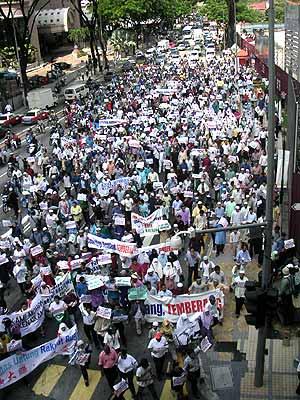 Back to the demonstration, which apparently didn't happen. Those of us who attended Friday's demonstrations were pleasantly surprised.
Shoppers came out and stood with us. A number of employees from the towers and surrounding offices slipped out and joined in. The FRU officers were relaxed and even gave a smile or two.
Some of them gave us a thumbs-up on the side, while a colleague of mine received a call from a police constable, asking him to do something about the economic situation - "for those who cannot speak out".
The same day, about half an hour's drive from the demonstration, 200 workers from CHG Plywood laid down their tools for the third consecutive day. They haven't received their wages for a while, some up to six months.
In the oldest part of Petaling Jaya, there are furtive yet desperate lines outside money-lenders and pawnshops.
Try telling them to tighten their belts and to change their lifestyles.


Report this comment
Are you sure you want to delete this comment?
This action cannot be undone.