




Write, blog and rap to roll the rage
Public space has no wrath like a writer or an aspirant rapper - scorned. Silence the messenger, and you stir the messenger's pot of wrath. Indeed, I feel a witch's pot brewing.
Pour in angst, sour grapes, conviction and a dash of mischievous fun. Then simmer. Voila, the lingering brew of bitter-sweet discourse stirred by Zainah and Amir, Mahathir and Anwar, Rocky and Raja Petra (Jeff has left to join the pollies), Wee and Negarakuku. Besides two ex-ministers, the rest may just be faceless names, if not for the heavy hand of the state.
Public space has no wrath like a writer or an aspirant rapper - scorned. Silence the messenger, and you stir the messenger's pot of wrath. Indeed, I feel a witch's pot brewing.
Pour in angst, sour grapes, conviction and a dash of mischievous fun. Then simmer. Voila, the lingering brew of bitter-sweet discourse stirred by Zainah and Amir, Mahathir and Anwar, Rocky and Raja Petra (Jeff has left to join the pollies), Wee and Negarakuku. Besides two ex-ministers, the rest may just be faceless names, if not for the heavy hand of the state.
The moral of the intro: write a column, run a blog, rap on YouTube and tell the truth, at times absolute, but most times wittily between the lines. That'll get you the state's attention. Expect a raid on your home and work computer. Get arrested and interrogated for days. Overnight, you'll be a celebrity dissident. And the personal triumphs? International recognition as an intellectual dissident like Anwar in 1998 as Newsweek 's Asian of the Year, invitation to speak at international conferences, and honorary fellowships at foreign universities out west.
I can feel the death wish of many Malaysian bloggers and public intellectuals to be roped in by the police. With the increasingly tiresome clampdown on critical writers and bold bloggers, many may even feel compelled to be louder, more provocative and controversial via alternative platforms to shake the status quo.
Ironically, news of critical voices snuffed from Malaysian mainstream newspapers is becoming pretty pass. "The witch-hunt on bloggers by the government are signs that the state is moving towards a semblance of totalitarianism," said the Center for Independent Journalism. Perhaps, a tad alarmist is the statement - and no longer original. Surely, we're far from Kim Jong-Il or Mugabe's rap on the dissident press. But, I suppose the over-statement reflects the seething public frustration and incredulous amazement at the state's and newspaper publishers' infantile handling of healthy critical discourse.
NST's axing of Zainah and Amir's columns, and the state's threat to run down on political bloggers will certainly draw the attention of foreign observers in their annual survey of global press freedom. Our records so far are not good not that the government gives a hoot to what foreigners say. Our politicians and editors are pretty self-sufficient, in denial, or just simply thick.
Reporters Without Borders' worldwide index in 2002 shows Malaysia ranked at 110 out of 139 countries. The PPPA, OSA, Sedition Act, Universities and University Colleges Act are repeatedly cited as killing our journalists' spirit. But to Malaysians, the abbreviated acts are 'same old same old'. Familiarity breeds resignation. An unchallenged press serving a market of passive readers - they are breeding grounds for bad journalism. We do deserve the media we get.
Malaysia's press freedom index improved by a few notches to 98 out of 168 countries in 2006. We can dream of being among the top 20 democracies where every citizen can write and speak publicly unencumbered by fear. Sadly, my talks with baby boomer parents of university age children most overseas for lack of opportunities back home - tells me otherwise. The fear factor and 'sulit' syndrome in the home front is as real today as it was post-1969.
Dr M's call to keep the rage alive
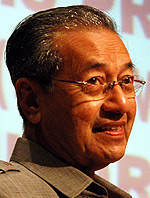 But if there's ever a glimmer of light, it's in Dr Mahathir's
call
on bloggers to maintain the rage and push the boundaries of public discourse. Although his call's a bit late at this time of his career, it's telling.
But if there's ever a glimmer of light, it's in Dr Mahathir's
call
on bloggers to maintain the rage and push the boundaries of public discourse. Although his call's a bit late at this time of his career, it's telling.
Mahathir ought to be re-quoted here: "You (bloggers) have to gather force. You have to talk to people. Even if you are arrested, you go and talk ... If you have only one person doing that, it's not good enough. If you want to do something that is positive, you have to get everybody, as much as possible, and do it openly and say it loud and clear."
Admittedly, we're freer to shout and speak today, albeit marginally, than 1987. It could be worse, as they say. Ahh, thank god for bloggers and the internet.
Pointing to university students who blamed the UUCA as the reason for not speaking out on issues, Mahathir urged students to work around the regulations. "If you want, if you love your country, you would take the risk," he added.
A most telling tip for students and academics on speaking up publicly for what's right and repudiating what's wrong. Ironically, Mahathir's tip echoes Anwar's thesis in his book Asian Renaissance (1996) which is, only when the mind and intellect is freed of internal insecurity and is relatively independent of external constraints can cultural and intellectual reawakening begin to evolve.
In an interview about his book with Time Australia (June 10, 1996), Anwar said:
"My principle is an informed citizenry is a responsible citizenry. We want a responsible citizenry, so there must be respect for the freedom of the press ... All the great sages of the past were great because they were able to write and publish freely. All our great freedom fighters ... were able to be great because they believed in freedom and they were able to use the media to articulate their positions."
Lest Mahathir and Anwar forget. Remember Operasi Lalang in October 1987? Likewise, it was during their watch in 1988 that the state clamped the columns Without Fear or Favour by our 'Mr Opposition' Dr Tan Chee Khoon, and As I See It by our 'Bapa Malaysia', Tunku Abdul Rahman both published in The Star over many years. Of course, The Star 's editorial contents in the 70s and early 80s were a far cry from its commercial news excesses and social trivia today.
Role models needed
Mahathir's dispositional contradiction is forgivable. Refreshing wisdom of the sage enters when intoxicating power of the ruler exits. It's his karma, you might say. But, truly, our disposition changes with time. What we see depends on where we stand. Like a chameleon, one changes with circumstances. As an aside, Boy George's Karma Chameleon rendition said so too: "(He's) a man without conviction; He's a man who didn't know; (So) how to sell a contradiction; He comes and goes "
We come and go. But, in any decent society, the cause for social justice, ethical media practice and political transparency should live and thrive. The voices of conscience in our mainstream papers today, however, are disturbingly prominent by its invisibility. Who among us outside the mainstream media circus will maintain the rage and inspire the rakyat with a cause and reason to "take the risk"?
Role models that's what we need to counter bad media practices. Hope lies in our home-grown media 'watchdogs' with their high presence on the internet, such as the Charter 2000-Aliran, Centre for Independent Journalism, and the Independent Media Activists Group (KAMI), Writers Action for Media Independence (Wami). Although, words and petitions alone will not move mountains, they do stir and sustain the public rage. When this rage cuts into mainstream media circulation and advertising revenue dips and slumps - there the strongest impact lies.
Indeed, we no longer rely on mainstream media for news, views and dross. The internet provides more than what we need to know. And, these days it's not even that expensive to connect to the wires. Perhaps, it's time to rethink our habit of buying the printed paper from the corner mamak shop - unless you're convinced that you'd read informed analyses and intelligent reporting in our mainstream papers. You wish. When circulation drops and advertising revenue dips, that's when editors will reflect on how they should do better to serve their readers' interests. To rank-and-file journalists who try to hold on to best practice precepts, despite the in-house constraints, my apologies. Offence not intended.


Report this comment
Are you sure you want to delete this comment?
This action cannot be undone.