




Courage will set us free!
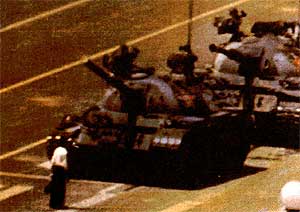
Like many of my age whose worldview is shaped by the events of the late 1980s - from the brutal massacre of innocent protestors at Tiananmen Square to the fall of the Berlin Wall - I often believe hope and courage will overcome fear, ridding the world of the evil and the idiotic.
 In December 1989, leaders of the Islamic Republic of Iran rolled out the red carpet to welcome Nicolae Ceausescu, Romania’s last dictator, for a state visit. There was much applause and eulogy in Tehran, but the diplomatic decorum soon turned into nightmare when Ceausescu was
executed
by a firing squad after a secret military tribunal exactly one week later.
In December 1989, leaders of the Islamic Republic of Iran rolled out the red carpet to welcome Nicolae Ceausescu, Romania’s last dictator, for a state visit. There was much applause and eulogy in Tehran, but the diplomatic decorum soon turned into nightmare when Ceausescu was
executed
by a firing squad after a secret military tribunal exactly one week later.
Like many of my age whose worldview is shaped by the events of the late 1980s - from the brutal massacre of innocent protestors at Tiananmen Square to the fall of the Berlin Wall - I often believe hope and courage will overcome fear, ridding the world of the evil and the idiotic.
 In December 1989, leaders of the Islamic Republic of Iran rolled out the red carpet to welcome Nicolae Ceausescu, Romania’s last dictator, for a state visit. There was much applause and eulogy in Tehran, but the diplomatic decorum soon turned into nightmare when Ceausescu was
executed
by a firing squad after a secret military tribunal exactly one week later.
In December 1989, leaders of the Islamic Republic of Iran rolled out the red carpet to welcome Nicolae Ceausescu, Romania’s last dictator, for a state visit. There was much applause and eulogy in Tehran, but the diplomatic decorum soon turned into nightmare when Ceausescu was
executed
by a firing squad after a secret military tribunal exactly one week later.
Ceausescu and his wife died on Christmas Day in the most dramatic fashion in modern history. Before that, Christmas celebration had been banned by the tyrant for more than 20 years. How very ironic.
Also in the late 1980s, monks burned themselves to death and bare-handed students fought against riot police on the streets of Seoul and other South Korean cities, eventually forcing the iron rule of Chun Doo Hwan to collapse. Chun, who had ordered a brutal crackdown on Buddhist monks, later took refuge in a Buddhist temple. How very ironic.
Hoping falsely for a reclusive retirement, Chun was dragged out by the angry public from his Buddhist sanctuary and made to stand trial for human rights violations. He was subsequently pardoned by his successor for the sake of national reconciliation in the 1990s.
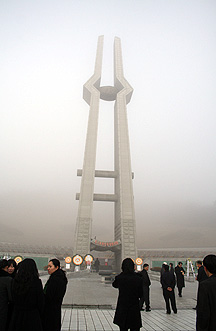 In Taiwan, the passing of Chiang Ching Kuo in January 1988 ushered in a new administration led by Lee Teng Hui, a native Taiwanese. Towards the end of his life, Chiang lifted press restrictions and permitted the founding of new political parties. Sensing the rapidly changing mood of the populace and building on his predecessor’s legacy, Lee gradually expanded political freedoms through universal suffrage and electoral reforms, culminating in the first ever direct presidential election in 1996.
Lee introduced democratic reform as a way to consolidate his rule as well as to marginalise the old and conservative forces within Kuomintang, whose White Terror had brought about economic prosperity to the island state at the expense of civil liberties.
Within a short span of eight years, Taiwan moved from authoritarian rule to being a beacon of democracy in Asia, alongside South Korea and others.
'Merdeka' on a silver platter
The same pattern was repeated elsewhere in the region. Thailand’s democracy, albeit imperfect, is vibrant and dynamic. For two months now, thousands of protesters have been gathering in the open space just minutes down the road from my office here in Bangkok. I find the carnival-like atmosphere irresistible sometimes.
When tens of thousands of Indian Malaysians took to the streets of Kuala Lumpur last November, an Indonesian colleague of mine asked: ‘Why the tension? Why the massive presence of riot police? We have this everyday in Jakarta and people do not give a damn!’
And I had to remind her that, fortunately or unfortunately, Malaysia has not trodden a tragic path of independence. While the Indonesians won their nationhood with the blood of the slaughtered, we had our ‘merdeka’ handed to us on a silver platter by the British. It did save us the loss of human lives, but has also produced an electorate that is predominantly unused to violence and struggle.
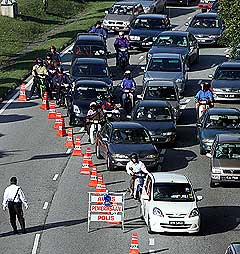 This fear still lingers despite the so-called political tsunami of March 8. When KL was rife with rumours of army moving in to keep civil order together with the police the weekend before, many abandoned the city for their hometowns.
To assuage the public’s fear, the scheduled anti-fuel price hike protest was relocated to Kelana Jaya from Padang Timur in Petaling Jaya. Obviously, the organisers had caved into the pressure from the authorities, which shows that a single word of intimidation by the powers-that-be, fighting to maintain their rule and vested interests, is enough to chill our bones.
Little bourgeois
The same tactic is employed time and time again, the latest being the high-handedness of the police in arresting Anwar Ibrahim from outside his house two days ago. While many were brave to turn up before the police station in support of the opposition leader, many more were perhaps quietly concerned over the economic implications of the episode.
What economics? I would ask. For the little bourgeois, the Barisan Nasional government has got its priority wrong at a time when challenging externalities call for exceptional leadership.
But does one realistically believe even without all the political tussles between Anwar and Najib Razak, the BN - which is infested with self-serving politicians of all races and corrupt to the core - would still be in a position to put the Malaysian economy back on track?
 Instead of hanging on the false promises of
new
authoritarians
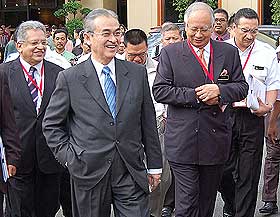
, Malaysians need to look at the experiences of the neighbouring countries, and to draw inspirations from them. If Abdullah Ahmad Badawi and Najib are convinced a small stick plus a rotten carrot can easily whip the nation into submission, they would not hesitate to use them again.
Instead of hanging on the false promises of
new
authoritarians
, Malaysians need to look at the experiences of the neighbouring countries, and to draw inspirations from them. If Abdullah Ahmad Badawi and Najib are convinced a small stick plus a rotten carrot can easily whip the nation into submission, they would not hesitate to use them again.
But are these leaders so confident of their invincibility? I would similarly advise them to learn from the tragic mistakes of Chun of South Korea or, worse, Ceausescu of Romania.


Report this comment
Are you sure you want to delete this comment?
This action cannot be undone.