




Dr M calls for immunity for graft whistleblowers
Former premier Dr Mahathir Mohamad said the law must be made effective in battling the scourge of corruption.
Former premier Dr Mahathir Mohamad said the law must be made effective in battling the scourge of corruption.
"One of the ways is to give immunity to the aggrieved party reporting the case, provided that the evidence was substantial and not perjury," the 84-year-old statesman added in his blog posting.
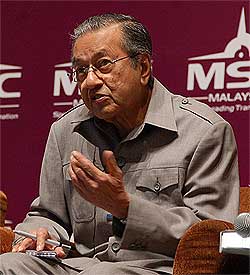 Mahathir said the law on corruption in Malaysia is framed in a manner that it promotes crime rather than prevent them.
He said it seems logical and right that those who receive illegal gratification should be considered guilty of breaking the law and should therefore be punished.
"But when we talk of corruption we think of those endowed with power abusing their power in order to gain personal benefit. We think those who offer gratification as being the victim and should be given some consideration.
"But the law says that those who pay for the service they receive should also be considered as guilty and should be equally deserving of punishment," he added.
Unwilling to report
Since both the giver and the recipient may be charged with corruption, Mahathir said both would be unwilling to report the incident.
This of course makes corruption difficult if not impossible to be brought to a court of law and tried successfully, he added.
Besides this, he said the process of law would be much prolonged, as each would seek lawyers to argue on their behalf.
"Not only will the trial take ages but the result can be quite unpredictable," he added.
Mahathir said there is another factor as well.
"The person reporting would be marked by those sympathetic to the other party so that it would affect his dealings with them as well.
"If they are government servants whose approval would be needed, the approvals may not be forthcoming at all later, even if other officers are involved," he said.
"Because of the ineffectiveness of the laws corrupt people often get away with their corrupt practices," he added.
Political corruption
In the case of political corruption, Mahathir said both parties may be willing participants.
The bribe is given by a candidate to a willing recipient to gain support for himself. Both are therefore unlikely to complain and reveal the act, he added.
He said the recipients on the other hand would be glad to receive the bribe unless he is a person of high principles unwilling to betray the cause his party was fighting for.
"In political corruption it would be extremely difficult to get evidence of the bribe being given or received. Electronics now play a role to hide the act.
"The money is deposited into the account of the person (voter) concerned via the ATM machines. The recipient would be called via phone to ask whether the money was received, giving the name of the candidate," he said.
"Despite the difficulties for detection, a government that is truly determined to prevent corruption can find ways of detecting corruption.
"But if the government itself is corrupt then corruption cannot be stopped. In fact corruption would spread in every direction and become a way of life. At this stage nothing can really be done," he added.


Report this comment
Are you sure you want to delete this comment?
This action cannot be undone.