




Pak Lah calls for repeal of ISA
Former premier Abdullah Ahmad Badawi has called on the government to consider abolishing the Internal Security Act (ISA) which allows for detention without trial.
Former premier Abdullah Ahmad Badawi has called on the government to consider abolishing the Internal Security Act (ISA) which allows for detention without trial.
He said the draconian security law - which has drawn negative views - should be replaced with a new legislation that allows for preventive detention and at the same time protects fundamental rights.
He said the ISA perhaps provides enormous powers and scope, which he felt could be too wide-ranging, in determining what constitutes threats to national security.
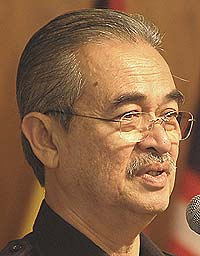 "As a former home minister, I had signed numerous ISA detention orders, and with the government reviewing the law now, I feel compelled to give my honest view on the matter," he explained.
However, Abdullah noted that Malaysia still needs a preventive detention mechanism to ensure the security of the nation is preserved.
The former premier said this in his speech at a special convocation ceremony where he was conferred an hononary PhD in Democracy at Universiti Utara Malaysia (UUM) in Kedah.
"Whether we like it or not, the ISA has been stigmatised as a negative element to the agenda of strengthening democracy and renewal in the country.
"So, this calls for the government to be brave to discard the old and open a new chapter," he was quoting as saying by Bernama .
Government must be courageous
Abdullah believed that the government must be courageous to bring about such change (abolishing the ISA) as its commitment to the agenda of democratic renewal in the country.
"I believe this is the transformation that the people are expecting, as a preventive measure should not sacrifice fundamental human rights or to be misused for a political objective.
"Perhaps one solution is to limit the scope of preventive detention to certain threats only or to draw up a new Act specifically to prevent terrorist activities, hence reducing the chances of abuse of power for a political interest," he said.
On the conferment of the honorary PhD on him today, Abdullah said he viewed it as a recognition from the academia on the vision, approaches and methods, as well as the democratic philosophy of his administration.


Report this comment
Are you sure you want to delete this comment?
This action cannot be undone.