




Do you have a valid point?
Author Janet Steele, who spent weeks in Malaysiakini office in Bangsar Utama last year, finds out what makes journalists in this online daily tick. This is her last of a five-part series.
Ironically, the riskiest part of Malaysiakini may be its ‘Letters' and ‘Vox Populi/Your Say' sections, all of which can be accessed for free. As editor-in-chief Steven Gan explains, whereas the news is produced under a strict process of verification, the same cannot be said of the letters.
"Our letters have a tendency to get us into trouble," he writes. "Our main guideline is to generate debate and this includes publishing letters with which we may disagree... Our letters page is arguably the nation's most exciting discussion forum."
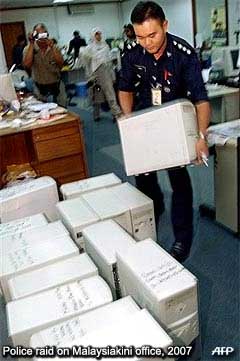 In 2003, a letter did get
Malaysiakini
into trouble, when police raided
Malaysiakini's
office in order to obtain the name of the writer who had criticised the youth wing of the powerful Umno.
In 2003, a letter did get
Malaysiakini
into trouble, when police raided
Malaysiakini's
office in order to obtain the name of the writer who had criticised the youth wing of the powerful Umno.
When Gan and chief executive officer Premesh Chandran refused to give up the letter writer's name, the police seized all 19 of Malaysiakini's computers.
Five years later, several computer terminals still bear white lettering from where the police noted the name and identity card number of the journalist on the back.
S Vicknesan, a tall elegant man is the editor in charge of the letters. When we first met, he said "my job is worrying, because the buck stops with me."
According to Vicknesan, the role of the letters at Malaysiakini is to provide a space where people can feel free to say what they want, or what he calls "a moderated public platform". Vicknesan has been at Malaysiakini since 2001, and he took on the letters in 2003. It is a rule at Malaysiakini that every letter has to be read by at least two people.
"If the government is going to clamp down, if it is ever going to happen, it will happen with the letters," he says.
Malaysiakini publishes 10 letters a day. Previously, (before the general election) the website received about 15 letters a day, but that number has since doubled. About eighty percent of the letter writers prefer to remain anonymous, which Malaysiakini does allow.
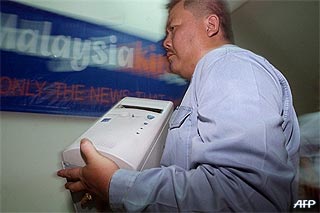 There are regular letter writers, but the rule is to try to limit each name to once a week. (This of course leads to the possibility that the same letter writer will send more than one letter a week under a different name, something that
Malaysiakini
tolerates, if not enthusiastically.)
There are regular letter writers, but the rule is to try to limit each name to once a week. (This of course leads to the possibility that the same letter writer will send more than one letter a week under a different name, something that
Malaysiakini
tolerates, if not enthusiastically.)
Vicknesan edits the letters for grammar and style, trying not only to be true to what the letter writer wants to say, but also to keep it "within the paradigm" of what is acceptable. He describes this paradigm as no personal attacks, no rough language, and no attempts to manipulate the forum. As he says, you won't be edited as long as you stay within those limits.
Vicknesan also edits the Vox Populi/Your Say pages, which are brief responses to news stories. Malaysiakini invites comment by asking readers to share their views. It is perhaps easy for those who live in democratic societies to underestimate the value of Vox Populi/Your Say as a forum.
More than ordinary letters to the editor, Vox Populi/Your Say comes close to embodying the ideals of citizen journalism, in which "the ability of anyone to make the news will give new voice to people who have felt voiceless".
As Gan puts it, "For Malaysians, seeing your opinions being published is ground breaking. We are surprised by the kind of people who are writing to us. For many people, this is the first time that they have expressed themselves in a public forum."
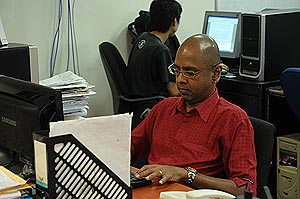 What Vicknesan (
right
) looks for in a letter is a "valid point". He recalls that when he first took on the letters, Gan told him, "you may hate the content, but if it's valid, we will print it".
What Vicknesan (
right
) looks for in a letter is a "valid point". He recalls that when he first took on the letters, Gan told him, "you may hate the content, but if it's valid, we will print it".
Vicknesan frequently imagines a conversation in which Malaysiakini is charged with "encouraging the people to go against the government." No, he would say, we are providing a platform. They would ask why, and he would say "we agreed with the letter writer that his points are valid."
Of course, in a corrupted media system like that of Malaysia, it is the government authorities who ultimately decide what is sensitive or "valid". And there are clearly limits even to what Malaysiakini considers valid for discussion.
Religion must be handled "with double kid gloves." (When I asked, for example, if I could submit a letter defending the publication of the cartoons of the Prophet Muhammad and disparaging Islam, the answer was a polite but firm "no".) The problem, according to Vicknesan, is "sensitivities", and the fear that people become too emotional. "The publication of such a letter could trigger a response that would engulf and bury us overnight."
 Yet this isn't to say that
Malaysiakini
publishes no letters on religion. Two of the most sensitive issues are apostasy (conversion away from Islam) and "body snatching", which sometimes occurs when someone dies and the family "realises" that the deceased had entered a different faith.
Yet this isn't to say that
Malaysiakini
publishes no letters on religion. Two of the most sensitive issues are apostasy (conversion away from Islam) and "body snatching", which sometimes occurs when someone dies and the family "realises" that the deceased had entered a different faith.
Malaysiakini published many letters on the Lina Joy apostasy case - a well-known example of a Malay woman converting to Christianity - because the case had gone to court and become a public matter. As Vicknesan notes, there is a fine line between what Malaysiakini will publish and what it will not, but that line is very well anchored. The two greatest concerns are defamation and religion. "We could have mobs out there!" he said, pointing outside the window.
The notion of the valid point has further implications. Vicknesan's words not only highlight the essence of freedom of expression, they also set out a mechanism for ensuring it.
 When Vicknesan responds to the criticism that
Malaysiakini
has given too much play to the speeches of former prime minister Mahathir Mohamad and his waspish attacks on his successor Abdullah Ahmad Badawi, he says "our argument is that he has a valid point; we're not interested in whether he is right or wrong."
When Vicknesan responds to the criticism that
Malaysiakini
has given too much play to the speeches of former prime minister Mahathir Mohamad and his waspish attacks on his successor Abdullah Ahmad Badawi, he says "our argument is that he has a valid point; we're not interested in whether he is right or wrong."
His explanation also resembles something that Habermas has described as crucial to the emergence of a public sphere - "the notion that rational argument [should be] the sole arbiter of any issue," and that it is the validity of the argument rather than the identity of the speaker that should carry the day.
It is noteworthy how many journalists at Malaysiakini define their mission as giving voice to the voiceless, whether it is through news coverage or through letters. Vicknesan says that Malaysiakini tries to give everyone a voice, even when it is difficult to do so. (During the election, he notes, it was hard to provide "balanced" commentary on the topic of whether Barisan Nasional needed to reform, especially when 99 percent of the letter writers agreed with this view.)
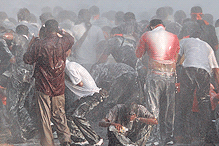 One of the more notable recent examples of
Malaysiakini
giving voice to the voiceless occurred with its coverage of a November 2007 rally by the Hindu Rights Action Force (Hindraf), in which tens of thousands of ethnic Indians protested against discriminatory treatment.
One of the more notable recent examples of
Malaysiakini
giving voice to the voiceless occurred with its coverage of a November 2007 rally by the Hindu Rights Action Force (Hindraf), in which tens of thousands of ethnic Indians protested against discriminatory treatment.
As Gan says, the issue was more or less ran on steam provided by Malaysiakini , especially the temple destruction. Chief editor K Kabilan agrees with Gan, saying "we gave maximum coverage to Hindraf; we helped give them oxygen."
At political rallies, the politicians brought up issues that had been aired on Malaysiakini , yet according to Kabilan, it was the video that had the biggest impact. Reproduced on VCDs and widely distributed by the opposition parties, the videos reached deep into Tamil communities where many people lack access to the Internet.
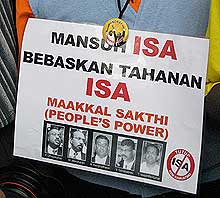 Video senior producer Shufiyan Shukur says there were two things that made
Malaysiakini's
coverage of the Hindraf rallies and temple destruction different from that of the mainstream media: they uploaded raw video so that people could see for themselves, and they provided a lot of "vox populi", in which ordinary people were interviewed.
Video senior producer Shufiyan Shukur says there were two things that made
Malaysiakini's
coverage of the Hindraf rallies and temple destruction different from that of the mainstream media: they uploaded raw video so that people could see for themselves, and they provided a lot of "vox populi", in which ordinary people were interviewed.
"I think this was quite popular," he says, "because these were just ordinary people. I've not seen vox pops come up on other video." Shufyian's words thus link two very important values at Malaysiakini : providing documentary proof, and giving voice to the voiceless:
"I want to bring the other side of the coin to as many people as I can. So they see this story line broadcast, but there is this other side of the story that they don't see. And when told that these things happen, they doubt that they are true. I want to show that it happened. So the more people that can see the other side, the better, the side that you don't see quoted in the mainstream media.
 In 2004,
Malaysiakini
celebrated its fifth anniversary with a dinner at a hotel in the upscale Ampang Park neighborhood of Kuala Lumpur. Despite driving rain and a huge traffic jam, over 1,000 people attended. It was a memorable moment for both Gan and co-founder Premesh Chandran. "They came just to be a part of it," Chandran says.
In 2004,
Malaysiakini
celebrated its fifth anniversary with a dinner at a hotel in the upscale Ampang Park neighborhood of Kuala Lumpur. Despite driving rain and a huge traffic jam, over 1,000 people attended. It was a memorable moment for both Gan and co-founder Premesh Chandran. "They came just to be a part of it," Chandran says.
Although Malaysiakini has a limited number of paid subscribers, its reach stretches much further than the numbers suggest. Many sections of the website are available for free, and even those who are not subscribers can read the letters and Vox Populi/Your Say. Malaysiakini.tv's videos are readily available on YouTube, and bloggers routinely copy material from the website.
During a 2008 visit to Malaysia, I found that nearly everybody I met claimed to be a regular reader of Malaysiakini . This seems unlikely, despite the fact that for 10 days during the 2008 election, Malaysiakini offered itself for free.
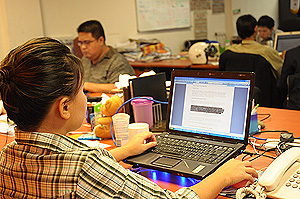 It is possible that many ordinary Malaysians identify with
Malaysiakini
and feel a sense of pride and ownership precisely because it grew out of the ferment of activism and reformasi that ultimately produced the electoral gains won by the opposition parties in the 2008 general election.
It is possible that many ordinary Malaysians identify with
Malaysiakini
and feel a sense of pride and ownership precisely because it grew out of the ferment of activism and reformasi that ultimately produced the electoral gains won by the opposition parties in the 2008 general election.
Malaysiakini's ideology of "doing good journalism" thus poses a challenge to the authoritarianism of the Barisan Nasional. The "valid point" test operationalises freedom of expression in a practical way, and provides a space as for the "rational-critical discourse" crucial to the creation of a public sphere.
The use of proof, documentation, and video testimony not only gives voice to the voiceless, but also changes people by showing them sides of stories they may not otherwise see. And the seemingly mechanistic tools of fairness and balance - "did you get a quote from the other side?" - become a means of guaranteeing that all voices will be heard.
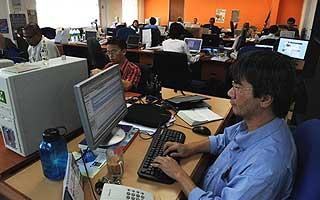 With
Malaysiakini
, Gan and Chandran have deliberately created a pocket of resistance to authoritarianism in Malaysia. Despite the popular belief that it is the Internet that challenges the Barisan Nasional's stranglehold on power, it is actually the norms and values of independent journalism that have made
Malaysiakini
such a threat to government authorities.
With
Malaysiakini
, Gan and Chandran have deliberately created a pocket of resistance to authoritarianism in Malaysia. Despite the popular belief that it is the Internet that challenges the Barisan Nasional's stranglehold on power, it is actually the norms and values of independent journalism that have made
Malaysiakini
such a threat to government authorities.
As I have shown, the ideology of independent journalism not only changes those who work within the sphere of Malaysiakini , but also creates a democratic space for public discourse. In this way Malaysiakini applies the norms of good journalism to create an institutional base for new forms of political debate that have the potential to make radical transformations in Malaysian society.
Part 1 l How Malaysiakini challenges authoritarianism
Part 2 l 'Our agenda is press freedom'
Part 3 l Holding the powers-that-be accountable
Part 4 l It's called 'watchdog' journalism
Part 5 l Do you have a valid point?
JANET STEELE is an associate professor of Journalism at the School of Media and Public Affairs at George Washington University. Her most recent book 'Wars Within' focuses on Tempo magazine and its relationship to the politics and culture of New Order Indonesia. She is a frequent visitor to Southeast Asia, and writes a weekly newspaper column called 'Email dari Amerika' for Surya daily in Surabaya, East Java.
 Malaysiakini
is celebrating its 10th year anniversary on Saturday, Nov 28 with a gala dinner at the Sime Darby Convention Centre in Bukit Kiara. Be there! Seats available from RM100.
Malaysiakini
is celebrating its 10th year anniversary on Saturday, Nov 28 with a gala dinner at the Sime Darby Convention Centre in Bukit Kiara. Be there! Seats available from RM100.
Click here for more information.


Report this comment
Are you sure you want to delete this comment?
This action cannot be undone.