




Anwar: Democracy is diversity's refuge
Anwar Ibrahim told a forum at the Parliament of World's Religions conference in Melbourne last weekend that democracy would sooner assure peace than provoke strife in a world of diversity of beliefs.
Anwar Ibrahim told a forum at the Parliament of World's Religions conference in Melbourne last weekend that democracy would sooner assure peace than provoke strife in a world of diversity of beliefs.
Addressing a panel discussion themed 'Democracy and Diversity in Global Perspective' , Malaysia's Opposition Leader said he did not see as a solution to religious diversity - and its concomitant peril - religious strife, the hope that belief would evanesce.
"I believe we can no more evade the question of religion than we can escape the daily ascent of the sun," he told his audience who had come to listen to a panel composed of distinguished spokespersons for a variety of faiths, among who were Dr M Din Syamsuddin, a former chairman of the Indonesian Ulamak Council, and Rabbi David Saperstein, an American lawyer and leader of Reform Judaism.
Anwar did not say why he took as inevitable the persistence and ubiquity of belief in a world where the advance of science was supposed to weaken religious belief, the expectation of the now famous Richard Dawkins' school of atheism.
Dawkins is an Oxford Professor and author of The God Delusion , in which he proposed the theory of "memes" which would make religious belief a kind of dangerous virus of the mind, a proposition that gained credence after 9/11.
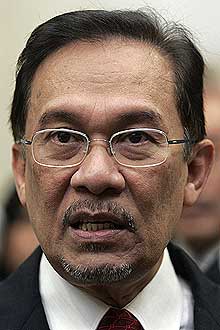 Ignoring the philosophical reasons for the persistence of belief, Anwar (
right
) instead brought his political instincts to bear on the phenomenon itself by appropriating it for his purpose: the thirst for freedom and justice which he held was embedded in the great religions of this world.
Ignoring the philosophical reasons for the persistence of belief, Anwar (
right
) instead brought his political instincts to bear on the phenomenon itself by appropriating it for his purpose: the thirst for freedom and justice which he held was embedded in the great religions of this world.
Thus he asked: "If religion seems to be a fundamental characteristic of various expressions of disunity, how is it that religion can lead us towards greater peace and harmony?"
Anwar said there was a universal teleology in religions that, at its best, inclined its adherents towards beauty, knowledge, peace and security.
"We rejoice in beauty, both within ourselves and in what surrounds us. We long for knowledge, peace and security amid the mysteries and uncertainties of the universe.
"In our disjointed world marred with so much ugliness, violence and injustice, there cannot be a nobler aim and vocation than the realisation of values which unify humanity, despite the great diversity of climes and cultures," noted Anwar.
Once again, he cited a favourite trope: Andalusian Spain under Moorish rule between the 8th and 14th centuries, parts of which period saw the establishment of the convicencia , a harmonious and enriching experience of living together among people of diverse religions and cultures.
Yet again, Anwar brought up the teachings of the 11th century Andalusian jurist, Iman Shatibi, who said that the higher objectives of the shariah were the preservation of religion, life, intellect, family, and wealth, iterating his oft-repeated argument that Shatibi's espousal of these outcomes prefigured the genesis of constitutional government under the promptings of the European Enlightenment.
Individual rights and freedom of conscience
Anwar conceded that the Muslim world has largely forgotten aspects of its legal tradition, such as Shatibi's promulgation of the higher objectives of Islamic Law, which he said had once contributed to the success of the religion's global civilisation.
"The memory of these universal values must therefore be resurrected and be the basis upon which we craft a new discourse that allows great civilisations thrust upon each other in a globalised world to coexist in mutual harmony.
"On both sides we must be able to transcend the pain and bitterness of past and present excesses. If we view democracy and freedom not as an imposition of a Western set of values but rather as a stream indigenous to the Muslim psyche, then it is possible for us to talk about individual rights and freedom of conscience," asserted Anwar.
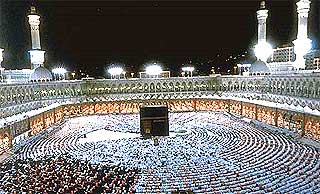 Once democracy's patrimony can be shown to be not exclusively Western, Anwar said the Muslim world would be encouraged to recover the basis of the more illustrious aspects of their history when they were part of a global civilisation.
Anwar said developments in some places in the Muslim world, like Turkey and Indonesia, and even Malaysia, held promise that the concept and practice of democracy could be shown as not alien to the Muslim psyche.
However, he said that democracy's popularity as a philosophy of governance should cause no surprise to both the Western and Islamic sensibilities.
Anwar said this was because the concept spoke deeply to the nature of man. He held the intuitions of the writer, E M Forster, about the psychology of democracy to be profoundly accurate. He noted that Forster famously gave two cheers to democracy in his renowned testament, What I believe.
Anwar said the first cheer was for the permission democracy gave to criticism and variety. He elaborated on this at length:
"Not in a democracy can you have a single voice above a million solitudes, which was Camus' definition of tyranny. You have a variety of voices and that criticism can be heard without which there would be no path towards improvement or accountability in action. Nobody improves by his own voice telling him to correct himself; he or she improves by dint of their own self-scrutiny and others' criticism."
Anwar intuited that there was a deeper basis for variety and dissent. He argued: "The famous jurist Oliver Wendell Holmes offered the view that the purpose of civilised argument between friends is to arrive at the point where you agree that some day it might be necessary to shoot each other.
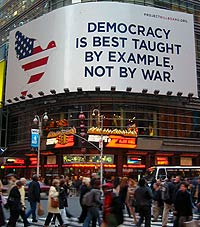 "Until that day is unavoidable, the democratic process is no more but no less, than an acceptance of the notion that in important issues you may be wrong. I hold that the acceptance of the notion that you may be wrong is what prevents civilised argument from reaching the stage of duelling pistols.
"In short, the democratic process, ipso facto , is a check on violence. Historians have ceased to wonder why democratic states almost never militarily attack each other."
Anwar held that Forster's second cheer for democracy was the more psychologically telling explanation for this form of government's durability. He said Forster felt all government entailed the use of force. But democratic government was best at concealing its force.
"Under democratic government, the intervals between its displays of force are more frequent and it is in these intervals that the true life of man gets lived and the true work of man gets done," explained Anwar.
He then posed a question and rounded off his speech with a summation: "What are the true life of man that gets lived and the true work of man that gets done? This life of diversity, this work of variety, flourishes best in conditions where the application of force in the life of man is concealed and attenuated.
"This would allow for the pursuit of what Dante described as a 'universal community of the human race', a community dedicated to justice and the realisation of man's intellectual potential.
"We cannot deny that several times in the past it was experienced as a living reality, and as the origin of the term convicencia denotes, Spain under Moorish rule represents one of its crowning fulfilments.
"Therein lie the enduring arguments for freedom which, as Forster said, gives permission to variety, aids self-improvement, and promotes the human disposition of sensible and intelligent matter for an aesthetic end."


Report this comment
Are you sure you want to delete this comment?
This action cannot be undone.