




DAP polls: A strategically advantageous outcome
COMMENT The Selangor DAP elections were arguably the most watched political event last weekend, perhaps even overshadowing the PKR national congress. This is not that surprising given that the results for the PKR elections was already known, although not officially announced yet.
The polls for DAP in Selangor, on the other hand, was expected to be a tightly contested affair, with no clear indication which of the two factions – the Unity and the Rainbow factions – was likely to emerge victorious.
The elections was politically significant for the following reasons...
COMMENT The Selangor DAP elections were arguably the most watched political event last weekend, perhaps even overshadowing the PKR national congress. This is not that surprising given that the results for the PKR elections was already known, although not officially announced yet.
The polls for DAP in Selangor, on the other hand, was expected to be a tightly contested affair, with no clear indication which of the two factions – the Unity and the Rainbow factions – was likely to emerge victorious.
The elections was politically significant for the following reasons:
Firstly, it is the only other state beside Penang in which the DAP plays a significant role within the context of the state government. Secondly, Selangor also happens to be the richest state (by output not by the state’s annual budget) in Malaysia.
 Thirdly, it is also the only state with a legitimate national level DAP leader in the person of Teng Chang Khim, the speaker of the Selangor state assembly, who is obviously and explicitly anti-Lim Kit Siang and anti-Lim Guan Eng (with due respect to Dr Boo Cheng Hau in Johor).
Fourthly, this contest also featured a DAP leader at the state level, in the person of Ronnie Liu, who has been tainted by his association with a number of financial scandals, the most serious being the accusation that he was somehow complicit in sacked Klang municipal councillor Tee Boon Hock’s alleged attempts to use Liu’s exco letterhead to obtain municipality contracts for his family.
In the context of this political backdrop, I would say that the Selangor DAP election result was about ‘strategically advantageous’ for the party at the state and national level as one would have wanted. And this means that the outcome was also strategically advantageous for Pakatan Rakyat in Selangor, and to a lesser extent at the national level as well.
What do I mean by ‘strategically advantageous’? I could better illustrate this point by showing possible outcomes which are not strategically advantageous.
Imagine if the Rainbow Coalition led by Teng had managed to elect eight representatives to the state committee instead of the five which they obtained.
 Teng would almost have been elected as the state chairperson, with key members of the Unity team, including the likes of Teresa Kok, Tony Pua and Ean Yong Hian Wah, most probably sidelined within the state leadership.
This would be seen as somewhat of a ‘slap in the face’ of DAP secretary-general and Penang Chief Minister Lim Guan Eng since he had openly endorsed 13 members of the Unity team in a dinner just a few days before.
This would have set the stage for an ongoing tussle between the Selangor state leadership, led by Teng, and the national DAP leadership, led by Guan Eng and guided by Kit Siang.
The election of a majority of Teng-aligned leaders would also mean that a few more state assemblypersons and perhaps MPs from the Unity team would have been left out of the state leadership and hence, decrease their own political stature.
While all this may not necessarily decrease the chances of the DAP retaining all of its current seats in Selangor, it could impact the ability of Pakatan to continue to garner the same or even greater proportion of Chinese votes, especially in the PKR- and PAS-held marginal seats.
Delegates send unmistakable message
Secondly, imagine if Liu had received sufficient votes to be in the top 15 voter-getters. Or perhaps even obtain more votes than Kok and Pua (an unlikely scenario but not altogether impossible).
This would have meant that Kit Siang’s own advice in that morning’s opening address that delegates should send the “clear and unmistakable message that DAP stands constant and consistent for honest, clean and incorruptible politics whether at the national, state or local levels” would not have been heeded.
 While it may be the case that what Liu was guilty of was nothing more than a series of poor judgment calls in terms of who to trust and who to associate himself with, rather than acts of explicit corruption, it cannot be denied that his presence has been used by the BN to attack the Selangor state government as well as the DAP in Selangor and nationally.
The fact that Liu did not even place within the top 20 places in the state elections is a reflection of the maturity of the Selangor DAP delegates, many of whom had probably been helped by or perhaps sympathetic to Liu’s case, in sending a strong message to the larger electorate in terms of the DAP leaders they wanted in Selangor to lead them.
As it turns out, the delegates voted in seven representatives who were in the Unity team from the get-go and five representatives from the Rainbow Coalition. Of the remaining three ‘neutrals’, who bagged the top three spots, Jenice Lee, assemblywoman from Teratai, had appeared in the Unity team’s dinner two days before the elections. With this majority secured, the Unity team was able to dictate the leadership line-up for the state, led by Kok as the chairperson and Pua as deputy chairperson.
At the same time, two of the key leaders of the Rainbow Coalition (and the only two elected representatives among the 12 in this list), Teng and Sekinchan state assemblyman, Ng Suee Lim, obtained the highest number of votes (after the three ‘independents’) and were given the positions of vice-chairperson and assistant secretary respectively.
Unlike the situation in Perak, where long-time DAP leader and Ipoh Barat MP M Kulasegaran did not even manage to break into the top 15 voter-getters, the Selangor delegates sent a clear and strong signal that they wanted these two key leaders within the DAP in the state to play an active part in the leadership of the party in Selangor. The fact that Teng was offered the vice-chairperson's position and the fact that he did not reject it is indeed a positive sign for Selangor DAP.
Minor changes in the line-up
Significantly, despite all of the ‘controversy’ surrounding this election, there was actually an incredible amount of continuity in terms of the composition of the DAP leadership in Selangor.
In fact, there were only three changes from the top vote-getters in the 2008 state elections. Liu did not make it to the top 15, nor did Kajang municipal councilor Lee Kee Hiong, and of course, Tee Boon Hock, who did not contest. Replacing them are Kok, recently appointed senator, Ramakrishnan Suppiah and Lim Soon Hong, the latter two being leaders from the Rainbow Coalition.
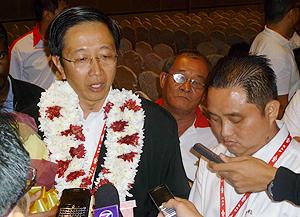 In the interest of full disclosure, I must admit to being personally involved in a small way during the process of campaigning in the DAP Selangor elections. I was asked to make an assessment of the possible electoral damage which could happen if the Unity team had lost out to Teng's Rainbow Coalition.
It is my sincere belief that the DAP candidates themselves would not have been significantly affected by a victory on the part of the Rainbow Coalition.
The likes of Pua, Kok and Ean Yong would still go on to retain their seats comfortably in the next general election. But I also believe that the impact of such an outcome would have been most felt by the PAS and PKR candidates who won their seats in 2008 with majorities of less than 10 percent (many of them less than 5 percent).
Many of these candidates won on the back of support from the Chinese and Indian communities. Now that the Malay vote has swung back to the BN somewhat, and perhaps the same can be said of the Indian community, one of the remaining hopes for these candidates to retain their seats would be to increase their share of the Chinese vote.
This would probably be possible only if some of the more popular DAP leaders at the state and national level such as Kok and Pua are not sidelined within the DAP state leadership. This may have happened (and probably would have happened) had the Unity team not won.
I shared my opinion at a dinner organised by the Unity team on Friday, which was reported in the Chinese section of Malaysiakini . Some people were surprised by my demonstration of ‘partisanship’ towards the Unity team. I responded by saying that I was sharing points and analysis during that dinner which I would gladly write about in a Malaysiakini piece. And I have done exactly that here.
Liu’s exco position has become untenable
Questions will remain for the next week or month or a couple of months in regard to the status of Liu as a DAP exco member within the Selangor state government. My sense is that his position may be untenable given these election results. The question then would turn to who should replace him.
 Judging by the number of votes received, one would have to choose Jenice Lee, the Teratai state representative. If one were to go by seniority in terms of number of terms served as a state assemblyperson, one would choose Ng Suee Lim, assemblyman from Sekinchan (assuming that Teng retains the assembly speaker position).
Of the two, choosing Suee Lim would be the better ‘strategic’ option given that it would bolster his changes of retaining his seat, a 56 percent Chinese seat which he won with only 190 votes in 2008, demonstrating his skill and ability to stave off the attacks of former menteri besar and Opposition Leader Dr Mohd Khir Toyo, from the adjoining Sungai Panjang state constituency.
Right now, DAP in Selangor, especially the 15 vote-getters, need to consolidate around the leadership of new chairperson Kok. Their priority should be to help Pakatan retain control of the Selangor state government - not a given especially in light of the larger national electoral patterns of the shifts back to the BN among the Malay and Indian voters.
The challenges for the DAP state leadership are many: perform their role and functions to push through positive policies as part of the Selangor state government, to play their part in not just increasing the share of Chinese vote for Pakatan as a whole in the state but also to limit the losses among the Malay and Indian voters, to expand their membership base especially among the Malays and to continue to build capacity within the rank-and-file as well as among the councillors, state assemblypersons as well as MPs.
Why should Kok be state leader?
One final point deserves some mention before I conclude. Many have pointed to the inconsistency that Kok was made the chairperson even though she came in 11th in the number of votes garnered while Teng came in fourth. This argument has a couple of flaws.
 Firstly, the delegates as well as the DAP leaders have worked within the confines of this voting system at the state and national levels for some time now. The delegates accept this process and in fact cast their votes (all six of them) based on the assumption that the top 15 vote-getters would decide among themselves what the leadership line-up would be.
If the electoral system were changed to one where candidates had to compete for individual positions, there is no guarantee that the delegates would have voted the same way and chosen Teng over Kok.
Furthermore, direct elections for specific posts would actually be less inclusive than the current system in the sense that the losers for each position would not be able to participate as members of the state leadership (apart from being ‘co-opted’ or appointed, a not very desirable option).
Under the current system, the leaders at the state level do not have to explicitly contest for specific positions which means that fewer of them have to be left out as losers in these position specific races. This is not to say that reforming this electoral system is not valid, but to say that it is undemocratic demonstrates an incredible amount of ignorance and does not take into account of the fact that this is a system that is respected by almost all of the delegates.
After all that has been said and done, DAP in Selangor has demonstrated that it has the resources, the tools, the people and now the strategic advantage accruing from the results of this state election to leverage upon. The time for campaigning is over. The time for delivering is here.
ONG KIAN MING holds a PhD in political science from Duke University. You can reach him at im.ok.man@gmail.com or follow him on twitter @imokman.


Report this comment
Are you sure you want to delete this comment?
This action cannot be undone.