




Najib's popularity dips to 69% after price hikes
Prime Minister Najib Abdul Razak's approval rating has taken a slight dip to 69 percent, down three points from a record high of 72 percent in May.
Prime Minister Najib Abdul Razak's approval rating has taken a slight dip to 69 percent, down three points from a record high of 72 percent in May.
The survey period - Nov 30 to Dec 11 - also includes the Dec 3 announcement of government's subsidy cuts for fuel, cooking gas and sugar.
 Najib’s popularity is back to the same level that was recorded by independent pollster Merdeka Centre in March this year.
In this latest Merdeka Centre survey, the premier’s highest approval rating came from the Indian respondents, as has been the case throughout this year.
It increased from 80 percent in May to 85 percent in December, but Indian support for Najib is nevertheless lower than the record high of 91 percent registered in March this year.
However, Najib suffered a drop in support amongst the Malays (from 77 percent to 74 percent) as well as the Chinese (from 58 percent to 54 percent).
The Merdeka Centre survey was based on 1,005 randomly selected registered voters aged 21 and above.
This survey, done via telephone, was carried out between Nov 30 and Dec 11.
Najib's popularity confirms that he is still the key asset in the BN's electoral campaign.
His approval rating was a dismal 44 percent when he took over as the economy was slipping into unforgivingly negative territory, and he had seemed vulnerable as he was pelted by bad news everywhere he turned.
Concerns over inflation, economy, crime and graft
Overall, slightly over half (54 percent) of the respondents believe that Najib is steering the country in the right direction but there are significant concerns over the health of the economy.
About 43 percent of the respondents described the economy as “unfavourable” while 53 percent said that it was “favourable”.
A major concern among respondents is inflation, with a whopping 78 percent describing the inflation as “unfavourable”.
 Among the three major races, the ethnic Malays were the most upbeat about the economy, with 62 percent saying that conditions were “favourable” while only 35 percent of ethnic Chinese respondents said the same.
More than half of ethnic Indians and Malays were optimistic about the state of the economy a year from now but only 25 of Chinese respondents felt the same. In fact, 29 percent of Chinese respondents said that the economy will decline.
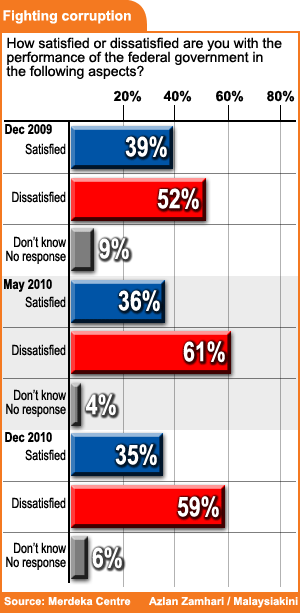
Graft was also a major concern among respondents with 59 percent stating that they were dissatisfied with the federal government’s efforts to fight corruption ( see chart ).
This is however an improvement of two percentage points compare to another survey done in May.
On crime, 51 percent of respondents were disatisfied with the government efforts to combat crime while 47 percent were satisfied.
The most dissatisfaction was again shown by the Chinese respondents (71 percent).
ETP fails to excite
Despite all the fanfare and months of heavy promotion, the Najib administration’s economic reforms centrepiece, the Economic Transformation Plan, appears to have gained little traction with the public.
 Only 52 percent of the respondents have heard of the ETP, designed to bring Malaysia to a high income economy by 2020, while 48 percent claims they were unaware of it.
A staggering 62 percent of ethnic Indian respondents - the stauch supporters of Najib - said they have never heard of it while nearly half of ethnic Malay and Chinese respondents said the same.
When asked if they understood the initiatives under the ETP, 82 percent of respondents replied “not very much”.
This was despite much publicity over the RM5 billion Warisan Merdeka 100-storey tower project, the RM36 billion mass rail transit (MRT) project and plans to establish two nuclear power plants.
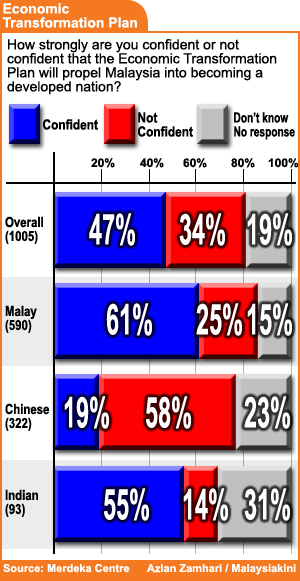
Nevertheless, 47 percent of respondents expressed confidence that the ETP will help Malaysia attain the status of a developed nation.
Positive response was recorded from the ethnic Malay and Indian respondents but Chinese respondents were sceptical, with 58 percent expressing lack of confidence that the ETP goals would be realised.
Poll: Two-thirds of M'sians oppose 100-storey tower


Report this comment
Are you sure you want to delete this comment?
This action cannot be undone.