




RCI wants psychiatrists to interview Teoh's wife
The Teoh Beng Hock Royal Commission of Inquiry (RCI) has requested three psychiatrists to interview Teoh's colleagues and family members, as well as the Malaysia Anti-Corruption Commission (MACC) interrogator.
The Teoh Beng Hock Royal Commission of Inquiry (RCI) has requested three psychiatrists to interview Teoh's colleagues and family members, as well as the Malaysia Anti-Corruption Commission (MACC) interrogator.
This is to determine Teoh's mental state before his death on July 2009.
 Commission chairperson James Foong
(left)
said Teoh's partner Soh Cher Wei is an important witness in the case.
Commission chairperson James Foong
(left)
said Teoh's partner Soh Cher Wei is an important witness in the case.
"So far, there is no statement (from her), we should look into this. I think this will do us a big favour," he said during the proceedings today at the Jalan Duta court complex in Kuala Lumpur.
Although Teoh's family has refused to be interviewed by psychiatrists without the presence of counsel, Foong said the commission will try its best to persuade them to agree.
He also agreed that they can bring their counsel with them if they are willing to take part in the interview.
"I don't see why not, at least we can get some information from them."
Of the three psychiatrists, two are from government hospitals and are engaged by the MACC, while the third is a private psychiatrist from Johor Baru engaged by the Bar Council.
In another development, government forensic pathologist Dr Shahidan Md Noor, who had performed the second autopsy on Teoh's body, amended his post-mortem report today.
He reiterated that the reddish mark on Teoh's neck was the result of blood seepage and not due to a bruise from external force.
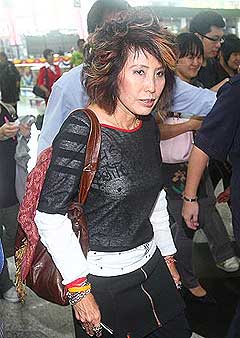 Shahidan told the commission that he and Thai pathologist Dr Pornthip Rojanasunand
(left)
, who had observed the second post-mortem, initially thought the mark was a bruise.
Shahidan told the commission that he and Thai pathologist Dr Pornthip Rojanasunand
(left)
, who had observed the second post-mortem, initially thought the mark was a bruise.
However after seeing the photographs taken by another pathologist Dr Prashant Naresh Sambekar who did the first post-mortem, Shahidan today said he believes the mark was caused by seepage due to internal bleeding.
"(From the first photograph), the body had shown the red mark before post-mortem. It became more obvious in the second post-mortem. I don't think it was caused by injury.
"There was still blood in the vessels, it would seep (to the skin) after some time. It would be different if it was a bruise," he said when cross-examined by MACC counsel Muhammad Shafee Abdullah.
Shahidan maintained his stance that Teoh was not strangled before he died.
He said Pornthip shared his view that the cause of the mark could be determined if they could examine the tissue under the skin.
However the body had degraded by the time of the second post-mortem, done four months after Teoh's death. As such, they could not perform the examination, he explained.
"If we have take tissue for examination, we might able to said it is a post mortem stain for sure."
Last week Shahidan had testified that the reddish mark, measuring by 4cm x 3cm, spotted on the left side of Teoh's neck was the result of "post-mortem staining".
He gave a more detailed explanation to the commission today.
The reddish mark below Teoh's chin has become the focus of the RCI since the cause of it could lead to the conclusion that Teoh was assaulted before he was found dead.


