




Environment given short shrift in Lynas plant study
Based on the preliminary environmental impact assessment (PEIA) study for the Lynas Advanced Material Plant (Lamp) in 2008, the environment has taken a backseat to economics.
Based on the preliminary environmental impact assessment (PEIA) study for the Lynas Advanced Material Plant (Lamp) in 2008, the environment has taken a backseat to economics.
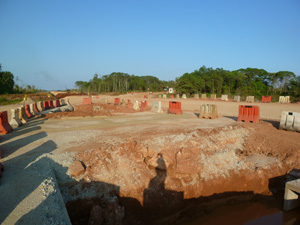 The PEIA executive summary, available online on the Department of Environment
website
only since last weekend, made a case for construction of the plant by outlining socio-economic reasons in the first few pages, as to why the project should go ahead.
The PEIA executive summary, available online on the Department of Environment
website
only since last weekend, made a case for construction of the plant by outlining socio-economic reasons in the first few pages, as to why the project should go ahead.
Page 6 of the report, prepared by Environ Consulting Services (M) Sdn Bhd on behalf of Australian mining giant Lynas, concedes that the plant could potentially have an “effect or impact” on the environment, “just like other industrial projects”.
But should the project be scrapped, Gebeng, Pahang - where the plant is being built - and the country would lose development and economic benefits while the surrounding environment would remain the same, the report said.
“To take on the clear economic and social benefits, it is recommended to go ahead with this project. Steps to control and monitor should be put in place efficiently to reduce the impact on the surrounding environment,” it said.
The executive
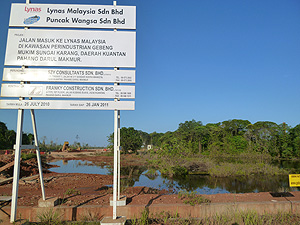 summary described the Lamp site as 100ha of disused land, where some 121,036 tonnes of lanthanide ore and 10,500 tonnes of lanthanide oxide would be produced annually, once operations commence.
The report pointed out that the increasing global value of lanthanides in the electronics and automotive industries justified the decision to build the processing plant in Gebeng, which would make Pahang an internationally important lanthanide ore processing centre.
Other points supporting the project are that it:
- is in line with the Pahang government’s focus on industrialisation;
- will be a catalyst for spin-off industries in the area;
- will bring an influx of foreign direct investment;
- will boost exports;
- enable technology transfer;
- make available job opportunities; and
- lead to economic gains.
Control measures
The report claimed that studies carried out to gauge the impact on the land, water and air quality and noise levels have proved that the benefits far outweighed the minimal potential hazards to the environment.
Touching briefly on fears about radiation - the main concern of Gebeng and nearby Kuantan residents - the PEIA said the ‘tailings’ or waste products from the plant would be kept in a temporary storage facility (TSF) on site, until a permanent storage site was decided on by both Lynas and the Atomic Energy Licensing Board (AELB).
 The TSF would have clay lining and high density polyethylene lining to prevent soil and ground water seepage, while any run-off from the TSF would be collected and treated at an effluent plant on the site, for reuse in lanthanide processing.
The report said a detailed radiological impact assessment of the radioactive waste was done by national agency Nuklear Malaysia, to be scrutinised and approved by the AELB.
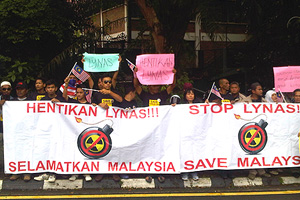
Strong public protests have been voiced against Lamp since March, especially by local residents who are enraged over the possibility of radiation poisoning, as was faced by Bukit Merah residents in Perak from the 1980s to the 1990s due to poor waste management by Asian Rare Earth factory operators Mitsubishi Chemical.
The constant pressure has pushed the government to call for a month’s halt to the project until an independent and international expert panel completes a study on the potential hazards from Lamp.


Are you sure you want to delete this comment?
This action cannot be undone.