




Media veteran pooh-poohs gov't council
A media consultative council proposed by the government last week has been met with much scepticism by media veterans, who view it as a way for the government to co-opt the industry.
A media consultative council proposed by the government last week has been met with much scepticism by media veterans, who view it as a way for the government to co-opt the industry.
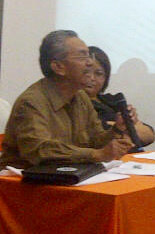 Speaking at a forum to commemorate World Press Freedom Day at Universiti Industri Selangor today,
the Sun
political editor Zainon Ahmad
(left)
said the council should not involve the government at all.
In fact, said Zainon who has been in the industry for about three decades, the media has called for a self-governing council since the 1970s, with no success.
"The media-government relationship should be like a railway track, parallel but never meeting, or else the train will derail.
"If the (media and government) hold hands and walk together, the people will not benefit, but maybe here the two are in deep embrace," he said to titters among the audience of 500.
Zainon said that while details of what the media consultative council would constitute are missing, practitioners are wary as the media is already constrained by so many laws.
However, it is expected that the Home Ministry and the Information, Communication and Culture Ministry will meet with publishers and editors by the end of the month to discuss the matter.
"With the two ministers there, I've a feeling the editors and publishers will say 'Yes, sir', (but) I pray very hard that what I'm saying is completely wrong," he said.
He added that it appears that the consultative council is an attempt for "greater (media-government) collaboration", but this seems unnecessary considering that most of the major dailies are owned by political parties in the ruling coalition.
"After (the) May 13 (racial riots in 1969) we had a lot of consultative councils...now we have this, which suggests that there is a crisis. Is the media behaving so badly?" he asked.
‘Responsible’ journalism waning?
Fellow journalist and now editorial advisor to publishing house Karangkraf, Abdul Jalil Ali agreed that the fight for greater media freedom in Malaysia has gone on for decades without much inroads.
"In our case, freedom of the press is something journalists can only dream of," he said.
However, he added that there seem to be a wane in "responsible journalism" with "ethics breached" most glaringly in the reportage of the sex video purportedly of a senior opposition leader.
"Every sequence of a 1 minute and 47 second clip of the video was reproduced on the front page of certain newspapers. I don't think this is responsible journalism...that amounts to slander. We don't know that it is him, but we say it is him," he said.
He added that this sense of "responsible journalism" also takes a new dimension with the rise of new media which allows anyone the power to publish.
 "Freedom of expression appears to be available in Malaysia through blogs and social network, but this has to be used responsibly or else one day we'll find our own videos on the Internet, too," he said.
A sceptical Zainon said, however, that the concept of "responsible journalism" sounds like another mode of control.
"It's like when an election candidate says 'Vote wisely', he is actually saying 'vote for me'. The same when the government says 'responsible journalists'," he said.
Coverage of Egypt revolution
Amina Gamil Khair (left) , a Cairo-based features editor and journalist of 30 years, agreed that the media have a responsibility to present truth, as their actions have significant repercussion.
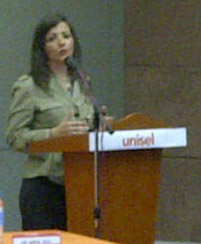 Speaking of the role of state-owned media during the recent Egyptian Revolution, Amina said that such media created a "parallel universe" which was in stark contrast with reality.
"While Tahrir Square was bursting with angry youth, images on state television was of empty streets, life was normal,” she said.
"Fear techniques were also used, where false reports and fabricated phone calls of scared citizens crying about being surrounded by thugs were aired."
State-owned television also reported of the existence of "outside influences" like Israeli agents and Iranian spies in Tahrir Square, claiming also that the demonstrators were paid EUR100 each and fed Kentucky Fried Chicken every day by "foreign sources with wicked agendas".
"The revolution removed whatever (remained of the) credibility of the state media. They are now accused of the crime of persuasion which led to the murder of demonstrators, with some cases filed against (personnel from the state media)," she said.
Other panelists were Sin Chew Daily journalist Tan Lee Chin, lawyer and lecturer in media law Jahabardeen Mohamad Yunoos and Malay Mail editor Irwan Abdul Rahman, who also blogs under the pseudonym Hasan Skodeng.
World Press Freedom Day is commemorated on May 3 each year. It is also a day to remember journalists slain in the line of duty. In 2010, 57 journalists died on the job, while 16 others lost their lives this year.


Report this comment
Are you sure you want to delete this comment?
This action cannot be undone.