




Expert: DNA samples may be useless
DNA samples that are more than 36 hours old are no longer “meaningful” evidence, Australian forensic pathologist Dr David Wells told the Sodomy II trial today.
DNA samples that are more than 36 hours old are no longer “meaningful” evidence, Australian forensic pathologist Dr David Wells told the Sodomy II trial today.
He told the Kuala Lumpur High Court that it would be difficult to get results from such a specimen, in reply to a question by defence lawyer Sankara Nair.
Sankara: If the specimen is in the rectum of (the complainant) for 56 hours before it was extracted, can DNA be retrieved?
Wells: I would be exceedingly surprised... I've not been on a case where DNA taken from the anus or rectum more than 24 to 36 hours after the deposit. It will add to it another lengthy period without air drying... I would be sceptical to get any meaningful results.
In his testimony, complainant Mohd Saiful Bukhari Azlan had told the court that Kuala Lumpur Hospital (HKL) doctors had took samples from him two days after he was sodomised.
It was also then established that the specimens included semen samples which were then sealed and handed over to investigating office Supt Jude Blacious Pereira, who kept the specimen for another 43 hours before sending them to the Chemistry Department for analysis on June 30, 2008.
Sankara asked Wells about the condition the samples would be in when sent for analysis.
Different expert opinions
Wells said it was important to ensure the swab samples were air dried, frozen or immediately taken to the laboratory, otherwise the DNA samples would deteriorate, especially in a “well moist” environment.
This contradicts with chemist Dr Seah Lay Hong’s testimony earlier in the trial that there was no need for steps to taken to ensure there was no degradation in the quality of the samples after 56 hours.
Similarly, Dr Mohd Razali Ibrahim of HKL, who examined Saiful, had said that seminal fluid can stay in the rectum for 72 hours.
The lawyer then told Wells that the investigating officer had also found it fit to remove the semen sample from a sealed package to repackage and store it in a cabinet, instead of a freezer.
“I’m not a police officer but I suspect he would be looking for a new job,” replied Wells, to the amusement of the gallery full of Anwar’s supporters, reporters and observers.
Sankara asked Wells to comment on Jude’s mistake in labelling the semen specimen during the early stages of the trial.
“The integrity of the specimen is absolutely crucial... if they found a mistake they (the police) should have informed the laboratory,” said Wells.
Police should not be present
He added that he could not comment on the seriousness of the experts who analysed the samples.
“But I would rather put it as someone new to the task and inexperienced (having done the job),” said Wells.
Earlier today, Wells told the court that he preferred that police officers not be present during the medical examination of sexual assault victims.
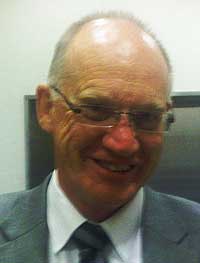 Wells (
left
), who specialises in sexual assault cases, said he would normally carry out an examination alone, with the help of nurses.
Wells (
left
), who specialises in sexual assault cases, said he would normally carry out an examination alone, with the help of nurses.
"It's very intimate, it's intrusive, and there is danger of contamination.
"Victims may feel uncomfortable,” said Wells - the third witness for the defence - and they may even feel pressured by the presence of the police officers.
Wells explained this is the practice in Australia and in many jurisdictions.
During the examination of complainant Mohd Saiful Bukhari Azlan, investigating officer Jude Blacious was in the room, along with the doctors inspecting Saiful.
Doctors must access patient's history
The doctors who inspected Saiful on the night he came to HKL were Dr Razali Ibrahim, Dr Siew Sheue Feng, Dr Razuin Rahimi and Dr Khairul Nizam Hassan.
Replying to questions from Sankara during examination-in-chief, Wells described the medical report filed by the HKL doctors as inaccurate and ambiguous.
He noted discrepancies and disparities between the HKL proforma form for sexual assault cases and the medical report of Saiful. While the form stated there was bleeding, the medical report says there was none.
Wells had stayed in Malaysia for seven years and his father had worked for first Prime Minister Tunku Abdul Rahman Putra.
It is important, he emphasised, to note the history of a patient or victim.
“It allows doctors the time to assess the patient, the confidence (of the patient) and also to record what the person tells you.
“It’s an important (aspect) of documenting a patient-led process of what they uttered,” he said, adding that for sexual cases, it was important to record the details, as it would be scrutinised by many people.
Wells also noted it was important to record the bowel habits of a sodomy victim.
‘Deficiencies in HKL report’
The witness described the HKL report on Saiful as deficient and inaccurate.
“This follows the words 'no conclusive findings' suggestive of penetration to the anus/rectum nor any significant defensive wounds on the body of the patient. The word 'conclusive' is ‘misleading’ and ambiguous.
“I would also not write a report with the presence of Male DNA types B5, B7, B8 and B9. I would not want to record if you want to interpret it.”
Sankara: Is it (what is stated in the report) presumptive as well?
Wells: It is inaccurate, yes.
He also expressed dissatisfaction when shown the HKL’s proforma form on Saiful as he noted some portions were partially incomplete. He also found that the proforma stated there was bleeding, but this is stated otherwise in the medical report by the HKL doctors.
Sankara: The proforma should be filled in properly?
Wells: It must be filled in to show that all the examination was done accordingly. I am puzzled by the crucial missing parts.
Sankara: Is contamination a real big issue in testing?
Wells: It is a real issue, as you always run into the risk of other DNA being there. That is why I asked that.
The witness said he did not prefer using a lubricant but would instead use sterile water, as this would prevent contamination, and that is was not good to rely on a single DNA test.
Sankara: (So it’s) not safe to rely on DNA evidence?
Wells: Yes, there can be other tests to back it up.
Related stories:
Dr Wells: 43-hour-old DNA sample 'won't be pretty'
Doc: Saiful told me plastic inserted into anus
An unsworn statement in court not evidence
Compelling basis for Anwar's defence strategy
PKR veep contrasts Anwar with Mandela


Report this comment
Are you sure you want to delete this comment?
This action cannot be undone.