




Asian polls watchdog defends use of indelible ink
Using indelible ink on the finger will not pose a health risk if its content conforms with the recommendations of the World Health Organisation, said election watchdog Asian Network for Free Elections (Anfrel).
Using indelible ink on the finger will not pose a health risk if its content conforms with the recommendations of the World Health Organisation, said election watchdog Asian Network for Free Elections (Anfrel).
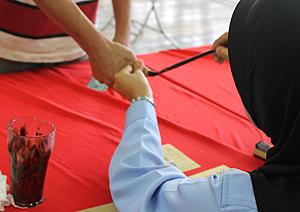 This means that the essential ingredient in the indelible ink, silver nitrate, should not exceed four percent of the total content, Anfrel officer Ichal Supriadi said in an email interview with
Malaysiakini
.
This means that the essential ingredient in the indelible ink, silver nitrate, should not exceed four percent of the total content, Anfrel officer Ichal Supriadi said in an email interview with
Malaysiakini
.
This was recommended because synthetic silver nitrate content exceeding four percent can harm the nerve system.
Some countries, he said, have gone further to require that the silver nitrate content be derived from natural sources so as to reduce the likelihood of itchiness.
"Indonesian indelible ink uses less than four percent (silver nitrate) and is strictly controlled, with only natural or herbal extracts, which are anti-oxidant and anti-bacterial, used.
 "Itchiness and skin irritation can be avoided with the natural extracts. I believe Malaysian scientists can formulate this (to suit the country's specifications)," Ichal (
left
) said.
"Itchiness and skin irritation can be avoided with the natural extracts. I believe Malaysian scientists can formulate this (to suit the country's specifications)," Ichal (
left
) said.
India and China are the largest manufacturers of indelible ink and many other countries have now begun manufacturing the ink on their own because of cost constraints.
Manufacturing the ink locally will also allow a country to tailor the ink to local needs, such as religious constraints.
However, Ichal said, there must be rigorous testing of the quality of the ink, since some producers may try to cut corners for a quick buck.
"Indelible ink is good business. For example, US$2.7 million was spent to buy 1,149,890 bottles of indelible ink for 574,945 polling stations in the Indonesian presidential election of 2009," he said.
Not completely foolproof
Last week, The Star reported that a Europe-based firm had demonstrated to the daily that indelible ink could be easily removed using off-the-shelf stain removers.
In the report, the newspaper also quoted the unnamed firm's spokesperson as saying that the ink has been disallowed in the US and Europe because of health concerns.
Ichal said the ink was not used in these places because of higher levels of voter confidence in the electoral rolls and the neutrality of the polling officers.
"Many countries use indelible ink to prevent multiple voting... it is mostly implemented because of a lack of confidence in the quality of electoral roll or voter enrolments and the neutrality of the polling officers," he said.
The use of the ink did not mean there were no drawbacks and that it was foolproof safeguard against fraud.
"The performance of indelible ink is important to safeguard the polling, but the most important is the professionalism of the polling officers.
"A good and safe ink cannot stop multiple voting if the polling officers commit fraud. Therefore, the presence of observers is crucial to guarantee the sanctity of the election," Ichal said.
Bangkok-based Anfrel is a regional network established in 1997, and has acted as official election observer in numerous countries that use indelible ink in elections, including Afghanistan, India and Indonesia.
Related stories :
To be 'cool', PM must implement Bersih's demands
Citizenship-for-votes: Home minister flays M'kini
'Keep an eye on dishonest polling officers'


Report this comment
Are you sure you want to delete this comment?
This action cannot be undone.