




Deja vu: Himpun rally has 21-year echo
COMMENT With the Himpun rally, freighted with anti-Christian overtones, set for staging tomorrow, perspective is needed not so much on the amorphous question of Muslim fear of Christianisation but rather the more pertinent issue of some Muslim politicians' manipulation of that fear.
Incidentally, it is 21 years this past week from the time the country witnessed what was then, for its Christian denizens at least, an astonishing demonstration of the latter phenomenon.
In the immediate prelude to the 8th general election on Oct 20, 1990, the opposition coalition of Gagasan Rakyat, made up of Tengku Razaleigh Hamzah's Semangat 46, DAP and PAS, obtained the support of Parti Bersatu Sabah (PBS) which had been in power in Sabah from 1985.
PBS's decision to link up with Gagasan added frisson to the popular discontent towards the BN administration of then Prime Minister Dr Mahathir Mohamad...
COMMENT With the Himpun rally, freighted with anti-Christian overtones, set for staging tomorrow, perspective is needed not so much on the amorphous question of Muslim fear of Christianisation but rather the more pertinent issue of some Muslim politicians' manipulation of that fear.
Incidentally, it is 21 years this past week from the time the country witnessed what was then, for its Christian denizens at least, an astonishing demonstration of the latter phenomenon.
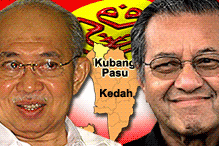 In the immediate prelude to the 8th general election on Oct 20, 1990, the opposition coalition of Gagasan Rakyat, made up of Tengku Razaleigh Hamzah's Semangat 46, DAP and PAS, obtained the support of Parti Bersatu Sabah (PBS) which had been in power in Sabah from 1985.
PBS's decision to link up with Gagasan added frisson to the popular discontent towards the BN administration of then Prime Minister Dr Mahathir Mohamad.
Mahathir's unpopularity stemmed from his authoritarianism in launching Operation Lallang in 1987, in which more than 105 politicians and social activists were detained under the ISA, and his removal of Lord President Salleh Abas in 1988.
The two episodes confirmed his critics' fear that there lurked dictatorial tendencies in Mahathir and that the liberalism of his early days as PM had been a veneer.
PBS chose to join Gagasan in the lead-up to the general election when it seemed that the latter, led by former Umno dissident Razaleigh, had a good chance of denying BN its customary two-thirds majority in Parliament.
Though in opposition to the BN in Sabah, PBS was part of the BN coalition at the federal level.
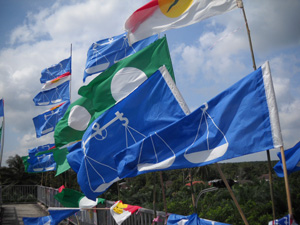 The PBS desertion was portrayed as treachery (‘menikam dari belakang', the graphic Malay rendition has a more visceral ring than its English equivalents) by Mahathir.
A BN campaign, using state-owned media, was immediately launched to counter the seeming coup that Razaleigh had pulled off by drawing PBS to the Gagasan banner.
A Kadazan ceremonial headgear that PBS leader Pairin Kitingan placed on Razaleigh's head when the latter campaigned in Sabah became the focus of a high-octane BN campaign that showed Razaleigh to be in thrall to the Christian-dominated PBS.
The headgear, which had a symbol that looked like a cross but was actually of agrarian import to Kadazandusun culture, was repeatedly portrayed on national television to have Christian connotations.
Razaleigh was depicted as a pawn in a Vatican-inspired scheme to make Christians and their religion dominant in Malaysia.
To the gullible, the implication was inescapable: voting for Razaleigh would be voting for Christian dominance in Malaysian politics.
In the upshot: Gagasan, within sight of denying the BN its traditional two-third majority, fell short though PAS and Semangat 46 made a near clean sweep of Kelantan's state and parliamentary seats and DAP, though maintaining its lead among opposition parties in Parliament, could not dislodge BN at the state level in Penang.
Fears of Christianisation very real
After the election, pundits cited the BN media propaganda about Gagasan's Christian trappings as crucial to swaying the Muslim vote away from the opposition coalition, though Kelantan's Muslims were immune to the propaganda.
The Kelantanese embellished their judgement with mordant humour. When the proverbial RM50 bribe was offered for their vote, they returned four ringgit with the quip: "Kita ambil setakat empat puluh enam sahaja (We limit our take to forty-six only)," a satirical play on the name their state's favourite son, Razaleigh's, party.
Unfortunately, the Kelantanese Muslim's brethren in the rest of the country did not possess a comparable sense of levity.
The entire episode was more astonishing in its aftermath, when its effects and consequences were weighed, than in its execution, when its cynically manipulative nature was viewed in some quarters as too blatantly far-fetched to be credible.
But, apparently, Muslim fear of Christianisation was very real and the BN propaganda capitalised on it to the extent that enough Malay/Muslims were diverted from voting for Semangat 46, the Razaleigh-led party that was headed for a strong showing in the 1990 GE.
The opposition's first concerted attempt, since the watershed 1969 election, to deny the BN its two-thirds majority in Parliament ran into an undercurrent of fear that the ruling coalition exploited to the hilt.
In effect, the episode delayed the maturation of Malaysian democracy by 18 years at least, with denial of a two-thirds majority to the BN coming only in March 2008.
Twenty-one years on from that rather tragic episode, history is poised to repeat itself, but this time its instantiation may be turn out to be redolent of farce than pathos.
A coterie of stool pigeons of Umno's failing political class, masquerading as defenders of the Islamic faith, are trying to leverage on nearly two years of propaganda beginning with the agitation against a court-sanctioned decision to allow Christian use of the ‘Allah' term for God, that Islam is under threat from Christianity in Malaysia when, actually, the real issue is Umno's suzerainty over Malaysian politics that is under threat.
The propaganda has led up to the staging of the Himpun rally tomorrow, an illicitly choreographed drama whose aim is to divert the Malay/Muslim voter bloc from a decision it would have taken but did not in 1990, whose delayed and successive refinements in the 1999 and 2008 GEs are headed for logical denouement in the 13th GE.
The country holds its breath and waits to see if history would recur as tragedy or as farce.
TERENCE NETTO has been a journalist for close on four decades. He likes the occupation because it puts him in contact with the eminent without being under the necessity to admire them. It is the ideal occupation for a temperament that finds power fascinating and its exercise abhorrent.
Related stories
Soup kitchen beneficiaries: Islamic bodies of no help


Report this comment
Are you sure you want to delete this comment?
This action cannot be undone.