




PDRM: We're not impotent in tackling crime
On July 23, Malaysiakini re-posted an article by Dr Lim Teck Ghee of the Centre for Policy Initiatives, headlined ‘Why police are impotent in dealing with growing crime’.
Police officer ACP Ramli Mohamed Yoosuf now responds to the comments. This version of his article has been edited for brevity and language.
There has been much debate lately on the issue of crime, particularly on the accuracy of official statistics and police efficiency in combating crime.
The Royal Malaysia Police (PDRM) have constantly kept the public abreast of the crime situation and police efforts in crime prevention.
In this article, PDRM would like to clarify pertinent issues concerning crime and, in particular, respond to the article by Lim Teck Ghee entitled ‘Why police are impotent in dealing with growing crime’, (posted on the) CPI website on July 23, 2012 .
On July 23, Malaysiakini re-posted an article by Dr Lim Teck Ghee of the Centre for Policy Initiatives, headlined ‘Why police are impotent in dealing with growing crime’.
Police officer ACP Ramli Mohamed Yoosuf now responds to the comments. This version of his article has been edited for brevity and language.
There has been much debate lately on the issue of crime, particularly on the accuracy of official statistics and police efficiency in combating crime.
The Royal Malaysia Police (PDRM) have constantly kept the public abreast of the crime situation and police efforts in crime prevention.
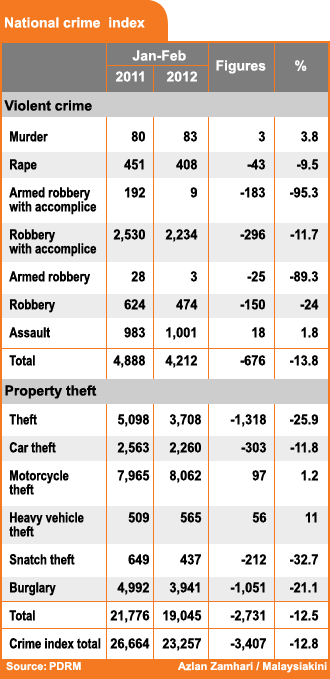 In this article, PDRM would like to clarify pertinent issues concerning crime and, in particular, respond to the article by Lim Teck Ghee entitled ‘Why police are impotent in dealing with growing crime’, (posted on the) CPI website on July 23, 2012.
Crime statistics released by the PDRM are the actual figures of criminal cases reported to and investigated by the police department. These figures are auto-generated by the department’s computer system, i.e. the Police Reporting System (PRS).
In this way, no alteration or adjustment to the figures can be done, in order to portray a rosy picture of the crime situation as claimed by certain quarters.
The process of lodging a police report starts when the complainant walks into a police station. At the Enquiry Office the police personnel receive the report and type it into the computer using the PRS.
The typed report is shown to the complainant for him/her to acknowledge it to be true and accurate. Where he/she cannot read Bahasa Malaysia, the report is read to him/her and translated if possible. The complainant will then sign a copy of the report as acknowledgment.
The PRS generates a police report number and the Officer-in-Charge of Police Station classifies the complaint according to the nature of the report, whether it is of a civil or criminal category. The Officer Commanding (the) Police District will re-check whether the report is appropriately classified.
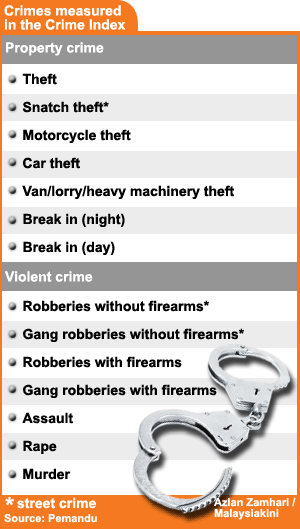 The PRS is linked-up throughout the country and to the Contingent and Bukit Aman headquarters. The Criminal Intelligence Unit at these levels compile crime statistics periodically - daily, weekly, monthly, and so on.
Since the inception of the PRS, PDRM have stopped compiling crime statistics manually; thus the question of doctored figures should not arise at all.
Lim may agree that while crime awareness have caused more victims to come forward to lodge reports for investigation, there are instances when crime goes unreported for reasons known only to the victim.
These are the so-called dark figures of crime. But so long as a case is reported and duly investigated, the public can be assured that it is reflected in the official crime statistics.
The PRS is monitored daily at the district, contingent and Bukit Aman HQ levels. Senior officers at these levels regularly check the accuracy of the classification via the system itself.
As a matter of fact, disciplinary action will be taken against officers who fail to classify cases accordingly and those who refuse or fail to take down a report.
In short, PDRM would like to assure and reassure the public that we do not resort to deceiving the public by playing tricks with crime figures. Obviously such wild and unfounded assumptions are against the interests of the police to serve the rakyat better.
Verified data only
All crime data and statistics generated within the PDRM system have been audited and verified by Pricewaterhouse Coopers Malaysia.
Therefore all figures presented by PDRM are valid and reliable in accordance with the standards of the professional auditors and not something of our own creation.
In light of this, it is definitely not true to claim that the current crime rate is the highest we have ever seen. Based on crime statistics over the past 10 years, the highest number was recorded in 2008 with 211,645 cases.
With aggressive crime prevention measures taken by the current top leadership of the force, the crime rate was brought down in subsequent years.
The implementation of NKRA Crime Prevention initiatives, in particular, has successfully helped to reduce crime index to 177,520 in 2010 and 157,891 in 2011.
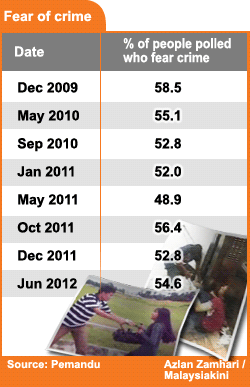 To gauge how the public feels about their safety and their confidence in the police service, Pemandu has commissioned a private international company, TNS Research International, to conduct a public opinion survey from December 2009 to date.
The survey is conducted with a sample size of 1,212 respondents of age 18 and above who are randomly picked proportionately according to state distribution. The mode of survey is face-to-face interviews.
The latest survey results for the period January to December 2011 reveal that public ‘fear of being a victim of crime’ has increased marginally from 52 percent in January 2011 to 52.9 percent in December 2011.
This slight increase could be attributed to the fact that some cases have generated more public interest, especially when they involved a ‘series’ or ‘pattern’ of specific crime such as fatal snatch-theft cases.
The reports of such crimes have in turn formed public opinions on the ‘state of crime in the country’, hence registering an increase in the fear of becoming a victim.
Still, public satisfaction with the performance of police service has shown a significant improvement, from 56.6 percent in January 2011 to 70.5 percent in December 2011.
Programmes in place
In his article, Lim made some valid recommendations as to how to combat crime more effectively. In fact, numerous measures have been taken by PDRM to tackle the crime problems, including those mentioned by Lim.
First and foremost, the force always give the highest priority to tackling crime, right from the IGP to the lowest ranking officers. We also welcome legitimate criticism and recommendations that will help us improve.
The force is in the process of deploying more personnel to work on the ground through our ‘civilianisation’ exercise where desk work that is clerical or administrative in nature is assigned to civilian staff, and the relieved uniformed personnel are transferred to the ground. In addition, all officers and men, including those who are office-based, are required to patrol the street under the NKRA initiatives.
 For instance, our latest ‘Omnipresence’ crime prevention strategy was launched recently where 300 uniformed personnel from the rank of constable to superintendent are deployed to 10 strategic locations in Kuala Lumpur and Petaling Jaya daily. This is on top of the regular beat and patrol duties carried out by personnel at the respective police stations.
With regard to Lim’s suggestion to take the ‘Broken Windows’ approach, PDRM have similar projects called Program Gerakan Tumpuan (PGT) and Safe City Programme (SCP).
PGT has been implemented since 2005 with the objective to tackle social problems and crime, instill more values in the community and create greater rapport between residents and government agencies and NGOs.
Under this programme, efforts are focused on the operational and strategic standpoint of policing, where resources have been managed optimally with officers being redeployed to the streets. The combination of this redeployment of resources and new tactical initiatives has resulted in the early detection of crime in certain populated and business areas.
Some of the issues addressed under PGT are related to drugs, robbery and snatch thefts. The success of the PGT depend on the cooperation of the various organisations.
As a point of reference, research conducted in the San Peng area by the National Institute of Public Administration (Intan) in 2006 showed a decrease in social problems and crime.
The government approved the SCP in 2004 with the main objective being to help crime prevention especially in crime-prone areas, specifically to free cities from destruction of properties and harm to people. This covers theft and robbery; vandalism; social and moral problems; and accidents inside or outside buildings.
Under the SCP, 23 crime preventive measures have been introduced, whilef CCTVs have been installed in public spaces and crime-prone areas. This has contributed to the reduction in snatch thefts. CCTV locations are identified by Geographical Integrated Systems (GIS) mapping of crime prone areas and are monitored by PDRM.
This programme has received a Special Achievement in GIS Award by ESRI -a US-based company specialising in project consultancy and implementation services - at the International User Conference in San Diego on July 25, 2012. The award was a form of recognition of collaboration between PDRM and other agencies in implementing the Safe City Monitoring System.
In sum, we have no doubt that Lim has good intentions behind his penetrating observations, but regrettably they do not reflect the actual state of affairs or of the various efforts by the government and PDRM to combat the ever changing landscape of crime and criminality.
PDRM is committed to relentlessly protecting the life and property of Malaysians 24/7, rain or shine. In the spirit of supportive and caring Malaysians, we know that this is possible.
ACP RAMLI MOHAMED YOOSUF is assistant chief of the Inspector-General Secretariat (Public Relations) at the Bukit Aman police headquarters. This article was first posted on the Centre for Policy Initiatives website.


Report this comment
Are you sure you want to delete this comment?
This action cannot be undone.