




Defence: Not calling Najib's ex-aide constitutes a mistrial
Not calling in Deputy Supt Musa Safri, a former aide-de camp of then deputy prime minister Najib Abdul Razak, to testify in the murder trial of Corporal Sirul Azhar Umar constituted a mistrial, the Court of Appeal was told today.
Not calling in Deputy Supt Musa Safri, a former aide-de camp of then deputy prime minister Najib Abdul Razak, to testify in the murder trial of Corporal Sirul Azhar Umar constituted a mistrial, the Court of Appeal was told today.
Lawyer Kamarul Hisham Kamaruddin, who is acting for Sirul Azhar, the second accused in the Altantuya Shaariibuu murder trial, said only Musa could verify the veracity of the controversial affidavit filed by the third accused, political analyst Abdul Razak Baginda, which led to Abdul Razak's acquittal.
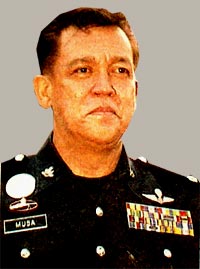 Kamarul said Abdul Razak's phone records showed more than 30 text- messages that the political analyst sent to Musa (
left
) between Oct 7 and 19, 2006, of which 12 were recorded on Oct 19, 2006, the night Altantuya was murdered.
Kamarul said Abdul Razak's phone records showed more than 30 text- messages that the political analyst sent to Musa (
left
) between Oct 7 and 19, 2006, of which 12 were recorded on Oct 19, 2006, the night Altantuya was murdered.
"It is only Musa who can vouch for the credibility and veracity of Abdul Razak's affidavit. However the prosecution decided not to call Musa in to verify this.
"For us, Musa should have been called by the prosecution (for the murder trial in the High Court in Shah Alam) to verify or rebut what Abdul Razak claimed in his affidavit.
"Certainly, with the affidavit there and if Abdul Razak had been called, he would have stuck to what was written. But there was no opportunity for the defence to challenge this as Musa was not called," Kamarul said.
Therefore, he added, the court was deprived of what took place in the conversation between Abdul Razak and Musa that night.
Prior to this, Kamarul said, Abdul Razak called Musa about his problem with Altantuya, his former girlfriend, saying she had barged into his Damansara home several days before thefateful night
 “This led to Azilah calling Abdul Razak (
right
) the next day and all this is stated in the political analyst's affidavit. However, we are being deprived as to the instructions that were given by Musa, (who is Azilah's) superior.
“This led to Azilah calling Abdul Razak (
right
) the next day and all this is stated in the political analyst's affidavit. However, we are being deprived as to the instructions that were given by Musa, (who is Azilah's) superior.
“Furthermore, Musa's phone records were never produced in court and the defence was deprived of this. The defence is deprived of a test on Abdul Razak's credibility in the affidavit,” he said.
Truly, Kamarul argued, Abdul Razak was freed without his defence being called as a result of the affidavit he filed during his remand. This was revealed in the Shah Alam High Court judgment, in which portions of the affidavit were made public.
'No motive' questioned
Kamarul also pointed out that Shah Alam High Court judge Mohd Zaki Md Yassin's judgment did not state any motive for the murder.
He said one of the greatest debates emanating from the murder of the Mongolian national, during and after the trial and even till today, has been about the lack of motive, as cited in the judgment in which the two former police officers were found two guilty.
 "Whatever the motive was, it is a matter of law that the motive, although relevant,
has never been the essential
to constitute murder," Justice Mohd Zaki Md Yasin said in his 70-page judgment released in March 2012.
"Whatever the motive was, it is a matter of law that the motive, although relevant,
has never been the essential
to constitute murder," Justice Mohd Zaki Md Yasin said in his 70-page judgment released in March 2012.
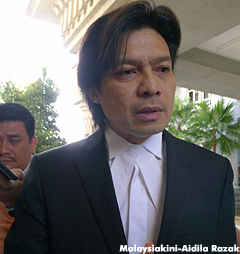
Kamarul ( left ) said this when submitting before a three-member bench headed by Justice Md Apandi Ali. The other judges are Justices Linton Albert and Tengku Maimum Tuan Mat.
As with any other criminal trial, he added, motive is an essential factor to determine the guilt of a person.
Adverse publicity
The defence counsel also argued over the adverse publicity, an additional ground put in earlier this month, which may have influenced the judge's mind following the late P Balasubramaniam's statutory declaration and his retraction, and also Sirul Azhar's cautioned statement, which was uploaded on the Internet by blogger Raja Petra Kamarudin.
"Such publication has resulted in adverse publicity to my client as the judge was in the process of hearing submissions at the end of defence case," Kamarul said.
Justice Apandi asked where in the judgment did the judge indicate that he was influenced.
He also asked whether the lawyer thought the judge had the time to look at the Internet.
"Not if you are a judge, we do not even have time to look at the Internet for 30 minutes.
"We act on facts and what is presented in the case. We do not pluck things from mid-air. Do not challenge our independence in delivering our decision," Justice Apandi said.
Kamarul agreed, but told the court there is public perception otherwise and now could be the time for the court to address this issue.
To this, Justice Apandi concurred and asked deputy solicitor-general II Tun Abdul Majid Tun Hamzah and the other DPPs why the prosecution did not charge those who acted sub-judice in making comments, unlike previously.
“In the judiciary, we are silent as we act as punching bags and do not have the opportunity to punch,” the judge remarked.
Doubts over blood stains
Lawyer Hasnal Rezua Merican, also acting for Sirul, raised doubts on the blood stains, purportedly that of Altantuya, on his client's shoes which were found in his car.
Hasnal said that prior to Sirul's stint in Pakistan sometime in early November 2006, (when accompanying the then prime minister Abdullah Ahmad Badawi), the police corporal had handed his house and car keys to Bukit Aman.
“Hence, there was an opportunity for policemen to duplicate the keys and fabricate evidence to put the blame on my client.
“My client had stated that before he left, the shoes were not in the car and somehow when he returned the shoes were there. Altantuya's jewellery were also found in his apartment. They could have been planted.”
Hasnal said when the police went to Sirul's apartment, they do not take long, just less than a minute, to open the doors, as if they already knew the keys to use.
Kamarul also submitted on questions related to the DNA evidence from the shoes and jewellery, as this were merely “empty DNA”, which did not prove that the blood was Altantuya's.
Based on these grounds, Kamarul argued, the conviction of his client by the High Court in Shah Alam should be set aside and Sirul's appeal allowed.
Related stories


Report this comment
Are you sure you want to delete this comment?
This action cannot be undone.