




Academician: Unfair to ask Najib, Taib to declare assets
Is it fair to ask Sarawak Chief Minister Abdul Taib Mahmud or Prime Minister Najib Abdul Razak to declare their assets publicly? For one academician, the answer is no.
Is it fair to ask Sarawak Chief Minister Abdul Taib Mahmud or Prime Minister Najib Abdul Razak to declare their assets publicly? For one academician, the answer is no.
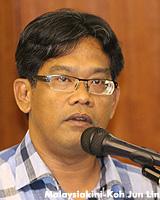 University Malaya lecturer Muhammad Asri Mohd Ali (left) said this is because they have been in politics for a long time.
“You have to be fair. If you are the chief minister of Sarawak, do you want to declare your assets? How many years has he (Taib) been sitting there?
“(For) Najib, how many years has he been in politics since becoming the menteri besar of Pahang? It is not fair for them,” he told a forum yesterday.
In contrast, he said Western nations have no issues with public asset declaration because they frequently change governments and politicians are likely to serve only five to 10 years.
“We have to take local realities in the consideration,” he said.
Taib has been in office for 32 years, making him the longest-serving chief minister, while Najib served as Pahang menteri besar from 1982 (31 years ago) to 1986, just before joining the cabinet.
Muhammad Asri was fielding a question from the audience on measures taken to prevent a recurrence of issues highlighted in the Auditor-General’s Report, and suggested asset declaration.
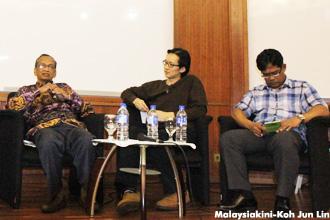 To the same question, Auditor-General Ambrin Buang (left in photo) replied that cabinet ministers currently declare their assets to the prime minister, however, he is not privy to that information.
“That means there is asset declaration but it is not publicised. You want them to (declare publicly) so it is a question of political will.
“It is beyond my power to force them to declare their assets. It is not within my mandate,” he said.
Growing middle class forces more transparency
He then went on to explain about other measures taken, such as making it easier to follow up on issues highlighted in the report via the National Audit Department’s website, and that his report is now tabled at every parliamentary session instead of once a year.
The third and last series of reports for 2012 will be tabled after the budget, which will be in the upcoming parliamentary session, he said.
 Also speaking at the forum organised by the Universiti Malaya’s Faculty of Economics and Administrative Studies is Lee Hwok Aun (left), who head’s the faculty’s Developmental Studies Department.
Through a series of charts, he showed that countries with better scores on the Corruption Perception Index and the Rule of Law index also do well on several other areas, such as gross domestic product (GDP) per capita, income per capita, and the human development index.
He explained that as a country becomes more developed, its middle class grows and becomes more educated and this exerts pressure on the government and the private sector to be more transparent.
On the reverse, he said better institutions lead to better public confidence in them and more efficient government expenditure.
“There is no denying that the relationship is two-way,” he said.


Report this comment
Are you sure you want to delete this comment?
This action cannot be undone.