




Now that Budget 2014 is tabled, what's next?
COMMENT As expected, Budget 2014 included the announcement of the Goods and Services Tax (GST) implementation, the removal of subsidy (one item now but potentially more within the near future), and the announcement of various spending allocations to boost the Malaysian economy, all embedded within the prime minister’s ‘Five Thrusts’ framework, with the hope to improve the nation’s fiscal deficit.
COMMENT As expected, Budget 2014 included the announcement of the Goods and Services Tax (GST) implementation, the removal of subsidy (one item now but potentially more within the near future), and the announcement of various spending allocations to boost the Malaysian economy, all embedded within the prime minister’s ‘Five Thrusts’ framework, with the hope to improve the nation’s fiscal deficit.
Frankly speaking, from a planning perspective, I believe that the budget contains steps needed to grow the Malaysian economy and enhance it through the development of basic infrastructure to the people, enhancing human capital development by focussing on the right sets of skills and knowledge, boosting economic activity to increase domestic and foreign investments, restructuring the tax system to enhance revenue, etc.
However, this is the same general view, year in, year out.
So what’s next? Are we to just sit back and go back to business as usual, with the frame of mind that all these plans tabled on Friday will bolster the economy as it said it would? A budget is just a plan, and if no proper measures are taken during implementation, then we may even experience a potential increase in fiscal deficit in 2014 compared to 2013.
Address cost issues first
As mentioned in my previous write-up, what we are facing is more a cost problem rather than a revenue problem. Cost problems in the form of wastage and leakage though ineffective and inefficient management. Among the things that cropped up my mind when reading the budget was the allocated amount of RM46.5 billion for development expenditure. Taking an excerpt from the prime minister’s speech:
“From the development expenditure of RM46.5 billion, a sum of RM29 billion is allocated to the economic sector. A sum of RM10.5 billion is allocated to the social sector for education and training, health, welfare, housing and community development. In addition, RM3.9 billion is allocated to the security sector. The balance of RM1.1 billion is for general administration and RM2bil for contingencies.”
Firstly, there are numerous plans such as the billions to develop five regional corridors, development of the West Coast Expressway from Banting to Taiping, RM700 million for a new air traffic management centre, RM128 million to upgrade the police headquarters, district police headquarters and staff quarters, etc.
What is unclear to the public is whether these estimated costs are reflected accurately according to the development cost. Are the cost of materials, labor and overheads reflective of market prices and will there be a supplementary budget to support these costs?
 In 2012, the Auditor-General’s Report found that the Marine Parks Department purchased marine binoculars at 2,805 percent higher than market price, the Majlis Amanah Rakyat purchased an oven at RM1,200 when the actual price in the market was found to be RM419, and many more instances where items were purchased at exorbitant rates compared to its market value.
Furthermore, several blueprints are in the pipeline such as the Services Sector Blueprint and the National Aviation Policy. Who will be hired to develop them and at what cost? What is the likelihood we won’t get another National Education Blueprint issue?
What are contingencies and other expenditures?
Secondly, what items actually fall under the category of ‘contingencies’? A whopping RM2billion have been allocated for ‘contingencies’. A report also showed that 12.4 percent of the overall budget is allocated for ‘Other Expenditures’.
These categories should be further clarified to the public, as we know how GE13 has already cost the government a substantial amount. Without proper clarification, it is likely that the public may perceive these allocations as a measure to replenish the government’s coffers.
Another highlight of Budget 2014 that caught my attention was the set-up of several funds. Among them are the Night Market Entrepreneur Scheme and Graduate Entrepreneurship Fund costing RM100 million and RM50 million respectively.
While these are reasonable initiatives to boost the development of entrepreneurs and strengthening of small and medium enterprises, what steps are in place to mitigate the issue of non-performing loans? Borrowers that do not end up paying back the loans will only contribute to the cost escalation.
The prime minister did state in his budget speech that emphasis will be given to increase efficiency spending as well as improving audit methods. Part of the plan is to take a proactive action for projects valued at more than RM100 million by auditing during the implementation of these projects.
The key questions are how is the audit process going to be performed, who will be conducting these audits? what will be audited? Is the scope limited to the implementation stage? What about the conceptualisation and design phase?
Singapore’s auditing process
Singapore has in place what is called a Gateway Process to strengthen the cost management of public sector development projects. This process involves staged approvals for concept, design and implementation. A panel called the Development Projects Advisory Panel (PDAP) plays the role to examine the specifications and designs of the projects at an early stage of project conceptualisation.
Furthermore, to ensure efficient and effective use of resources, the Value for Money Review Office, (which is under the Accountant-General’s Department of the Ministry of Finance) conducts regular reviews of government projects. These reviews are performed to ensure accountability, value-for-money and fiscal discipline within the public sector.
So, as we now move on from Budget 2014, the prime minister needs to be transparent and open to the public with regard to how the budgeting process was performed (how the allocated spend was derived), and what are the action plans to ensure the initiatives and projects will be executed effectively and efficiently (tender process, accountability, cost control measures and audit process).
By providing clarity to these types of information, the public will have a better sense of where and how the additional revenue will be spent.
OECD budget improvement process
For OECD countries, a detailed study was conducted to identify mechanisms to improve budgeting process. Basically, the Finance Ministry can use performance results to motivate agencies to improve performance; to do so, the ministry has a number of potential mechanisms at its disposal. These incentives can be financial or non-financial, and formal or informal. There are three mechanisms to manage budgeting process:
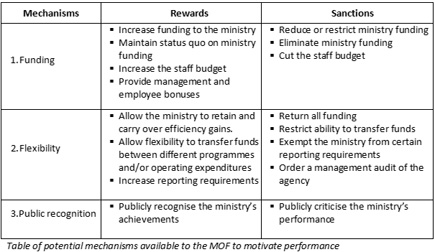 Both Australia and the United Kingdom have requirements that link increases in spending or new spending to performance targets or performance evaluations. For example, the United Kingdom has a more systematic approach in which each department develops three-year spending plans and public service agreements, which include performance targets negotiated with the Treasury.
The Finance Ministry can use performance results to hold other ministries and agencies accountable for performance. There is an ongoing debate about how tightly performance results should be linked to funding.
There are many areas that can be improved in Budget 2014. We need to address costs issues seriously by identifying and plugging leakages, and improving the budgeting process by learning from countries with leading practice. There must be efforts to improve the implementation of the budget by setting targets and reviewing the performance of each ministry. Every working adult pays taxes directly or indirectly, so the BN government must be accountable to all communities.
Unfortunately, Budget 2014 does not address all stakeholders. Malay and Indian communities were allocated funds for development while the Chinese community was left out. This budget should be meant for all, not for those who only supported the governing coalition, Mr Prime Minister?
RAJA AHMAD SHAHRIR is research associate at Institut Rakyat, a think-tank affiliated with PKR. He tweets at @RajaShahrir and Facebook RajaAhmadShahrir.
Related stories
BN MP echoes Anwar's urging to end sugar monopoly
Aid to poor and disabled 'quietly cut' in Budget 2014
PM's Dept's huge budget justified, says Idris Jala
'Shoddy sugar deal by gov't caused price hike'
PKR: Sabah's needs ignored again in Budget 2014
New income tax structure savings won't offset GST
'Not too much to ask PM to change his lifestyle'
Customs Dept gets ready to implement GST in 2015


Report this comment
Are you sure you want to delete this comment?
This action cannot be undone.